
Here are three recent and much-talked about middle grade historical fiction titles. Red River Rose is just coming out this month (March 2026) and has gotten multiple starred reviews. The Nine Moons of Han Yu and Luli won a Newbery Honor award, while Where Only Storms Grow won a Schneider Family Award Honor.
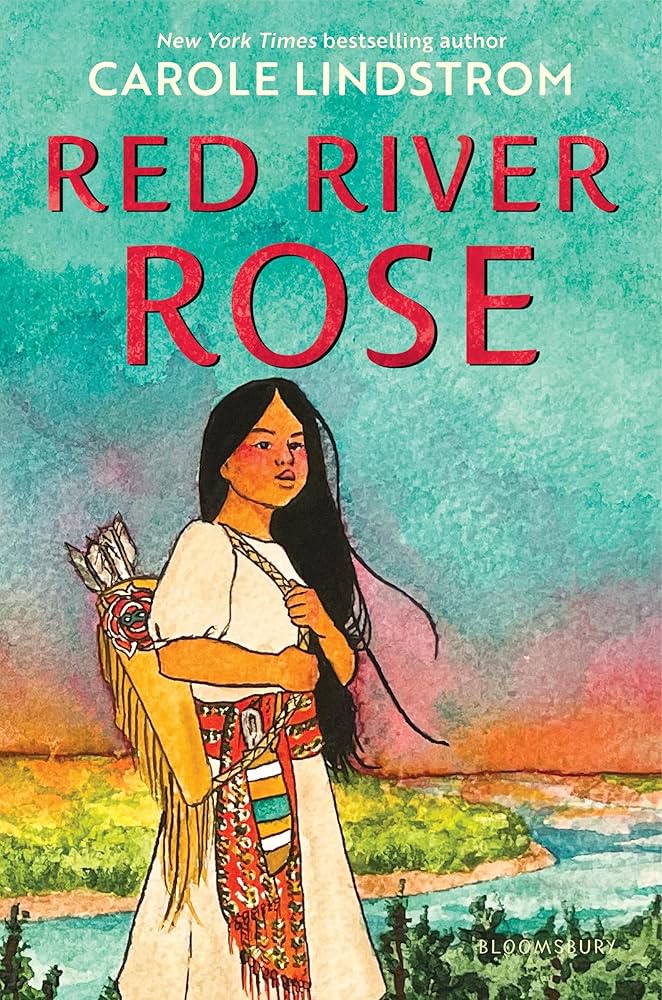
Red River Rose by Carole Lindstrom. Bloomsbury Children’s Books, 2026. ISBN 978-1547612482. Review copy kindly provided by the publisher.
It’s 1885 in the land of the Métis. Rose has grown up here, in the Red River Valley, where her ancestors have lived for generations. Now, though, there are whispers that Canada wants to take over their land – give most of it to settlers and charge rent to the people who have been living on it forever. There are several options for further actions being talked over by the adults – the priests encouraging going along with this peacefully, Louis Real suggesting peaceful insistence on independence, and others in the community suggesting armed resistance. Rose, first seen in the 2025 picture book The Gift of the Great Buffalo, is not one to sit around and wait, nor is she willing to go with an option that would take her family away from their house and the grave of her baby brother. Over the course of the book, Rose’s priorities shift from trying to get her mother to allow her to go hunting (and then actually being able to shoot an animal) and finding time to spend with her friends away from her little sister to actively working to save her community from attacks. That in turn will require Rose to give up some of her own prejudices and work alongside more people in the community. Red River Rose pulls us into an important time and place that I haven’t seen covered in fiction for any age before, with a spirit and energy that will draw young readers in.
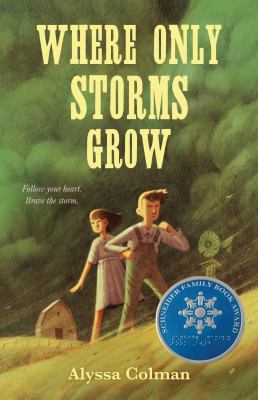
Where Only Storms Grow by Alyssa Colman. Farrar, Straus and Giroux, 2025. ISBN 978-0374392789. Read ebook on Libby.
It’s 1935 on a small Oklahoma farm. Twins Joanna and Howe used to be close to each other, but lately things have been off. Joanna is left out because her doctor has recommended that she limit physical activity to avoid damaging her back because of her scoliosis. Howe has discovered a new love for poetry that he’s keeping hidden from the fmaily. The increasing number of dust storms has made their farm produce less and less, so when their uncle and cousins lose their next-door farm, Howe and Joanna’s father goes to California to look for work along with them. In their absence, both twins discover new strengths. Joanna is offered a job at the Red Cross hospital in town, where victims of a measles epidemic and dust pneumonia are treated. A friendly nurse there identifies Joanna’s strengths in helping in medical situations and shows her that scoliosis doesn’t need to be debilatating. Howe is the only one who will talk to a goverment researcher trying to test methods to stop the dust storms and soil loss. Then, the biggest dust storm of all hits.
Even though I’ve enjoyed Alyssa Cole’s books in the past, I somehow missed this one last year. I was quite surprised to see a book about scoliosis on the Schneider Family Award list this year – I have never seen one, and since I have scoliosis and had to wear a brace all through high school, you’d think I would have noticed. I was horrified at the way Joanna was told to treat it at the beginning, and then -spoiler alert – very relieved as her knowledge and physical strength improves. The nursing assistant role was a good way to give her more agency in a historically accurate way, and I appreciated having Howe be the one to love poetry. This is a solid book that should hold up well with classic books like Karen Hesse’s Out of the Dust, even if I will always have a soft spot in my heart for Dust Girl, Sarah Zettel’s fantasy take on the Dust Bowl.
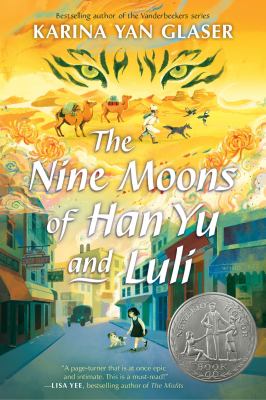
The Nine Moons of Han Yu and Luli by Karina Yan Glaser. HarperCollins, 2025. ISBN 9780063284432. Read from a library copy.
I’d somehow missed reading any of Karina Yan Glaser’s popular Vanderbeeker books, though I think I should fix that soon. I checked this out after it won the Newbury Honor, figuring that historical fiction with a slight fantasy element is right up my alley. In parallel stories, two 11 year olds find themselves taking on major roles to help their families as they fall on exceptionally hard times. In 731 in Chang-An, capital of Tang Dynasty China, a plague is spreading. First Han Yu’s younger sister, apprenticed to a healer, falls sick, then the rest of his family. When they are all quarantined, Han Yu has to find a way to save them himself. The two things he has in his favor are his strange affinity with animals, who naturally flock to him and protect him, and the skills he’s learned at his father’s steamed bun stall. Meanwhile, in 1931 in Manhattan’s Chinatown, Luli’s beloved family restaurant and the Silk Road Gift Store run by their friend on the main floor is failing. The money to make their mortgage payments in short supply as no one can afford to eat out. Her parents tell her they have things under control, but Luli can’t believe their comforting words and is willing to do anything to save her beloved restaurant and the building that houses it. The viewpoints alternate between the short chapters, which nearly all end on cliffhangers. Both children survive both with their own spunk and tenacity, but also with the help of friends and animals. Luli has a street dog who looks remarkably like Han Yu’s, her neighbors, and friends from her Catholic school, while Han Yu has a trio of magpies, some loyal camels, and a poet who befriends him on the road – as well as more mysterious companions that Han Yu doesn’t see himself. The Silk Road Gift Shop also has a length of painted silk reportedly from the Tang Dynasty, a physical link to Han Yu’s time. Steamed buns, or bao, also play an important role in both story lines – which led me down a rabbit hole of looking at gluten-free steamed bun recipes. This is a beautiful look at two times of collaboration between cultures at the same time as massive upheaval, filled with adventure, friendship, and hope.


 alibrarymama