When I got an email asking if I’d like to take a look at a middle grade book from a founding Drag Queen Story Hour Queen and Asian-American, the answer was an enthusiastic yes! This is a sparkling and heartwarming story set in the heat and humidity of a Georgia summer, and one you won’t want to miss.
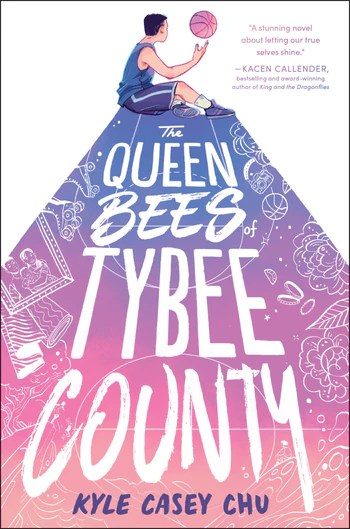
The Queen Bees
of Tybee County
by Kyle Casey Chu
Quill Tree Books, 2025
ISBN 9780063326958
Read from a digital galley kindly provided by the publisher.
Rising 8th grader Derrick Chan has had to work hard to be noticed on his basketball team, and is looking forward to going to basketball camp this summer, even though this will be his first summer without his best friend JJ for as long as they’ve been friends. His plans are upended when his father announces that he’s got an intense construction job away from home. Since Derrick’s mother is dead, Derrick will have to spend the summer with his grandmother Claudia in rural Georgia, whom he doesn’t remember ever spending time with. He’s expecting to be very bored, apart from some pickup basketball games with local boys.
It turns out that Derrick’s assumptions are far from the mark. Grandma Claudia first wows him with her loud music and delicious cooking, which ranges from traditional Chinese to guacamole and pancakes. Even though she’s officially retired, she’s still making a few dresses for the local pageant, including one in bold purple with bright fabric poppies that catches Derrick’s eyes. Even though the girl Claudia is making it for, Ro, is more interested in roller derby than the pageant, Derrick soon strikes up a friendship with her and her best friend Giles, a bowtie-wearing photographer. And it doesn’t take much convincing for Derrick to step in as a sub for the dance routines in the town pageant – surely it will help his basketball footwork, too!
But even as he’s deciding that pageant-loving country Derrick and basketball-playing city Derrick need to stay separate, he feels a pull not to give up either side – and his attempts to keep his selves separate start alienating those around him. His journey is bumpy and ultimately triumphant – I was so rooting for him to find his way, and am really looking forward to the next book in the duology.
KYLE CASEY CHU (AKA Panda Dulce) is a San Franciscan Author, Filmmaker and one of the founding queens of Drag Story Hour. In 2022, far-right extremists stormed her Drag Story Hour to silence her. She is now leveraging her global platform to tell even gayer stories. Chu’s writing has received awards and recognition from Sundance, SFFILM, the San Francisco Arts Commission, the California Arts Council, Lambda Literary and more. In 2023, she served alongside Drag Story Hour as Grand Marshall of San Francisco’s Pride festivities. Her debut two-novel middle grade series, “The Queen Bees of Tybee County” (HarperCollins, 2025) was optioned by Lambur Productions into a UK episodic.
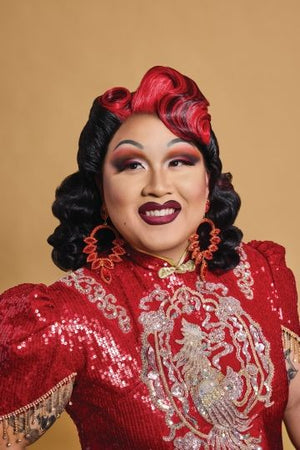
Interview with Kyle Casey Chu
Courtesy of Books Forward
- You have made quite the impact in the book industry with your work as a founding queen of Drag Story Hour. Have you always wanted to be a writer yourself?
Short answer: Yes! One day, as a 7-year-old in summer school, we were tasked with writing a children’s book. That afternoon, I ended up writing and illustrating five books. Come seventh grade, I wrote a hundred-something-page book: “Brother’s Ethnicity,” a vaguely plotless fantasy adventure novel about four best friends who embark on a cross-country road trip together. Looking back, I realize writing this helped me process the crushy-crush feelings I was developing toward one of my closest friends. Oop! came out to my friend group shortly after completing the book.
Writing continues to be cathartic for me in this way, allowing me to safely unpack and process my internal world, no matter how intimidating, through the safety of scenes and hypotheticals on an open page. It reminds me of what I am capable of. I want kids to access a similar sense of satisfaction and empowerment through reading and writing.
- Your protagonist’s journey is inspired in part by your own personal journey. When did you know you wanted to be a drag queen?
Often as a kid, when adults asked me, “What do I want to be when I grow up?” I had at least 17 answers. At certain points, I wanted to be a detective, a figure skater, a writer, a teacher, an actor, a musician or a “face painter,” which I now, of course, interpret as a pull toward drag.
Much like writing, drag encourages you to be and experience all of these things — to imagine outwardly and expansively. As a drag queen, you are at once expected to be a makeup artist, a dancer, a comedian, an actress, a hostess. You can be a figure skater for the night, or a noir detective, until you whirl off a coat at the exact right moment to reveal a show-stopping gown.
People used to tell me I was “a handful” and that I wanted to be too many things. It wasn’t until discovering drag in middle school that I realized the art form could contain all of these wants and more. That in fact, what I wanted, was just enough.
- Why did you decide to pick Georgia as the setting?
There’s a couple of reasons (2).
- Small town queers deserve ALL of the love!
There’s this pervasive trope in LGBTQ+ media that queer and trans kids living in small towns have to be positively aching to escape. That they are all yearning to turn 18 so they can move away and find true community and acceptance in big, queer metropolises. A real Dorothy mindset. And while I’m sure this is absolutely true for many, it’s not everyone’s experience. And it actually contradicts some of the research I conducted for this book.
Many of the Southern Queer and Trans middle graders I interviewed spoke fondly of their hometowns – of the dripping humidity, the church gatherings and cookouts, and all of the friendships and reference points they’ve cultivated across a lifespan. Some even expressed wanting to stay in their hometowns, and brimmed with love for the lives they’ve built. This was an important learning and counterpoint for me, as a new author whose main point of reference for the South is media. I wanted to touch on this, so I did my best to include the details of these interviewees’ upbringings into Derrick’s story to do these perspectives justice.
As a side note, I’ve found that queer and trans people living outside of major cities are some of the fiercest among us. They organize that much harder, they picket that much louder, and need to be that much more determined to drill their stakes into the earth to proclaim their spaces and their right to thrive. I have such deep respect for that, and hope it comes through in the book.
- I’m a nerd who wanted to learn more about Southern pageant culture!
Doing drag during my teens and 20s, many of the queens I met in San Francisco, Los Angeles and New York City regarded Southern drag as an entirely different drag tradition.
I wanted to know why.
I chose Georgia specifically because Atlanta is commonly regarded as one of the South’s largest queer metropolises. Doing research for this book helped me better appreciate pageant culture, a tradition that focuses more on jaw-dropping regalia — high-stacked wigs, dripping drop-earrings and resplendent gowns — as opposed to the more edgy experimentation and genre-bending performances I was used to, coming from San Francisco.
I also learned how the pageant model is a bedrock for so much of the drag we consume today. For instance, as much as RuPaul’s Drag Race fans tease contestants for being “Pageant Queens,” the show is structured like a pageant!
And let me tell you, I’ve helped my drag sisters train for pageants, and it is NO JOKE. Designing, sewing, tailoring and stoning a host of looks, readying time-constrained talent performances, prepping for Q&As — both silly and deep, intimate questions. The process really forces you to reflect and be honest about who you are and present your best self. It challenges you. At their worst, they can reinforce harmful thinking, but at their best, they can help you better understand who you are, what you believe in and how you want to impact the world. I thought this was a great structure for Derrick to question and explore who he is and what he wanted.
- What inspired you to share this story, particularly now?
Queer and trans joy subverts the media’s standard formula and approach to our stories and who we are. Today, LGBTQ+ youth are phoning crisis hotlines in record numbers. Trans kids are being banned from competitive sports despite comprising negligible percentages of youth athlete populations. LGBTQ+ books have been purged from shelves and mischaracterized as overtly sexual content, and LGBTQ+ resources have been expelled from government websites.
The media’s blueprint to approach LGBTQ+ stories is through the lens of trauma, a real impossible-struggle-to-triumph arc. There’s good reason for this, for there’s a lot that we’re up against. It is not enough to live like this, starting on our back foot, always responding to the latest terror. We must also imagine the futures we want and dance toward them.
This is what I hope to put forth in “The Queen Bees of Tybee County.” It is a joyous story about a fish-out-of-water who boldly proclaims who he is, and is met with support that overwhelms any discouragement. Not only is this story, and the world it introduces true, and quite possible, but I think it’s the type of tale we all need right now.
- How has your background as an educator and in social work informed your storytelling?
My book draws on a lot of concepts I learned in social work school that wish I’d learned earlier on. Ironically, many queer stories out there still operate on binary terms — having to be one or the other, to choose this identity or that. But queer imaginations are more creative and expansive than that. We have to be. This tale shows us that we don’t always have to choose between our differing parts. That we can integrate our masculine, feminine and androgynous qualities, or our interests in sports and drag, as equal and essential parts that make us whole and unique.
- What do you hope your readers can learn from your book that readers and industry critics alike have acclaimed for its authenticity?
Like me, my book’s protagonist Derrick Chan is a Queer fourth-generation Chinese American drag artist, raised by a third-generation, acculturated American parent. He takes a journey that I myself once took — investigating my Asian American heritage and reclaiming it with pride, after growing up with a dearth of positive, dignified and accurate representation. Through this story, Derrick is able to explore his identities alongside trusted loved ones, relatively insulated from the misinformed playground taunts that so often (and inaccurately) equate Asian Americanness with shame, invisibility and a stinging alienation. Connecting with drag, punk music and Asian American history as a teen offered me a resilience and pride in who I am that is distinctly my own. I wish this same sense of power for every reader who picks up this book.
- And you use your art as a means of fighting back against those who try to erase or silence LGBTQ+ voices?
I wrote this novel driven by a fire to make up for what happened to me at the San Lorenzo Public Library. For all of it to land somewhere, with a conclusive exclamation point. This was my healthiest point of closure.
It’s important to acknowledge that nothing became of my library incident. The sheriff and authorities didn’t lift a finger until the media caught on, and once the circus died down, they neglected to file a crime report. Today, the authorities still have no record of it ever happening. I don’t want kids to grow up and internalize that being targeted as queer and trans people is a part of life they must simply accept, without consequence.
This story is, in a way, a survival guide. It contains a lot of lessons I learned as both a social worker and a kid who came out extremely early. Support systems are essential. Your friends are everything. And as drag queen Sasha Velour would say, take your broken heart and turn it into art. Simple axioms with a lot of heft to them. Writing this story was a practice in hope and optimism in the face of unrelenting political chaos. It’s been wildly cathartic and healing to the way I relate to both writing drag as art forms.
- For your multi-award-winning and entirely grant-funded short film, you decided to shoot on set of the former incident. Why did you feel it was important to revisit that scene?
People often ask me, “Why revisit the incident?” both literally/physically and figuratively. The thing is, I never really left the site of the incident. There’s still a part of me in that reading room. I return to the library often in my head, like when I hear a loud noise while walking home from a drag show, or in the dark, before asleep, when all you can do is think. I can’t help it. Because I never got resolution or closure.
It is difficult to experience something painful. And it can feel altogether more difficult when that first pain goes unacknowledged and unseen.
Writing, producing and starring in “After What Happened at the Library” felt somewhat like an exorcism. Sure, I was back at the scene of the crime, but I also had a script mapping out our day. There were frequent check-ins, and I was encouraged to ask for breaks. I was surrounded by people I love and trust, who believe in this story. There was a sense of care, control and authorship that was wrested from me on the day of the actual incident. This time, the pain was seen and acknowledged.
- Are you working on any new projects – either books or film?
I am blessed to have many irons in the fire!
“After What Happened at the Library”: A Debut Feature Film (for adults)
The short film, “After What Happened at the Library,” is a character introduction and
proof-of-concept for the eponymous surrealist drama feature film (Comps: “Everything
Everywhere All At Once,” “I May Destroy You,” “May December,” “Eternal Sunshine of the
Spotless Mind”). The feature expands on the world of the short in the days and weeks post-
virality, when everyone — friends, authorities, politicians, bad actors — want a piece of Akita.
You’ll meet Akita’s absurdist drag sister Tonya; outspoken, neuroatypical leftist work
wifey Eve; and charming, anime-obsessed, autistic twin brother Mikey, as Akita’s mind bends
around reality in her struggle to reclaim authorship of her viral story.
“Betty”: A Short Film (for adults)
Thanks to a short film production grant from NewFest and Concord Music Originals, we
are producing a grimy, heartwarming, absurdist drag queen comedy with the same director of
“After What Happened at the Library,” Syra McCarthy (“Grey’s Anatomy”, “The Dropout,”
“Josephine”).
“Betty” follows Betty St. Clair, mother of an all-Asian American drag family (based on my
all-Asian American drag family, the Rice Rockettes), as they perform for an all-Cantonese-
speaking senior center (also based on a real-life performance at San Francisco’s On-Lok Senior
Center). Betty soon discovers her Yeh Yeh (paternal grandfather), who isn’t aware of Betty’s drag
persona, is in the audience! Gulp!
Will Betty overcome her debilitating self-doubt and her sisters’ poorly-timed backstage
hijinks to come out to Yeh Yeh through an epic drag performance??
“What Kind of Queen?”: A Picture Book on José Sarria” (for kids)
My friend, an LGBTQ+ Historian and I, are releasing a historical children’s picture book on San Francisco drag legend and activist José Sarria, an opera-singing WWII veteran and the founder of the Imperial Court System, a network of regional royal drag courts raising money for charitable LGBTQ+ causes.
Book 2 of “The Queen Bees of Tybee County”: A Companion Book (for kids)
Derrick and JJ’s adventure continues in a forthcoming soft sequel/companion book that I am currently drafting! No sneak peeks to speak of yet, but on the foundation of self-reflection and discovery built in the first book, you can expect more light-hearted adventure, as well as developments on JJ and Derrick’s relationship in this second novel


 alibrarymama
Pingback: Monthly Book Round-Up Middle Grade-Adult: April 2025 | alibrarymama