The Girl Who Chased the Moon

Now that I’ve read this and the author’s most recent book, The Peach Keeper, I can cross her off of my unfinished series and authors list.

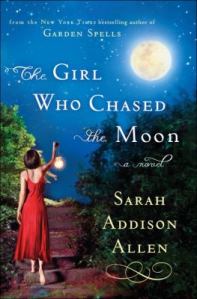
The Girl Who Chased the Moon
The Girl Who Chased the Moon by Sarah Addison Allen.

I adored Allen’s first book, Garden Spells, and have been picking up her books on and off since then. They’re mostly set in modern-day North Carolina, with little bits of magic woven into the otherwise ordinary world. In this book, teenaged Emily Benedict moves back to her mother’s home town of Mullaby, North Carolina, following her mother’s unexpected death. She’s never met her reclusive but actual giant of a grandfather before, and knows nothing of the scandal that caused her mother to leave. Next door, her mother’s former classmate, Julia Winterson, lives in a tiny second-floor apartment. She’s just running her father’s old diner to pay off the mortgage, before she goes back to New York to fulfill her dream of opening up her own bakery. Even though there are many good reasons not to reach out to Emily, Julia does: Julia was an outcast and Emily’s mother ran with the popular girls. And Julia can never forget the boy and the memories she ran away from before she left Mullaby herself. Still, Julia’s cakes with their cutting-edge flavors have been gaining a following in Mullaby, and her cakes send the smell of love and hope through the air, whatever their flavor. Meanwhile, Emily sees from her window the mysterious Mullaby lights that appear only in the dark, and makes friends with the handsome Win Coffey, decidedly against his father’s wishes. Another touch of magic comes from the wallpaper in Emily’s room, which used to be her mother’s: it changes to reflect what it thinks the occupant needs. Some days, it’s fluttering butterflies, others, snow-covered pine trees.

So twenty-year-old problems are resolved, and there’s romance and reconciliation for both of our female leads. The only thing that really struck a false note for me was when Win confessed that he had been sneaking into Emily’s bedroom at night to watch her sleep, and she doesn’t find this creepy. Memo to authors: breaking into people’s houses to watch them is creepy, stalkerish behavior. It is not romantic. Stop doing it. Aside from that, this had just the right notes of integrating past and present in a slightly magical, feel-good story that made a perfect summer read.

Posted in books | Tagged , | 2 Comments

The Cats of Tanglewood Forest

The Cats of Tanglewood ForestThe Cats of Tanglewood Forest by Charles De Lint. Illustrated by Charles Vess.
I was slightly hesitant when checking out this book, as animal fantasy has never really been my thing. However – Charles De Lint and Charles Vess! De Lint of course is a fantasy great (my first introduction to him was his Jack of Kinrowan duology, part of Terri Windling’s Fairy Tale series, but.) Vess may be less familiar to my readers, but he is a graphic novel artist great and has illustrated such things as Neil Gaiman’s Stardust. (His style is somewhat similar to one of my favorite picture-book artists Trina Schart Hyman.) Put the two of them together and you can’t help but get a magical book. It’s not a graphic novel – much like Stardust, it’s told in prose with frequent watercolor paintings, large and small, but all beautiful.

Our story is set in an indeterminate time near a rural mountain town, with a nearby Native American tribe. Orphaned Lillian lives with her Aunt on a small farm, mostly on their own but with some dealings both with the town and the tribe. Lillian really wants to see fairies, and after her farm work is done, she goes out into the nearby forest, leaving small gifts of food for the fairies and for the oldest apple tree in the orchard, even though all she sees are ordinary birds and animals, and large numbers of wild cats. One day, she falls asleep in the forest after chasing a deer. Still sleeping, she is bitten by a poisonous snake. The wild cats feel sorry for her – they having drunk most of the milk left out for the fairies – and decide to brave the wrath of the ancient cat father to save her life. Except that the only way they can do so is by turning her into a cat. And the only problem with that is that poor heartbroken Aunt doesn’t recognize Lillian in her cat form. However, Lillian’s journey to set things right again isn’t the straightforward quest that it first seems to be. Simply turning human again is easily accomplished, but only makes the situation worse and requires her to try again, and then again. On the way, she meets several characters who try to help her, including some brothers from the neighboring tribe and T.H. Reynolds the fox. There are wise old women of multiple traditions – some more sympathetic and helpful than others – including Old Mother Possum, Aunt Nancy of the Crow tribe and Mother Manan of the Bear people. These last two helped to navigate the treacherous waters of Wise and Innocent Native Persons, by being decidedly not innocent rivals engaged in an ancient feud. That being said, I was still not entirely comfortable that the waters had been entirely successfully navigated.

It’s pretty obvious from the premise that the book deals with death – but there is not a lot of violence otherwise, and nothing in the way of romance. Its easiest target audience is the middle grade cat-loving girl. However, it is less full of cats than the cover and title would indicate – Lillian spends most of her journeys traveling in human form and the fox character is more clearly drawn than the cats. I think there’s enough suspense to keep boys interested as well. My own boy, almost of target age, was certainly interested, and kept peering around to see the pictures as I was reading. It feels like it would make a perfect read-aloud book for him, and I plan to suggest it when we’re done with our current book. It looks like a companion novel, Seven Wild Sisters, where Lillian is the older aunt, is set for publication next winter, and I’ll keep an eye out for this as well.

I think that Charlotte liked it somewhat less well than I did; you can read her well-written opinion over at Charlotte’s Library.

Posted in books | Tagged , , | 2 Comments

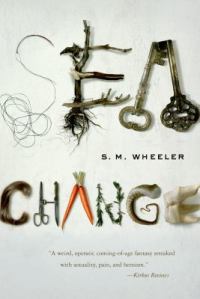
Sea Change

Sea ChangeA few years ago, I was enchanted with this book trailer for Maggie Stiefvater’s Shiver, which features the ridiculous idea of a human/kraken romance. So when I read this review of an (adult) novel featuring just that, I had to read it. (Look! You can see Stiefvater’s harp in the background!)

Sea Change by S.M. Wheeler.
Lilly is the only child of the local noble, but between outclassing the neighbors and having been born with a disfiguring birthmark on her face, she’s never had any friends. Even her parents are distant and critical, both with each other and with her. She met Octavius as a child, when he was just a tiny baby kraken, small enough to hold in her hands. Now that she’s in her teens, he’s much bigger than she is, but she still spends all her free time with him, sometimes talking, sometimes exploring the nearby countryside. Even though there isn’t a physically sexual aspect to their relationship, Octavius is the most important person in her life. When he goes missing, she is distraught, and willing to do anything to get him back. The rest of this gender-bending book explores just what she means by “anything”, in a personal sacrifice kind of way. First, she makes a grueling journey to the remote mountain home of an ogress, and trades her female organs to find out where Octavius is: held captive in a too-small tank for a circus. (This book, though officially published for teens, is one of those rare books that explicitly mentions menstruation: Lilly’s somewhat upset at the lost opportunity for children, but had suffered from debilitating menstrual cramps that she’s quite happy not to be rid of.) Lilly now wears men’s clothing and goes by Lyle, and her quest turns into a kind of Firebird story, where the person who has what Lilly needs for the next step will only give it to her if she first gets another magical object from yet another person. The characters she meets include a magical tailor, a skinless witch, two bandits and their assistant automata, and a boy who used to be a donkey. The ending is not as straightforwardly happy as I would like for a character who has worked so very hard for it – but it does at least come to a place of peace, and the journey there is both thought-provoking and adventurous. I think it’s published for adults more because the tone is on the literary side and because of the squickiness of a few of the scenes – it’s low on the both the traditional violence or sex that would otherwise push a book into the adult realm.

This could also pair well with Cathrynne M. Valente’s Deathless.

Posted in books | Tagged , , | 2 Comments

Literary Knits

Knitting based on favorite books? What could be more perfect? Well, maybe a slightly higher ration of fantasy to realism in the titles, but that’s just quibbling.

Literary KnitsLiterary Knits by Nikol Lohr.
This is another one I snagged of the new nonfiction shelf at the library. Sadly, due to forces outside my control, I haven’t been knitting much recently, and so I wasn’t really looking for a knitting book to fall in love with. But fall in love I did. All my friends at Knit Night loved it, too, even though no one felt like they needed more projects to think about doing. The book starts off with a great intro and technique section. Lohr wisely assumes that if you’re going for a pattern book over a basic learn-to-knit book, you already know the basics of knitting. She focuses on intermediate and advanced techniques to give knitting a more professional look or make things a little easier, like how to join smoothly to knit in the round and how to do needle-less cables. Her notions section had some nifty suggestions I’d never seen before, and this is the only knitting book I’ve ever seen have a section on useful knitting apps. She also assumes that you might not be knitting with the recommended yarn: has a solid section on yarn substitution at the beginning, and every yarn used has a close-up photo and a description to help you find a similar yarn.

And then, on to the patterns. Each pattern is based on a favorite book (mostly classics), with a paragraph of introduction on re-reading the book and why Lohr designed the garment she did for each book: cozy bed socks for Wuthering Heights, for example, because on re-reading, the heroines spend far more time recovering in bed than gallivanting about the moors. Here are some of my favorite patterns: the girly and practical variations on the same mitten for Meg and Jo March; the sleek Daisy cloche; the Emma shawl for Madame Bovary, with an arsenic atom diagrammed into the center; the Galadriel hooded dress (even if the thought of knitting an entire hooded dress makes me go cross-eyed), the Jane Eyre shawl, the Anne Shirley Puff-Sleeve Top; the intricately cabled John Thornton scarf; and the Sydney Carton Cowl based on a Tale of Two Cities, with Morse code messaged knitted in. For children, the Oskar pullover had a lovely classic look, while the Edmund Crown/Hat nicely reverses from looking like a crown to looking like a plain hat. The Lyra hood’s cozy ruff hides the tiny embroidered Pantalaimon in the lining, and the Eppie bonnet is just sweet. Really, this is everything a knitting pattern book should be.

Posted in books | Tagged | 1 Comment

The Rithmatist

The RithmatistThe Rithmatist. Rithmatist Book 1. by Brandon Sanderson. Illustrations by Ben McSweeney.
This book is described by the author as a “gearpunk fantasy” – meaning similar in spirit to steampunk, but a world where everything is operated by a combination of gears and magic. The United States is the United Isles, a large archipelago (I spent a long time reading the names of all the islands.) The magic, rithmatics, is based around geometric designs drawn in chalk with a strong dose of tactics – often things like circles, but also small two-dimensional chalk creatures that can crawl along the ground and attack other designs or even people. In the preface, we meet a young rithmatics student who is unexpectedly waging a losing solo battle against a horde of invading wild chalklings. But the main story is about Joel, the son of the deceased chalkmaker, who’s been given a scholarship to attend Armedius Academy, where both regular students and rithmatists study. He failed the childhood inception ceremony that would have labeled him a rithmatist, but spends his time sneaking into rithmatics lectures and practicing the designs. As the story opens, several things happen all at once: Joel’s favorite professor, the brilliant but absent-minded Professor Fitch, is defeated in a rithmatic duel by the new and arrogant Professor Nalizar, newly returned from the battles against the wild chalklings in over-run Nebrask. Joel forms a somewhat rocky friendship with Melody Muns, a rithmatics student who draws beautiful unicorns but terrible rithmatic diagrams, and who reminded me strongly of Eilonwy of Prydain. And more and more of the best rithmatics students disappear in the night, with only traces of blood and smudges chalk designs to show for it. Joel starts working officially with Professor Fitch on investigation-related research and unofficially with the federal inspector who comes to investigate the disappearances.

I’d read good things about this book on many blogs I love, including the Book Smugglers (they also have an interview with Sanderson.) Just recently, I recommended it to a retired colleague who came in looking for books. She asked me if it was bloody. I looked at the flap information, which does indeed make it sound bloody. It wasn’t. Yes, there are students disappearing – and I’m very sensitive to horrible things being done to innocent children in the name of making protagonists Do Something or Feel Something – but this didn’t set off any alarm bells. The disappearances are only mildly violent, and we only see part of the one in the prologue. This feels like it’s set in about the 1910s, and the book felt delightfully restrained and old-fashioned even as it stayed very exciting. Melody and Joel go out for ice cream together, and that’s the extent of the romantic side of the story. Melody felt a little shallow and maybe too reliant on orchestrating scenes to get her way, but Joel was a very engaging character. I really liked that he wasn’t a gifted rithmatist himself, and how he and Melody worked together to solve the mystery. The true identity of the villain was only partially clear to me, and there were some nicely unexpected plot twists. The world-building was fantastic, with its very original magic system and related religion, the geography, the educational system, even the barely-relevant government system featuring knight-senators. Since it’s exciting without being super-violent or sexual, it would work well for older middle grade students as well as the teens it’s being marketed to, and you already know that I’m recommending it to adult fantasy and steampunk readers. What are you waiting for? Go find a copy! And if you’ve read it already, let me know what you think!

Posted in books | Tagged , | 6 Comments

A Wizard of Earthsea

A Wizard of EarthseaA Wizard of Earthsea. Earthsea Book 1. by Ursula K. Le Guin. Narrated by Rob Inglis.

My parents were big Le Guin fans, so I’d read this book and many others by her as a child, though I confess I never loved her as much as my father especially did. I was recently in need of a digital audiobook to listen to while washing dishes, and found that my love had bought it for our son. It is a classic, first published in 1968. It is the story of a poor boy, Ged, who finds out that he is a wizard. Given a choice between a slow apprenticeship to a great wizard and a faster tutelage at the school for wizards on a small island, he ends up choosing the school for wizards. But at one point, goaded by pride and the need to show himself as better than the rich apprentice wizards, he accidentally allows an evil passage into the world. The rest of the book narrates his journey towards maturity and his struggle to defeat the darkness before it uses him as a stepping stone to take over the world.

I remembered some of the central scenes of the book, but I know that this wasn’t a favorite, regularly reread series. I had issues with the book at the time. And wow, rereading, I have different issues. As a child, I was a very conservative Christian. I believed in the victory of light over dark and found Le Guin’s central, explicit message of the need for balance between light and dark uncomfortable. Now I find myself much more sympathetic to her ideas on balance. But the sexism – boy howdy! Not only are all the wizards male, all the people of power male, but there is only one sympathetic female character in the book, a naïve younger sister. There are, however, two or three witches, all unfavorably depicted. It’s explicit that women aren’t as powerful as men, that their magic is crafty and manipulative in a dishonorable kind of way – they’re just messing around with forces that they know they ought to be leaving alone. And Ged starts off an extremely arrogant young man, and I find I have very little patience for that.

And yet – Amy over at Rockin’ Librarian was asking me if I thought she shouldn’t read it based on the sexism. I can’t really say that. The language and the world-building are fantastic, all told in a rich, formal style that I think is very difficult to pull off successfully. Rob Inglis, narrating with a rich, older-sounding voice, read the story beautifully to capture this aspect of it. This is also one of the earliest, revolutionary examples of multicultural fantasy that I know of: there are only a few light-skinned people, all considered suspicious. Most of the people range from medium to dark brown, Ged and his best friend included. His best friend, a wise and caring soul, was my favorite character in the book. Also, I only read the original trilogy, not the books that were published in 1990 and 2001, and I know that Le Guin revisited the topic of sexism both in Tehanu (1990) and in published lectures on the topic. I still find books with troubling lack of agency in the female characters, but reading this just brings home to me how very far we’ve come since 1968. Did Le Guin herself really have such a poor opinion of women, or was she fitting in where she felt she needed to in order to sell her also-strange ideas on race and good vs. evil? I guess I could read the other books to find out. But what do you all think of Earthsea? Do you read it? Do you love it, hate it, or, like me, feel torn between the two?

Posted in books | Tagged , , | 6 Comments

Picture Book Pile-Up

Today is the 22nd KidLit Blog Hop! That reminds me that the kerfuffle last week put me behind on my hopping, but I’m going to try again this time. There’s a lot of fun books linked up already!

Kid Lit Blog Hop

We keep a large basket full of our current library picture books in our living room. These are the ones that we loved from the last month or so.

King Arthur's Very Great King Arthur’s Very Great Grandson by Kenneth Kraegel.
On his sixth birthday Henry Alfred Grummorson, a distant descendant of King Arthur, rides forth in search of battle and glory on his donkey, Knuckles. But each creature he meets offers him a non-violent competition: the dragon blows smoke rings, the Cyclops begins a staring competition, the Griffin plays chess, and so on. At the end of his journey, Henry still hasn’t used his sword – but he does have some new friends. Wavery ink and watercolor art gives this book an old-fashioned charm. My son would have obsessed over it during his four-year-old knight phase.

MonstoreMonstore by Tara Lazar. Illustrated by James Burks.
“At the back of Frankensweet’s Candy Shoppe, under the last box of sour gum balls, there’s a trapdoor. Knock five times fast, hand over a bag of squirmy worms, and you can crawl inside…. THE MONSTORE.” Zack has a problem: his little sister Gracie is always getting into his room. The Monstore monsters are supposed to do whatever you tell them to, but his monsters don’t keep Gracie out. Now he has a new problem: his whole house is full of monsters. He tries to take them back, but “No returns. No exchanges. No exceptions.” This has bright art that looks like it could be from a digitally animated movie, with cute monsters hiding on every page. It took a couple tries for my three-year-old to get into it, but once she did, she cried when it was time to take it back.

Princess in TrainingPrincess in Training by Tammi Sauer. Pictures by Joe Berger.
Viola Louise Hassenfeffer wants her kingdom to be proud of her – but karate chops, diving in the moat and skateboarding don’t work. Will Camp Princess help? This delightful story (still sparkly on the cover) features a multicultural princess class a tomboy princess who (spoiler!) defeats the dragon on her own. The layout varies between more traditional picture-book style and large comic book-style panels with written-in sound effects.

Unicorn Thinks He's Pretty Great Unicorn Thinks He’s Pretty Great by Bob Shea.
Goat thought he was pretty cool, until Unicorn came to town and started doing everything better. Goat tries a typical kid-style magic trick; Unicorn is really magic. Goat bakes a treat that almost comes out right; Unicorn can make it rain smiling rainbow cupcakes. Goat is sure they’ll be enemies… until it turns out that Unicorn envies Goat, too. It’s told in child-like drawings that capture the spirit perfectly.

Belinda the BallerinaBelinda the Ballerina by Amy Young.
This is an older one (2002) that’s just right for my little girl now. Belinda loves to dance and is very graceful but…. “Belinda had a big problem – two big problems: her left foot and her right foot.” No one will even let her audition because her feet are so big. This is a silly story about following your heart no matter what.

HiccupotamusThe Hiccupotamus by Aaron Zenz
A story told in extra-silly bouncy rhyme about a hippopotamus that can’t stop his hiccups. It features a full cast of brightly colored, round animals, whose bios at the end I enjoyed as much as the story.

Cinnamon BabyFinally, one I reviewed a couple of years ago that my daughter wanted daily for about five weeks this time: Cinnamon Baby by Nicola Winstanley.

Posted in books | Tagged , , , , , , | 22 Comments

The Wake of the Lorelei Lee

This is me plugging away at my series, and also me still being about five weeks behind on my reviewing. I finished this book, put in a request for the next two books in the series, finished the next book in another series, and am now on to the next Jacky Faber book.

The Wake of the Lorelei Lee. Bloody Jack Adventures Book 8. by L.A. Meyer. Narrated by Katherine Kellgren.
This entry in the long-running Jacky Faber series involves Jacky going to Australia. She had always dreamed of going to Bombay, Cathay, and Australia – but not as a convict sentenced to life in the penal colony. And certainly not on board the ship she paid for herself and lovingly outfitted before it was seized by the English crown. She’s on board with 200 other female convicts, and her beloved fiancé Jaimy, in despair at her loss, is himself similarly sentenced and sent on another ship. The resulting journey is full of the usual Jacky Faber hijinks. There are reunions with old friends, new friends made, historical figures charmed, lustful kisses exchanged, and torment from enemies endured. I will not dwell too much on these, since the real fun is in reading them. I pause to note, though, some of the unexpected historical accuracies: a Jewish female convict falls in love with and then marries a naval officer on board the penal ship, and the naval officer goes on to a position of power in Australia. I’d thought, reading the book, that such a difference in class and religion would surely have prevented a marriage – but the note at the end said that was lifted straight from the historical record. Jacky also meets the pirate queen Cheng Shih, one of the most powerful pirate queens in history.

I love the Jacky series for the straight-up quasi-historical adventure. That is, the setting is historical, but Jacky herself has a deliberately modern feel. I dropped a less-satisfying audio book for this one: Katherine Kellgren is quite possibly my favorite narrator of all time, and this series really showcases the breadth of her range. The characters, all with different voices and accents, the range of emotion, even her ability to sing all the tunes, and sing them in different voices depending on who’s singing in the book – these amaze me every time. I don’t have enough child-free car time right now to make it through these quickly, and they are exciting enough that I feel a need to listen to something more restful in between the entries. Still, for any fan of adventure looking for a good audio book series (or just to find out why audio book fans love them so), I’d heartily recommend this series.

Posted in books | Tagged , , | Leave a comment

Dark Triumph

Dark TriumphDark Triumph. His Fair Assassin Book 2. by Robin LaFevers.

In the first book of this series, we met Ismae, a novice at the convent of St. Mortain, the patron saint of death, whose nuns are naturally assassins. In that book, Ismae found love while thwarting (at least temporarily) devious plots against the ruling Duchess, Anne of Brittany. In this book, we learn the story of Ismae’s friend and fellow novice Sybella, who seemed slightly insane in the first book and who was sent out on a mission even before Ismae. Sybella may know she’s on a mission, but since the mission involves returning to her abusive legal father, the powerful d’Albert, her cover is good even if her actions are still closely watched. D’Albert has buried six wives and is now one of the many men betrothed to the Duchess and determined to follow through. Sybella witnesses the mighty Beast of Waroch being struck down as the Duchess’s forces attack d’Albert’s stronghold directly. Soon she discovers that he has survived and is being held prisoner. Her struggle to rescue him and take him back to the Duchess turns out to be redemptive for both of them.

The first book in this series had a lot more politics; Sybella and the Beast are much less involved with the whole web and more focused on one mission at a time. There is more of a look at the various roles society puts people into, as a significant amount of time is spent with the pair recruiting the assistance of the despised charcoal-burners or charbonnerie for the Duchess. But while Ismae had a hard enough backstory, Sybella’s is downright nightmarish. Not only did she watch her father kill multiple wives, but she has abusive older brothers, and beloved younger sisters who can be used as hostages. The Beast seems to have survived a life not much better with somewhat less mental scarring, but he is dedicated to St. Camulos, as are all children born of battle-fueled rape. Their journey to overcome their pasts to find a place of trust is just beautiful. In the first book, I was bothered by the focus on romance in a story about nuns, but this time I was expecting it. It’s explicit that chastity is not among the vows of St. Mortain’s nuns, but Sybella and Ismae both have growing doubts about how the convent is run and the role of the Abbess in particular. This plot line looks like it will come even more to the fore in the last book in the trilogy. The Beast seems to hold some ideas that were potentially anachronistic, which I was perfectly willing to accept in the name of a more balanced relationship for modern teens to read about. (I’d say it’s best for high school and up, due to the dark subject matter.) Otherwise, this is a book that pays beautifully close attention to historical accuracy. That, combined with strong characters and the exciting, multi-stranded plot, made for a story I got sucked right into. And yes, I’ll definitely be looking for the sequel.

Posted in books | Tagged , | 4 Comments

Cinnamon and Gunpowder

A tale of pirates told by a chef? How could I resist?

Cinnamon and GunpowderCinnamon and Gunpowder by Eli Brown.
Owen Wedgewood was chef to the head of the Pendleton Company, which seems to be a fictional relative of the East India Shipping Company. When the famous pirate Hannah Mabbot arrives to kill Wedgewood’s employer, she pauses to eat some of the dinner he’d cooked and decides to take him with her. She offers the straight-laced Wedgewood a bargain: cook her a full dinner every Sunday and be spared. Initially horrified by her lawlessness and determined to try to escape, he gradually comes to appreciate Mabbot’s iron determination to bring down the opium trade, so ruinous for both addicts and for those forced to grow it. Wedgewood is a philosophical cook, waxing poetical about the powers of civilization and wheat to create bread and the meanings of different tastes. Brown seems to have a good background in old-fashioned cooking, as he describes Wedgewood’s efforts to create what he considers a modern, functional kitchen on board ship, including his difficulties with the stove, creating a yeast starter from scratch, using a cannonball as a rolling pin, his joy over making sauerkraut and his delightful first experiments with miso. In between the fabulous meals, there are many piratical adventures, including attacks on prisons, sea chases, and fights in seedy port taverns.

My love, on whom I pressed this, said that he had to decide that Wedgewood was an unreliable narrator when it came to describing nautical things, as there were just too many times when he used the right words just a little bit wrong, such as when he described the ship as “running against the wind.” That last was the only example that I’d noticed myself (ships run with the wind – the laborious process of tacking to go against the wind is not running), but my love is a sailor by avocation and has pored over his books of the old sailing ships. People like myself more casually interested in the sea will probably not be bothered by this. My love, once having dealt with this difficulty, was able to enjoy the story, while I was able to jump into it from the start. Even though Mabbott’s ideas are decidedly more modern than 18th century, Wedgewood’s struggles to reconcile his new world with his beliefs felt perfectly appropriate to his time. While it might seem like an odd combination, I have so many friends who love both food and pirates that I am confident in recommending this to a broad circle of my acquaintance. (Need I say that the subject matter best suits it to adults and perhaps older teens?)

Posted in books | Tagged , , | 2 Comments