Revenge of the Dragon Lady

This series is one that my son’s school librarian recommended for him, which he and I both read.

Revenge of the Dragon LadyRevenge of the Dragon Lady. Dragon Slayers’ Academy Book 2. by Kate McMullan.
This is the second in a series of early chapter books geared at boys. As you can tell from the title, it’s a school story with dragons. There’s also a lot of humor at the expense of teachers – the incompetent headmaster Mordred, as well as a professor who spits a lot and uses lots of spit-producing alliteration when he talks. In this particular story, Wiglaf, our gore-fearing would-be hero, learns that Seetha, the mother of the dragon he accidentally defeated in book one, is looking for revenge. Wiglaf defeated the last dragon by finding out its secret vulnerability: bad jokes – and now begins looking both for ways to look fiercer so the dragon will be scared off on sight, and of research to find out what Seetha’s weak spot might be. His attempts range from the silly to the serious, and include his asking advice from his wise pig, Daisy, who speaks to him in Pig Latin. The book in general has many instances of silly fake Latin meant for second-graders to be able to understand, from labeled diagrams of dragons to the school motto, “Goldius est goodies.”

I had mixed feelings about this book. On the plus side, it has lots of elements to appeal to early readers, especially boys. The chapters are short, exciting, and usually end with cliffhangers. There are entertaining bios of the major characters in the back, complete with pictures. There is both slapstick and gross-out humor, as well as relatable school dynamics. A strong plus is that the books held my son’s interest for two full books. On the negative side, even the short chapters seemed padded to me. I felt that so little was happening in each one that the whole thing might just as easily have been told as a picture book, with each chapter condensed down to one page spread and illustrations. Maybe all the repetition is put in on purpose to help beginning readers? It didn’t bother my son, though, who is actually the right target audience. I wouldn’t recommend this as great literature, but definitely, if you have a reader at the early chapter book level who’s interested in fantasy with boy appeal, this is a good choice.
Posted in books | Tagged , | 2 Comments

Touchstone

One of the retired librarians at my library has a similar taste for fantasy, and we often trade book recommendations when she comes in. This one came from her (the recommendation, anyway; the book itself came, as usual, from the library.)

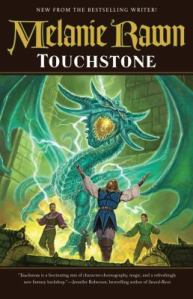
Touchstone. Glass Thorns Book 1. by Melanie Rawn.
TouchstoneTouchstone is an adult fantasy novel, telling the story of theater geeks in a world where the theater runs on magic. It might be the epic tale of a small company’s rise to prominence, but refreshingly so far, kingdom politics are tangential to the main plot, and saving the world is not on the agenda.
The story is at first narrated to us from Cayden or Cade’s point of view, the tregedor or playwright of a small group. Jeska is the masquer or actor, and Rafe the fettler, who holds all the magic together. As the book opens, they are trying for the first time a new, young, and very self-confident glisker, who projects magical scene and costume changes and emotions to the audience. Mieka may be overconfident, but Cade knows in his heart that Mieka is right when he says that they are the perfect match for each other, and together the four young men will go far. The goal is to get invited to the annual event where troupes compete for the chance to win one of three royally sponsored tours around the country.

The world is its own fantasy world, not a reimagining of a specific time period on Earth, but with magic, as so many are. It has a decidedly 17th-century feel to it, though, based on the technology, style, mores, and the archaic vocabulary sprinkled in. The troupe is all young men because only men are allowed to act or attend the theater. But Cade’s best friend Blye is a female glassmaker. She can make the glass quills that hold the theater magic better than her father, a Guild member, but will lose her livelihood when her father is no longer there to stamp off her work, as women can’t be Guild members. She also must disguise herself as a man every time she wants to see Cade and his troupe perform, which results in Cade becoming a leader in what might become a women’s rights movement.

The world is populated by a full array of traditional fantasy races, including wizards, humans, goblins, elves, trolls, and piskies. Unlike Tolkien, though, while the races all have defining physical and magical characteristics, they all come in a variety of skin tones and have been intermarrying for hundreds of years, so that while someone may have a defining race or two by looks, hardly anyone can claim to be pureblood anything anymore. All gliskers, like Mieka, must be part elf to be able to work that magic, for example.

Cade is part elf, part wizard, and has the dubious gift of being overtaken by visions of possible futures. He can and does take action to change futures for himself that he finds unpalatable, but he has been taught to keep the visions a secret from all but his closest friends. Throughout the whole book, he keeps having visions related to Mieka, but struggles with whether or not to tell Mieka about them. Meanwhile, Mieka is as talented as he claims to be, but also addicted to a drug that comes in a glass thorn, ready for injection.

There are multiple strands braided together here, the bright tale of theater antics contrasting with the darkness of Cade’s visions and Mieka’s addictions. I guess I’d been concentrating on the more up-beat plot lines, because I was shocked when things came together into a decidedly depressing ending. Still, there’s a lot in this gorgeous book to please those who read for character, plot, writing, or world-building, and I guess I will just have to wait for the second book in the series to come back to the library. Elsewhens came out in February, and Thornlost, the third in the series, is scheduled for publication in April 2014.

Posted in books | Tagged , , | 2 Comments

Kat, Incorrigible

This is another one that I’ve been seeing a lot of love for on all the blogs. I was possessed of such a strong desire to read it, even though the library where I work didn’t own it, that I took the radical step of making a special trip to the library in my hometown, both children in tow, to find it. With renewed love and respect for my love, who does this nearly every weekend I’m at work, I went in for one book and came out with 27, mostly not for me.

Kat, IncorrigibleKat, Incorrigible. The Unladylike Adventures of Kat Stephenson Book 1. by Stephanie Burgis.
The setting is Austen-era England. Magic is real, but considered terribly improper, and especially frowned on by the church. Twelve-year-old Kat, our heroine, is the youngest of four, including a brother, Charles, and two older sisters, Elissa and Angeline. Their mother died when Kat was born, and her father remarried. None of the children get along very well with Stepmama, but Stepmama finds willful, wayward Kat a special challenge. She’s trying to impress on all the girls that their first duty is to make a marriage that will be financially advantageous to the family. Kat, naturally, finds the very notion horrid. When she discovers that she’s inherited their mother’s illicit magic, and that her oldest sister, Elissa, is being courted by the sinister Sir Neville, she decides to do everything in her (very untrained) power to save her sister.

Those bare bones are fun enough, but Burgis puts in a whole lot of related plots and interesting details. Should Kat believe the Mr. Gregson who claims to have been her mother’s tutor, but who seems to feel that her mother failed by getting married to her father? And what will become of the handsome young man who insists on following Angeline around everywhere? There are highwaymen in swirling black cloaks, and touching reflections on familial love and duty. This is solidly middle grade girl, with nothing inappropriate and plenty of excitement both for the target audience and older fans of Regency and fantasy.

I gobbled this right up and passed it on to my mother before returning it, getting a report back of someone having stayed up into the wee hours with Kat. And since my home library doesn’t have any of the two sequels, I prevailed upon our youth fiction librarian to buy the whole series, so I can finish it.

Posted in books | Tagged , , | 18 Comments

The Mark of the Golden Dragon

The Mark of the Golden DragonThe Mark of the Golden Dragon. Bloody Jack Adventures Book 9. by L.A. Meyer. Read by Katherine Kellgren.
At the end of the last Jacky Faber book, Jacky was on board her own ship, a free woman again, and eating dinner with her beloved Jaimy and a group of other friends. Of course, something that good could never last – readers of the series will know to expect a separation if the book starts out with Jacky and Jaimy together. There is a typhoon, and Jacky and little Ravi are washed overboard, landing in Burma. With her usual talent of landing on her feet, Jacky manages to charm a powerful English-educated businessman, Chinese Charlie, befriend his daughter, and convince him to give her a shipful of treasure with which they will both be able to buy their way into England’s favor. While in England, Jacky hopes to track down Jaimy.

Once in England, though, her plan doesn’t seem as straightforward. For one thing, Jaimy appears to have gone mad at her supposed death, and has descended into lawlessness, seeking only to revenge himself on the two men he holds responsible for Jacky’s sentence and therefore her death. He is now the very romantic yet tragic Black Highwayman. For another, Jacky still has a lot of enemies in England herself, and must proceed very cautiously. Fortunately, she meets up with her old friend, the handsome Lord Richard Allan, who is more than willing to help her with her mission (at least the part that doesn’t involve her finding Jaimy.)

As I’ve been reading this series for a full decade now, I feel prone to a little reflection on why I like it so much. I’ve often mentioned how I love the wild adventures, Katherine Kellgren’s fabulous reading, and the frequent inclusion of period songs. But the books couldn’t have survived on that formula alone if Jacky herself weren’t such a great character. She’s bold and daring, with a decidedly anachronistically modern sensibility that makes her easy to relate to. But she’s also full of faults acutely aware of them – her tendency to rush into things head-first without checking, her inability to keep from kissing a similarly inclined pretty boy even while she’s determined to stay ultimately loyal to Jaimy, the ease with which she loses her temper. She is deeply emotional in general, exuberant when happy, and quick to tears when accused of heartlessness or when she hears bad news about any of her many, deeply loved friends. In short, she’s a person with the temperament that I can believe would get into the kind of adventures she does (as increasingly unbelievable as they are) and who would inspire the kind of deep, friendship-based loyalty that makes the stories work.

I had just started last year’s Viva Jacquelina! with plans to move on to the most recent entry in the series, Boston Jacky, when my love bought The Dream Thieves for me. And – well, I don’t know that it’s a weakness, per say, as I like the comfort-adventure I get with Jacky very much. It’s still on hold until I find out what’s going to happen to Blue and the Raven Boys.

Posted in books | Tagged , , | 4 Comments

A Corner of White

This book sounded so intriguing when I read about it on the Book Smugglers months ago that I went around and entered multiple giveaways… I might be embarrassed about that now. I didn’t win, but luckily my library got a copy, so I was able to read it in my usual manner.

A Corner of WhiteA Corner of White. The Colors of Madeleine Book 1. by Jaclyn Moriarty.
Here’s the wonderfully concise Official Summary of the book:

“14-year-old Madeleine of Cambridge, England, struggling to cope with poverty and her mother’s illness, and fifteen-year-old Elliot of the Kingdom of Cello in a parallel world where colors are villainous and his father is missing, begin exchanging notes through a crack between their worlds and find they can be of great help to each other.”

Madeleine has a life that seems interesting enough, with close relationships to her mother, a couple of good friends, and a homeschool program her mother has cobbled together for them, being tutored in various subjects by colorful neighbors and the odd relation. But she can’t help remembering the larger-than-life father and the extravagant lifestyle she left behind when she and her mother moved to Cambridge. Now, her mother sews hours a day to pay for their one-room apartment, practicing and failing at quiz show questions, while Madeleine, instead of being the toast of parties, she has just two friends, Jack and Belle. It’s not that she dislikes her new life – she just can’t help going back to the “what if” of staying in her old life.

Elliot lives in the Kingdom of Cello, a parallel world where colors are often-dangerous beings. You might have a cloud of Reds fly by that simply make everyone feel warm and fuzzy, but many more of the colors are deadly. Elliot has been spending the past year traveling, putting himself in danger, trying to track down his father, who was kidnapped by a violent Purple. It’s been long enough that his mother has decided to rent out their electronics repair shop to another couple, the Twicklehams, who have a small and silent daughter. Now, though, people keep urging him to stay in his home town of Bonfire, where he’s the star of the local sports team, a role he’s not quite comfortable with.

The people of Cello know about Earth, while Earth, obviously, does not know about Cello. That means that when letters start appearing – stuffed in the seam of a broken parking meter for Madeleine – it takes a long time for Madeleine to believe that Cello is real. But even though Elliott knows that failing to report a crack is a crime and both Elliott and Madeleine are developing romances with friends in their own world, they keep writing more letters. (I really appreciated a story where a teen boy and girl could be drawn to each other just for friendship, without the need for the central relationship to be romantic.)

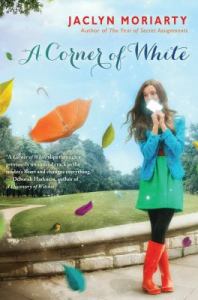
Madeleine looks bright and whimsical on the cover of the book, and she and the book are very wonderfully so. But there’s plenty of adventure to go along with the whimsy, from Madeleine’s struggles with her family in Cambridge to Elliott’s more dramatic struggles in Cello. And there is a lot of heart behind all of it, as both of them are realizing that they might not get their fathers back, and musing about the nature of the universe, especially displayed in the Cambridge teens studying of real-world Cambridge figures Isaac Newton, Lord Byron, and Ada Lovelace. The characters are complicated, appearances are extremely deceiving, and there is a lot more depth to everything than first appears. It has solid teen appeal, without anything offensive for advanced younger readers, and plenty of draw for older readers as well.

It’s the first of a series, and I will be tracking down the second book as soon as it’s out next March.

Posted in books | Tagged , | 6 Comments

The Hum and the Shiver

It’s October! What are you going to nominate for a Cybils Award? Take a look at the great books that have already been nominated and make sure your favorites are in there, too!

There’s a librarian in my state who gives talks on the latest in sci-fi and fantasy that I make a point of getting to whenever I can. I heard about this a year or two ago now, but it just now made it to the top of my reading pile. This is Fantasy for Music-Lovers.

The Hum and the ShiverThe Hum and the Shiver by Alex Bledsoe.
Deep in the Smoky Mountains of Eastern Tennessee is Cloud County, the home of the Tufa people. They might look similar to Native Americans, with their olive skin and straight black hair, but they have been there longer than anyone can remember. Usually, not many outsiders notice them, but right now, there’s a lot of attention focused on them as Private Bronwyn Hyatt, a First Daughter of the Tufa, is returning from war. She doesn’t remember the incident that people are saying made her a hero, but she’s wounded and knows she has to come home. At home, both of her parents have been seeing signs that death will come soon to somebody in the family – there is a haint trying to talk to someone, and the sin eater was seen shambling around the house – but no one can tell for sure who. It looks like either Bronwyn or her mother, but Bronwyn’s father or one of her two brothers are still possibilities.

As she’s trying to heal her shattered leg, Bronwyn realizes that she has forgotten how to play her mandolin and so can’t access the healing power her music would bring her. Meanwhile, she needs to avoid both the press and her abusive ex-boyfriend Dwayne Gitterman, though his sweet and obviously smitten younger brother Terry-Joe has been sent over to help her with her mandolin. There’s also Craig Chess, a handsome young Methodist minister who’s the latest in the steady trickle of preachers the church sends to try to convert the Tufa. The story makes it clear that the Tufa can’t be converted; my mother found this disturbing, but still couldn’t put down the book. I, on the other hand, like Craig’s sense of humor (“What… was the Good Lord smoking?” he asks himself at one point) and that he is determined to minister to people in need – the sick and dying and so on – whether or not he can get them to come to church.

There’s a lot going on here, both for Bronwyn and for a host of secondary characters, including her mother, Craig, and the local journalist who must learn more about his deliberately forgotten Tufa ancestor to get close enough to Bronwyn to get the story his boss says will save his job. The story is as much about who the Tufa are and what it means to be one as it is about Bronwyn’s particular troubles – though of course she has to figure out her own identity to solve her problems. Though there’s definitely a dark side to the story, the joy of life and music shines through as well. This is one for the mature, between Bronwyn’s recent violent past and the sexual exploring she was known for before she joined the military. There aren’t a whole lot of present-time bedroom scenes, most of them between married people, but there is a lot of talk about what various characters did before they settled down. Even though I felt like I didn’t need to hear so much about either the wild pasts or the haint’s trailing entrails, I loved the world. I loved the importance of music and the folk ballads, both traditional and original, that filled the pages. I loved the Tufa, both individually and collectively, living in the modern world while their heritage is carried on the night winds, and the rough edges where Tufa and other people meet. And I went right out and got the sequel, which came out in June.

Posted in books | Tagged , , | 4 Comments

Sir Princess Petra’s Talent Blog Tour

Tour BannerBook two: Sir Princess Petra’s Talent synopsis

Sir Princess Petra has already proven she is a kind and noble knight. This, however, does not please the king and queen—they want her to behave like a princess and forget this silly knight nonsense of hers!

But when the king writes a new rule in the royal rule book that requires her to attend Talent School and acquire a princess talent certificate or suffer the spell of the royal magician, Petra, reluctantly, agrees to go. But who could have guessed what Sir Princess Petra’s Talent would be?
Continue reading

Posted in books | Tagged , , , | 10 Comments

Starting to Read

Well, probably no one except other librarians would find it exciting that I’ve spent the last couple of days figuring out how to make Excel sit up and beg and tell me how well my language learning materials are doing in percentage checked out and circs per year. Sexy, right? Also, we had issues with the drains, which reminded me of old-school British children’s lit.

Anyway, since the review I started Saturday still isn’t done, I thought I’d tell you that I finally have The Dream Thieves to listen to (I’m loving it so far, but that might not be surprising.) And Song of the Quarkbeast came in on hold (as well as a book on performing early music that may be exciting only to me). I found the latest Merrie Haskell on the shelf, too, and I can’t even remember all other the lovely books I have waiting for me at home.

What are you reading, or looking forward to reading?

Posted in books, Personal | Tagged , | 4 Comments

City of Glass

Continuing on with the best-selling teen urban fantasy series…

cityofglassCity of Glass. Mortal Instruments Book 3. by Cassandra Clare.
As our story opens, Clary is packing for her first trip to Alicante, capital of the historic home of the Shadowhunters in Idris. There, she plans to look for the magician who wrote the spell that’s keeping her mother asleep, as he’s likely to be the only one who can break it. Jace, though, thinks it’s too dangerous for her to go, when their evil father Valentine is sure to be heading there next. Hoping to convince Simon to help keep Clary in New York, Jace asks Simon to meet him at the New York Institute. But plans go badly awry, and all our major characters, including vampire Simon and werewolf Luke end up in an Idris that’s feeling very unfriendly towards outsiders.

At the house where our favorite teen Shadowhunters Alec, Isabelle and Jace are staying, Clary meets Alec’s cousin Sebastian. Seeing him instantly calls to mind the dark, tortured prince she’d been drawing in the manga series she’d been working on at home, and she consents to let him help her in the search for the only magician in Idris. What she finds are hosts of secrets that affect nearly everyone she knows.

Meanwhile, Valentine visits the Assembly and presents them with an ultimatum: put him in charge, or he will attack with powerful demons and bring down all of Alicante. While all of the New York Shadowhunters know that this is a snare, Alec is the only one of age and therefore able to attend council meetings – will his voice be enough to convince the Assembly?

All this time, Clary and Jace are fighting their forbidden feelings towards each other. They know they’re siblings, but they just can’t stop being attracted to each in other in a deep, romantic way. Finally in this book, Clare is able to resolve this storyline, which has been going on since the first book. The solution feels in retrospect like it contradicts some of the story we got in the first book, but was neat enough that I didn’t really mind. In any case, the final showdown is so spectacular that it’s hard to even notice a minor inconsistency from two books ago.

I started reading this series after I read the prequel series, and it was really clear how much Clare’s writing skill and her knowledge of the Shadowhunter world had grown since she started the first book when I went back to it. Now, in the third book, I notice her skill improving in the first series (if that makes sense.) It’s still a world of danger and drama that feels full of pulpy excitement, but with the underlying message that family is the people we count on most. Sometimes it’s the family you’re born with, and sometimes you make your own family.

I’m now on hold for the fourth book and wondering where Clare will go with the story from here.

Posted in books | Tagged , , | 2 Comments

Friends with Boys

I’d been hearing good buzz about this teen graphic novel since before it was published last year, and finally actually checked it out.

Friends with BoysFriends with Boys by Faith Erin Hicks.
Maggie is the youngest of five and the only girl. All of the kids were homeschooled until high school, and Maggie, just about to start, is decidedly nervous. She doesn’t know how to be friends with girls and misses her mother, who’s left home. Her brothers start off trying to let her find her own way, leaving Maggie even more alone. She’s approached by punkish Lucy and her brother Alistair, and confused by the animosity of the cool volleyball team captain towards both Alistair and her oldest brother. There’s a touch of the supernatural as Maggie is haunted by the ghost of a 19th century sea captain’s wife, echoing Maggie’s own feelings of loss and confusion. We don’t really know why the mother has left, or if she’s left permanently or temporarily: she’s just gone.

Even with ghosts, a missing mother, and jocks with superiority complexes, the story is far from depressing. It’s all mixed with a good dose of humor from all parties. The scene that had both my love and I snorting involves Maggie, Lucy and Alistair going to see a late-night showing of Alien together. Maggie and Alistair have both seen it already and like it, but Lucy has never seen it and isn’t a fan of horror movies to begin with. The page is filled with panels showing the three watching the movie. Maggie sits, smiling slightly, through the whole thing. Alistair looks blasé. In between the two of them, Lucy watches in squirming horror, changing every panel.

I am oversimplifying the whole book here, as we have time to get to know all of the brothers, and for the friends to get involved in adventures as well as simple school and movies. This totally lived up to the hype, and my love and I both thoroughly enjoyed it. While it’s appeal isn’t limited to teen girls, as most Western graphic novels seem to be skewed male, this is a good one to remember for solid girl appeal.

Posted in books | Tagged | 2 Comments