[Updated to add] Authors and illustrators are getting together to help victims of Typhoon Haiyan in the Phillipines. Authors for the Philippines (an online auction from Nov. 13 – 20) Art for Haiyan
This was one of my most anxiously-awaited books of the year… we bought it on audio as soon as we could, and I made extra time to listen to it, finishing it in maybe two weeks.
The Dream Thieves. The Raven Cycle Book 2. by Maggie Stiefvater. Read by Will Patton. Scholastic, 2013.
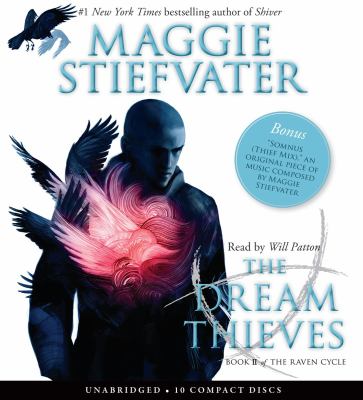
This is the middle book of a trilogy. It’s obvious from the cover that this book focuses on Ronan, where Raven Boys was more about all four teens coming together in the search for Glyndwr. Ronan was my least favorite of the gang last time, but here, seeing him more from the inside, he’s much more sympathetic. We get to know all the other characters as well: Blue shows some impressive backbone, the various facets of Gansey are explored, there are some very sweet moments with Noah. With Adam, we learn more about what the sacrifice he made in the last book means and, heart-breakingly, disappointingly, yet realistically, see the effects of growing up with abuse. More characters are introduced for Ronan to play against, including his adored younger brother Matthew, of golden curls and ready smile and for whom I was instantly afraid; and a fellow Aglionby student, Joseph Kavinsky, known for his forgeries, illicit substances and, most irresistible to Ronan, late-night street drag racing. It became clear to me that Persephone, Maura and Calla are the Maiden, Mother and Crone of the Triple Goddess, as well as balancing out the overwhelming maleness of the Raven Boys. Filling the role of villain abandoned in the last book by Mr. Welk and possibly Neeve, we have Mr. Gray, a hit man searching for the Gray Warren, a mythical object for bringing things out of dreams.
So here I get around to plot (yes, I read for character first). The search for Glyndwr continues (and here I’m distracted in my review writing by noting that my library owns a 1965 book by Rosemary Sutcliff called Heroes and History that includes a chapter on Glyndwr), but is stymied when Cabeswater, the most magical and promising place on the ley line, disappears. There are relationship developments for Blue. We – and Ronan – explore his power to bring things out of dreams. It’s not at all the happy power it could be: he can’t control what he dreams, and frequently nightmare creatures come out whether he wants them to or not. Mr. Gray, the hit man looking for Ronan, visits 300 Fox Way and gets involved with Maura – a very odd development indeed, but one I think worked. The progress towards actually finding Glyndwr felt very small, both to me and to the characters – but I noticed it mostly only in retrospect, as the book is so filled with other interesting things. While this book is definitely darker than the last one, I still didn’t feel that we’d touched on whatever dark thing Neeve was dealing with in the last book. Was this an omission or even more darkness waiting for the next book?
I was interested to note that it’s been nominated for ALA’s Rainbow list (as well as the Cybils), and am not sure quite why. There isn’t any explicit non-hetero –sexuality in it, though maybe a suggestion of an idea that maybe Ronan isn’t straight. He feels more asexual to me, though, too busy with all of the enormous things going on in his life right now to be bothered with anything so extraneous. Actually, I really like that while these teens feel to me like they’re living in the modern world, just getting to dating and kissing is a big deal. The jokes are not clean, but the behavior on exhibit is. Part of that is Blue’s curse, of course – but it’s still lovely to see the importance of being friend-friends before dating friends and the magic of first kisses celebrated.
As always, Stiefvater’s writing is amazing. Here’s a small example, a description of Ronan’s father:
“a handsome devil of a man, with one eye the color of a promise and the other the color of a secret.”
I fell right into Will Patton’s narration, which took me a while to get into the first time, loving the toughness of Ronan’s voice, the cool, wariness of Mr. Gray, Calla’s growl. Even the basic narration shifts slightly in tone depending on which character we’re following, while still remaining distinct from that character speaking out loud. Now, a month after finishing the book for the first time, I’m listening to it for a second time in leisurely fashion, and still ignoring all the other books that I know I want to listen to.
Sorry for the silence, folks! It’s been a rough fall for viruses at our house, and I was running a game day at the library over the weekend as well. (Not going to Kid Lit Con… but hopefully some year!)
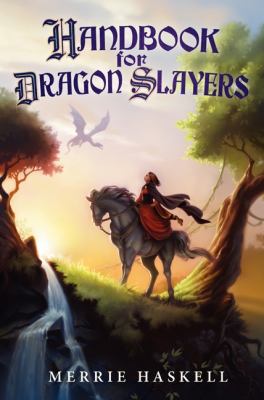
Handbook for Dragon Slayers by Merrie Haskell.
I really liked Haskell’s first book, The Princess Curse, so naturally I wanted to read this one as well. It’s also been nominated for a Cybils in Middle Grade Speculative Fiction.
Princess Tilda is the heir to a tiny principality on the Rhine. Her mother rules since her father failed to come back from the Crusades, and tries to train Tilda in her duties as well. But Tilda would much rather be a nun and have the time to devote all day to becoming a scribe. One day she hopes even to write her own book, instead of just copying old ones. She has a lame foot, and is very sensitive to the people in her kingdom who take this as a sign of demonic affliction.
Tilda and her maid, Judith, are visiting a neighboring castle (where Tilda’s crush Parz just happens to be squired.) Then Tilda is kidnapped by her cousin Ivo, who already has her mother captive and plans to take over their kingdom. Though Parz and Judith rescue her the same night, Tilda, in a somewhat hard-to-accept way, is inclined to just give up her kingdom. After all, Ivo isn’t deformed – maybe she can just join a convent and have the life she always wanted.
Before breaking that news to her companions, though, they decide to do a little dragon hunting. This will help Parz gain some points with his knight, as well as giving Tilda a topic for her very own book. Naturally, hunting dragons with a small and untrained party of three turns out to be more dangerous than they’d realized. Dragons turn out to be not what they’d thought. And Tilda has soon gained the attention both of the Wild Hunt and of the wicked Sir Egin, a Bluebeard-type knight beside whom Cousin Ivo seems endearing.
It will take a good deal of persuasion from loyal Judith, Parzival, as well as a dragon who ends up helping her for Tilda to work up the gumption to try to reclaim her kingdom and decide not to let her lame foot define her. It’s a story of resilience, transformation and love, in a beautifully detailed medieval German setting.
There are still some weaknesses to the book, however. Tilda is somewhat frustrating in her willingness to let other people push her around in the first part of the book, and it takes a bit for the plot to heat up. There is not as much dragon hunting as readers might hope for from the title. And Judith – Judith I never felt I knew as well as I felt I should, considering the book has only three main characters. But I can’t decide if this is a weakness in the book, or if Haskell is making a deliberate point here: while Tilda doesn’t like that people don’t see past her foot, she also doesn’t see past Judith’s station in life. Tilda may tell Judith everything about her own life, but she doesn’t try to learn as much about Judith.
These things aside, I very much enjoyed this book. I’d recommend it for readers of about 10 and up, looking for a fantasy story focusing more on character and setting than on action.
Delilah Dirk and the Turkish Lieutenant by Tony Cliff. First Second, 2013.
Constantinople, 1807. Lieutenant Erdemoglu Selim first meets Delilah Dirk in prison, when he takes her official interview. She’s in for trespassing. Miss Dirk is an adventuress: half English, half Greek, all trouble-maker. When she escapes quite handily shortly afterwards, Selim ends up being blamed. Miss Dirk is not wandering aimlessly: she plans to steal loot back from the evil pirate captain Zakul, whose depredations have made life difficult for her struggling merchant uncle.
There are lots of fun action scenes, reminiscent to me of the Three Thievesbooks, but here they are punctuated by quiet conversations between Mr. Selim and Miss Dirk on board ship or around a campfire in the wilderness, where they discuss things such as good quality tea and the relative merits of city versus wilderness living. Always, the reader wonders where Mr. Selim will find his next cup of tea and if he will survive making the acquaintance of Miss Dirk.
The story is drawn with angular lines and fluid faces, making for a very fun story. My love and I both found historical quibbles – he thought the boat looked much too late period, though he withdrew his objections when it started flying. I thought Delilah Dirk’s outfit resembled nothing historical and was wildly improbable. It’s a fantasy adventure, so we let these things go in favor of enjoying the ride.
I’d recommended that the teen librarian buy this for her graphic novel collection, based on the large number of good reviews I was seeing of it. It’s been going out gangbusters here, and deservedly so. It’s also been nominated for a Cybils in the graphics category, though for kids rather than teens. It could go either way, really. There’s some cartoony violence and nothing really sexual, but the characters are all adults. Comic publishers like to publish things as “all ages”, which makes things difficult for libraries with separate shelving areas, but this really is one that would be fun from at least third grade up through adults.
This is one that I asked my library to buy so that I could read it, based mostly on Charlotte’s recommendation, and especially because it sounded like a good boy fantasy.
What We Found in the Sofa and How It Saved the World by Henry Clark. Little, Brown and Company, 2013.
River and Freak are always best friends; Fiona only talks with them while they all wait for the bus, before anyone else can see them. But the morning an old, claw-footed sofa appears next to their school bus stop, something is put in motion that brings them together in ways they never expected. We’re talking teamwork – this is middle grade fiction.
It feels like our time, our world, and not a particularly cheerful corner of it. All three of our kid protagonists have lost at least one family member, and their subdivision is nearly empty because it borders an underground burning coal seam, which leaks toxins into the air and sometimes sets nearby houses on fire. But this is just the backdrop, and in the foreground we have a talking, tessering sofa, frequent flash mobs featuring everyone around except River and Freak breaking out into numbers from classic musicals, and a rare zucchini-colored crayon.
The sofa turns out to be part of a computer named Guernica, more or less run by their eccentric neighbor, Alf, who turns out to be the only person trying to stop a total takeover of the earth by aliens from another dimension. These aliens usually look like humans, and have been working on their scheme to turn the residents of this small town into mindless factory workers for half a century, making processed food and giving away cell phones that let them control minds. Because they view kids as even less worth noticing than adults, the kids are a central part of Alf’s plan to defeat the Disin Corporation. But how far can they get, and is a rare World War II crayon really bait enough to lure a criminal mastermind into revealing himself?
This is really just about perfect fiction. The kid protagonists, mystery, humor, and lots of close escapes make for a story that will suck in even reluctant readers, while environmental themes and character growth give it some heft and depth. My son was definitely interested in it as I was reading it; my only quibble with it is that at 355, it’s a little long for him just yet. Still, I’d say he’s just on the lower edge of the age range for this book. More advanced readers and those in the middle or top side of the middle grade range should do just fine, and will love it.
What We Found in the Sofa and How It Saved the World was nominated for the Cybils award, and so counts for my Armchair Cybils reading.
This book came recommended by my friend Annette over at The Stars Are Not Made of Fire, who knows the author through her writing group. She told me the book went unexpected places, and I have to agree.
When the Sea is Rising Red by Cat Hellisen. Farrar Straus Giroux 2012.
Felicita is a teen heiress, younger sister to the man who rules a major port city in a world with a late-19th century feel. The ruling class rules because of the magic it controls, a genetic magic that’s only activated when members of the magic-bearing aristocracy take scriv, a very expensive and highly addictive powder. But though Felicita is given enough scriv to become addicted, she’s never given enough to do anything really powerful, nor is she trained to use her magic. Among the upper class, women are valued only as brides and mothers of male heirs.
Felicita had hoped to go to university for at least a couple of years, but when her best friend commits suicide after an unwanted engagement, Felicita’s mother and older brother decide to marry her off instead. Something snaps, and Felicita fakes her own suicide, running away to the dock-side slums and dying her tell-tale naturally red hair a doxy-bright red to cover it up. In the slums, she falls in with a group of young revolutionaries, led by the handsome and charismatic hob Dash. For the first time in her life, she’s working for a living, washing dishes at a tea house frequented by poets. She’s also being courted both by Dash and by a young vampire, Jannik, who knows who she is and who bonds with her over their mutual family difficulties. Vampire society is the mirror image of the aristocrats, with queens ruling the hive and young males considered disposable.
While Felicita is engaged in self-discovery, things in the larger world are not going well. Her friend’s suicide seems to have called a dark magic from the sea, one that threatens to bring up a red tide that’s dangerous both to marine life and to the people who make their living from the sea. Public sentiment, too, is rising against the ruling aristocracy – Felicita’s family. Very soon, Felicita will have to choose between her family and her new friends.
I was very impressed with Hellisen’s work here, putting some common teen elements together into something quite unexpected. This is complex, layered, and thoughtful in a way that made it very hard to put down. Felicita may be sheltered and ignorant of life outside of her circle, but she works hard to keep her head. Even the two men that could have felt like just another love triangle – it didn’t even register as a love triangle to me until after the fact. There was so much going on that I now want to go back and re-read, just to see what I might have missed the first time around. This is one for teens and up, with plenty of appeal even for adults who (unlike me) don’t normally go for YA.
This felt like a fine stand-alone novel, but looking it up, I see that a sequel, House of Sand and Secret was just published last month, in ebook only.
March. Book 1. by John Lewis, Andrew Aydin, and Nate Powell. Top Shelf, 2013.
African-American Senator John Lewis tells the first part of the story of his life, including his childhood and his collegiate activities with the Civil Rights Movement up to the March on Washington, in this graphic memoir. It’s told with a frame story of the senator getting ready to give a speech at Obama’s first inauguration, but pausing on his way to tell his story to two young boys who come to his office to meet him. I read in an interview that Lewis decided on the graphic format for his memoir because one of the key pieces of instructional literature that was passed around during the early days of the Civil Rights Movement was a comic book on the methods of non-violent resistance.
Lewis was a key player in the Movement, taking part in department store sit-ins, training people in nonviolent resistance, and participating in bus boycotts. While of course I’ve read about the movement – it feels like mostly (deservedly) worshipful juvenile biographies of Martin Luther King Jr. and Rosa Parks – I don’t think I’d ever before read a first-person account of someone involved at the grassroots level. Maybe the difference is that the other biographies are focusing on how special the individual was? Here, the spotlight is on the belief and dedication of all the people involved, even as it’s told from the perspective of one person. It’s an inspiring story, and the pictures really brought the story to life. Nate Powell is an acclaimed graphic novel artist in his own right, and it shows. The ink and watercolor pictures combine feeling with historical accuracy, while still keeping characters recognizable.
This is a challenging topic for a graphic novel – while the Civil Rights Movement is rightfully taught in schools, the first-person perspective and the graphic format could easily have made for a book with too much violence to be appropriate for kids. However, it’s very thoughtfully put together – while the text is clear that nonviolent protestors were treated violently, the violence is described briefly and matter-of-factly in the text but not shown in the pictures. While you’d probably still not want to hand it to a first-grader, I’d say this is appropriate for children old enough to really learn about what this period of history involved, about 10 and up, depending on the child. It has been nominated for the Cybils in the Elementary/Middle Grade Graphics category.
The book has a cover blurb from Bill Clinton, and was getting publicity lots of big places. We have copies here at my library in both adult and teen, figuring there’d be a lot of demand for it. So far, unfortunately, there hasn’t been, but I’m hoping that it will build momentum as time goes on. This is a deeply moving and important piece of American history.
Look! Another case where I finished a book and checked out the sequel right away.
In Armchair Cybils news, I put together a list of all the Cybils-nominated books I’ve read in the four areas I’ve decided to focus on: Middle Grade and YA Speculative Fiction, Graphics and Picture Books. This is a continuation of my life-long inability to focus on just one thing. I note that without planning anything, I’ve read 9-10 nominated books in each of my four categories.
Wisp of a Thing by Alex Bledsoe. Tor, 2013
Wisp of a Thing is set in the world of the Tufa explored in to The Hum and the Shiver. It’s not quite a sequel, as Bronwyn, the main character from the first book, hardly appears at all. Instead, Bledsoe introduces a new main character, while expanding on themes and the stories of side characters from the first book.
Rob Quillen was a star on the reality TV show “So You Think You Can Sing” who gained even more national fame when his girlfriend, Anna, tried to fly out to surprise him and was killed when her plane crashed. It’s a kind of fame he never wanted, and when a young musician in an Elvis-style suit tells him that a Tufa song and words carved in stone could help him with his grief, he heads straight for Cloud County, Tennessee.
Rob isn’t Tufa, but part Filipino (part Filipino! That’s my love’s heritage, and I don’t think I’ve ever read of a protagonist with it before.). Still, part Filipino looks a lot like Tufa, so he’s able to get farther with his explorations than someone with obviously non-Tufa looks would, even though no one knows the answer to his question nor who could have sent him. He meets a crazed, wild girl named Curnen and her sister Bliss Overbay, the deputy for young Mandalay, the head of one of the two Tufa factions. We know Bliss from the first novel; it’s a question how much of the Tufa secrets Rob will learn.
In the first book, a handsome Tufa man named Stoney with a distressing tendency to date and drop young women, leaving them in despair so great they often commit suicide. That was just mentioned in passing, an example of the kind of behavior and disregard of non-Tufa held especially by those of the other Tufa faction, led by old Rockhouse. Now Rob sees the devastation Stoney causes in the lives of two women close-up: Berklee, the wife of a friendly local who had a brief fling with Stoney before they were married, and now drowns her feelings in alcohol; and Stella, another resident at the hotel where Rob is staying. But while locals are inclined to stay out of other people’s business, Rob can’t seem to stop himself from trying to save the troubled people he meets, even when it puts him in danger.
The first book was told primarily from the point of view of Bronwyn, herself a Tufa. Rob is somehow able to see things that only Tufa should be able to see, and so notices things that weren’t remarkable to Bronwyn. This continues a question that Bronwyn herself brought up in the first book: being Tufa is considered something you’re born to. In the first book, we saw Tufa people who had stopped listening to the Night Winds. Now, the story looks more seriously at the role of the Night Winds and the possibility that people not born to the Tufa might be able to hear them.
As before, this is a dark fantasy, filled with cursed women and haunting music; this time mostly original lyrics rather than the folk tunes used in the first book. It’s a lovely blend of character, drama and setting that would be perfect if you’re looking for something a little spooky to read for Halloween.
The Last Enchanter. The Celestine Chronicles Book 2 by Laurisa White Reyes.
In the prologue of this book, we see the old king being poisoned by a trusted advisor. Then, the main story starts with young Marcus, taking care of his grandfather’s goat in a remote mountain village. His grandfather is the enchanter Zyll, and Marcus is also his apprentice. Zyll has a vision of the treachery at court, while Marcus has a vision of Zyll lying bloody and dying. This last vision is especially rare, as it shows that Marcus has the rare talent of seeing visions of the future, not just the past and present as most enchanters do. Clearly, it’s time to head for the capital, where Marcus’s older brother is heir to the throne so recently left vacant. His friend Clovis comes with Marcus (Zyll having travelled ahead) as does a girl named Lael, who’s escaping an abusive father and looking for her mother, and Bryn, a shape-shifting groc who prefers to take the shape of a little boy. Marcus’s mother, Ivanore, is also missing, though she appears to him in visions and seems to be leading him towards finding powerful magical artifacts.
There’s a lot going on in this book. Part of it was confusing to me because I hadn’t read the first book and events from the last book were not summarized here. It’s a challenging balancing act, trying to get readers up to speed, whether they’re starting in the middle or trying to remember the last book. I felt there was some critical information that I didn’t figure out until well into the book that would have been very helpful earlier on, like knowing that Zyll’s annoying bird sidekick, Xerxes, is wooden, and that Marcus’s father Jayson is a cat-person, not just a human oppressed minority. But there are a lot of plot lines going on in this book, too, a quest story with three or four different quests going on simultaneously.
While I found Marcus and Lael generally likeable, nice kids, there were some character things that didn’t quite make sense to me. Marcus first urges for the party to include Bryn the groc and for everyone to treat him fairly – they had gotten to know each other in the previous book. Then Lael comes along, and suddenly Marcus no longer thinks of Bryn as a real person and has to learn to do so from Lael, whose polished and feminine table manners he also admires. While I appreciate having a girl in what was clearly a previously all-boy story, it felt like Marcus was being set up to be improved by a Feminine Touch, Victorian-style. Clovis leaves to go back home partway through the book when Marcus tells him to, even though no one but Marcus is convinced that that’s the right thing to do. That felt very odd, and could be potentially jarring for readers who were fans of Clovis from the first book. And, when they reach Marcus’s brother in the capital, he is remarkably unwilling to listen to them. There are also some very brief discussions of a trade in indentured servants which felt unresolved.
While the characters didn’t quite work for a character-focused reader like myself, and kids will probably be better off starting with the first book in the series, there are still plenty of readers for whom this book would be thrilling. Stories of children who find out that they have hidden powers that they need to use to save the world always have a place. This one, filled with magical creatures, enchanters, and princes in danger, and told in very short, action-filled chapters, is especially good for reluctant boy readers in the upper middle grades.
This book was very kindly sent to me by the author in exchange for an honest review and participation in the blog tour, and was nominated for a Cybils award in the middle grade speculative fiction category.
In Book I, THE ROCK OF IVANORE, enchanter’s apprentice Marcus Frye and five other boys set out on a dangerous journey to locate the Rock of Ivanore and bring it back to their village.
In THE LAST ENCHANTER, months have passed since they succeeded in their quest. One of the boys, Kelvin, is living as royalty in Dokur, and Marcus is studying magic with Zyll. When Lord Fredric is murdered and Kelvin becomes king, the Enchanter Zyll and Marcus head for Dokur in hopes of protecting Kelvin from meeting the same fate, though it quickly becomes apparent that none of them are safe, and Marcus has had disturbing visions of Zyll’s death. With the help of his old friends Clovis and Bryn, joined by new friend Lael, a feisty girl in search of her mother, Marcus uncovers a powerful secret that will change the course of his life forever.
In addition to THE LAST ENCHANTER being released on OCTOBER 15th in hardback,THE ROCK OF IVANORE is also now available in paperback! Both titles can be purchased at bookstores nationwide and online at Barnes & Noble, Amazon, and Indiebound. They are available as E-books, too.
To celebrate the release of her newest book, author Laurisa White Reyes is giving away a brand new 16 GB NOOK HD!!! Details on how to enter the giveaway can be found at the end of this post. In the meantime, please enjoy this excerpt from THE LAST ENCHANTERfollowed by an interview with the author, Laurisa White Reyes.
Marcus waited until he heard Zyll turn the lock in his door before heading back down the corridor. Zyll had told him to do what he thought was best, and that’s exactly what he would do.
He passed several armed sentries, one at every door, as he made his way through the lower level of the Fortress. Kelvin was determined not to let the Agoran rebels get inside again. Maybe Marcus shouldn’t worry about his brother. With all these guards around, Kelvin was far safer than Fredric must have been. Still, he deserved to know how their grandfather died. Secrets had nearly destroyed Marcus and Kelvin’s relationship during their quest eight months ago. There would be no secrets between them ever again.
Marcus didn’t want to go back to the dining room. Kelvin and Jayson were probably still arguing over dinner, and what Marcus had to say was private anyway. He would go instead to Kelvin’s council chambers and wait for him there.
Other than the sentries, the interior of the Fortress was quiet. Most of the servants had already retired to their rooms for the night. Marcus hurried across the vast entry hall toward the east alcove where the offices were located. He had made it halfway when he suddenly had the feeling that he was not alone.He turned and looked behind him, but there was no one beside the guard standing at the Fortress’s main door. The light from several oil lamps left the corners of the room hidden in darkness. Someone could easily conceal himself in one.
This is silly, Marcus thought. I’m letting my mind play tricks on me. Still, he walked the rest of the way as fast as he could without actually running.
The door to Kelvin’s council chambers stood just inside a narrow alcove. To Marcus’s surprise, the sconces on the wall were not lit. The alcove was dark except for a weak glow from the lanterns in the great hall.He had expected to find a guard here, too, but the alcove was empty—or was it?
Near the door to Kelvin’s chambers Marcus saw a large, dark clump of something on the floor. He approached cautiously and touched it with his foot.An arm fell forward, hitting the floor with a dull thump. Marcus stepped back, his breath quickening. The dark clump was a sentry. In the dim light, Marcus couldn’t tell if he was unconscious or dead.
Behind him, Marcus heard the sound of footsteps which stopped abruptly.
“Hello?” Marcus called out hoping it was one of the other guards. “There’s a man here,” he said. “I think he’s hurt!”
When no one replied, Marcus realized once again that his imagination was running away with him. But he did need to find help for the sentry. He was about to leave when he heard a new sound coming from inside the chambers: an unmistakable rattle as if something had fallen and rolled across the floor.
Marcus stepped over the guard’s body and took hold of the door handle. Slowly he turned it, pushing open the door just an inch. Candlelight spilled through the narrow crack into the alcove. Marcus saw now that the sentry’s eyes were open, staring dully up at nothing. He was most certainly dead. And Marcus suspected that whoever was inside the room had done it.
Pushing the door open a little further, Marcus stepped inside. Large tapestries hung floor to ceiling against the walls. Three stories above, the stained glass ceiling looked like a patchwork of black and gray. Charred remains of a log stood cold in the fireplace, though six candles burned in an ornate candelabra beside Kelvin’s desk. On the floor lay an ink bottle, dark liquid trailing from it like a tail. This must be what had made the noise. Marcus bent to pick it up. The glass bottle felt warm to the touch.
The air in the room was chill. So why would the bottle be so warm? Someone must have been holding it, Marcus thought, but who?
As he set the bottle back on the desk, he noticed movement from the corner of his eye. A tapestry fluttered ever so slightly. Marcus’s heart raced. He reached for his knife, but then remembered he had left it in his room for he had thought he was just going to talk to Kelvin. What would he have needed it for? He reached for the tapestry with trembling fingers and jerked it aside, but the only thing behind it was a bare wall.
All of sudden, something heavy hit him from behind. Sharp pain exploded across his shoulders, and Marcus’s face smashed into the wall. He felt drops of hot blood trickle onto his lips. Licking them, he tasted copper, and he wondered if the loud crack he’d heard had been his back breaking or something else. He turned and saw Kelvin’s chair in pieces behind him on the floor. Someone had thrown it at him! He had only a second to think before something else came flying at him, but this time it was a man.
The man yelled. Marcus caught the glint of a blade in his hand just before it came down on him. Marcus twisted away just in time, the blade grating instead against the stone wall. But the man did not stop. He sliced his dagger wildly in every direction. Marcus jumped and slid his way across the room, doing his best avoid the attacks. The man was slender, almost frail-looking, and yet was surprisingly fast and strong. He lunged at Marcus, not with the dagger, but with a set of blood-stained claws extended for the kill. It wasn’t a man at all, Marcus realized. It was an Agoran.
Marcus grabbed the candelabrum. As he swung it in an arc, the candles flew off. Two went out as they hit the floor, but the other four stilled burned, casting long, unnatural shadows onto the tapestries. One lit the corner of a tapestry on fire, the flames soon licking the woven patterns like a hungry snake. The candelabrum hit the attacker with a force that would have knocked most men to their knees, but this one didn’t even flinch. When the Agoran took hold of it, Marcus expected him to yank it out of his hands. Instead he thrust it forward, pushing Marcus off balance. He fell onto his back, sending a fresh tremor of pain through him. A second later, the attacker was on top of Marcus, holding the point of a blade to his throat. Damp tendrils of long, shaggy hair clung to his face. His pupils, narrow like a cat’s, peered at Marcus, recognition slowly dawning.The Agoran and Marcus stared at each other, both remembering the day months earlier when they had first met.
Just then the door to the chamber flew open. A guard rushed in, his sword raised. Behind him came Kelvin and Jayson. The Agoran leapt off of Marcus and crossed the room in half a breath’s time. The guard ran after him, but the Agoran tore the burning tapestry free from the wall and flung it at him. The guard screamed in pain as fire engulfed his uniform. The tapestry dropped to the floor, the flames trapping the Agoran at the back of the room. Marcus managed to roll clear of it, though he felt his skin blistering with the heat and smelled the guard’s scorched flesh.
Jayson ripped the burning fabric from the guard’s body as Kelvin picked up his fallen sword. Kelvin slashed at the tapestry, trying to make a path through the fire. As he broke through, Marcus looked up to see what would happen next, but to his and everyone’s surprise, the Agoran was gone.
INTERVIEW w/ LAURISA WHITE REYES
What books influenced you most when you were growing up?
My favorite series for years was the TRIXIE BELDEN MYSTERIES. I still have the entire set of books in a box in my garage. Some of my other favorites included ROBINSON CRUSOE, OF MICE AND MEN, GONE WITH THE WIND, WUTHERING HEIGHTS and ROOTS. Heavy duty stuff for a kid, I know, but I loved them. Still do. As an adult I learned more about writing from Dan Brown (THE DAVINCI CODE, ANGELS & DEMONS) than anyone else. He is a master of suspense, every chapter a cliffhanger so that you just can’t put his books down. Period. And I love how he weaves multiple points of view together until they all collide at the end. I wish I could write like that.
What gave you the idea for your book series The Celestine Chronicles?
I’ve always enjoyed reading to my kids at night before they go to bed. When my oldest son was about 8 years old, he asked me to make up a story instead of read one. So I told him about an enchanter’s apprentice who botched his spells. Each night my son would tell me what he wanted to hear that night, whether it was dragons, or magic, or sword fighting, and I’d weave it into the story. Eventually I started writing it down. A year later I had a completed manuscript of THE ROCK OF IVANORE. I wrote THE LAST ENCHANTER two years later.
What is your writing day like?
I don’t have a typical writing day. As a mom of five kids, I actually have very little time to write. Years ago I used to stay up late at night to write, but I now I try to wake up an hour before the kids do and get a little work done then. On a good day I might write 1,000 words — the equivalent of about 5 printed pages.
Who are your favorite characters in THE LAST ENCHANTER?
That’s a tough question. While I like all the characters (I wouldn’t write a character I couldn’t like) Lael is new to this book. She wasn’t in Book I. Lael is Marcus’s age but wasn’t included in the original quest because she is a girl. She really proves herself, though. While the boys use swords and bows and arrows, Lael is adept with the sling. Also, Bryn (the Groc who parades around in the form of a little boy) is particularly fond of her. And any friend of Bryn is a friend of mine.
Will there be a book III in The Celestine Chronicles?
Yes. The Seer of the Guilde is tentatively slated for 2015. However, in the meantime, I am working on the parallel series called The Crystal Keeper, which chronicles Jayson’s years in exile in Hestoria. Anyone interested in the story of Jayson and Ivanore will want to read it. In the meantime, I hope everyone will enjoy THE LAST ENCHANTER.
GIVEAWAY TIME!!!
Laurisa White Reyes, author of THE LAST ENCHANTER,
is giving away a brand new
16 GB NOOK HD!!!
There are many ways to win:
1) Take a pic of you and your copy of THE LAST ENCHANTER – post it on the web (Facebook, Twitter, Pinterest, Tumblr, a website, etc.) and email the link to: laurisawhitereyes(at)yahoo(dot)com
2) Follow Laurisa’s blog and/or Facebook page
3) Tweet about this giveaway
4) Leave a comment below
The winner will be chosen at random via Rafflecopter.
Disclaimer: I received a copy of the book (soon to be donated to my son’s school library) and a pewter griffin medallion (already given to a young friend named Griffin) in exchange for being a stop on this blog tour. Good luck with your book, Laurisa!
Someday – maybe after my youngest is in school full time (that would be next year), I’d love to be an actual Cybils panelist. But since that isn’t in the cards right now, I was thrilled when Charlotte posted about the Armchair Cybils over at Hope Is the Word.
I’m a little late signing up, but I hope that’s OK. I have a shelf full of Cybils-nominated books waiting at home for me already (I think I have upwards of ten novels for me checked out right now) and will hope to find a little time to do some reading. I think the way it works is that I read all the books I can and write about them, and everyone who’s in the challenge checks in on the 15th of every month to discuss what they’ve read. I’m really looking forward to it!