The Girl Who Fell Beneath Fairyland and Led the Revels There

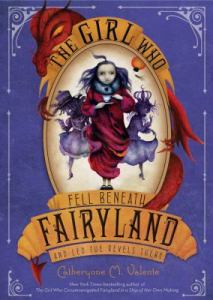
The Girl Who Fell Beneath Fairyland and Led the Revels The Girl Who Fell Beneath Fairyland and Led the Revels There by Catherynne M. Valente. Illustrated by Ana Juan

It’s over a year since our heroine September was last in Fairyland, as narrated in The Girl Who Circumnavigated Fairyland in a Ship of Her Own Making. It’s been a year of social isolation and anxious waiting for the Green Wind to come to take her back again. On her birthday, she finally finds a way back in – only to find that Fairyland has changed for the worse, and it’s all her fault. Her own shadow, the one she allowed to be cut off to save another child in the first book, has turned against Fairyland. Now, she leads other shadows from Fairyland Below as Halloween, the Hollow Queen of Fairyland Below. All sort of shadows are being stolen from the residents of Fairyland Above, and with it, their magic. September sets off to right things, heedless of the danger. In Fairyland Below, she meets the shadows of her old friends Ell the Wyverary and Saturday. The shadows are people in their own rights, normally forced to stay with their owners. On their own, the shadows are similar but with hidden and shown qualities reversed – the shadow of Ell is shy rather than bold and friendly, where the shadow of shy Saturday is much bolder. September travels with Ell and Saturday for some way, but they are not quite the same as their real selves, and she must eventually abandon them. The narrative is somewhat more unified than the last book, which felt very episodic, but September still meets lots of strange and interesting people with odd but set ideas – things like magical living Markets run by goblin Economics and quiet Physicks with the Night-Dodo Aubergine, who was quite a nice characters.

On the whole, the story feels darker and more serious than the first one. The whole story is told by a very intrusive narrator, about whom I had mixed feelings. On the one hand, having narrators with their own voices is a venerable tradition, and reminds me pleasantly of other such books, like the Chronicles of Narnia. On the other hand, this narrator is much more intrusive and possessed of very vocal and odd opinions. For example, a major theme of the book is that children are heartless – this was in the last book too – but that teens are just beginning to grow baby hearts. Perhaps Valente means something else by this, but it seems to me that what she means is that children are incapable of empathy. This is just patently false – even a toddler will try to cheer up a sad baby or parent. The narrator claims to be friends with the reader at the same time as blithely announcing that it is a sly narrator, and will therefore withhold significant plot details from us or September, so as to make things more interesting for us. This, frankly, is just irritating. Any narrator should have a better reason than that to withhold plot details. I find I can’t say, though, that I wish the narrator weren’t there, because that narrator is necessary for the feeling of the book. While my total reaction might be coming off as lukewarm, it’s not that it was a tepid book but rather that there were parts that I loved and parts that I was just less sure about. In any case, this is one that middle graders and those who like middle grade fantasy should enjoy.
Posted in books | Tagged | Leave a comment

Shall I Knit You a Hat?

Taking a break from knitting on my son’s Christmas present to write about this sweet Christmas picture book featuring knitting!

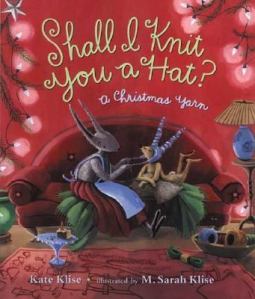
Shall I Knit You a Hat?Shall I Knit You a Hat? by Kate Klise. Illustrated by M. Sarah Klise.
When Mother Rabbit hears that a giant blizzard is expected for Christmas Eve, she knits Little Rabbit a hat to keep his long ears warm. He loves it so much that he asks if they can make hats for all their friends. They go out to the Market together, where all their friends are, and find sneaky ways to measure them all – the horse, the dog, the goose, the cat, the squirrel and the deer. Then they go home, where Little Rabbit takes the lead in designing the hats. He puts great effort into making hats just right for each friend, but of course, as Christmas is only a few days away, they can’t be all knit, and incorporate some household objects along with the knitting. Oh, the looks on the poor animals’ faces when they first see themselves in the mirror that Little Rabbit brings along with the gifts. Soon, however, it starts to snow, and all the animals realize how warm they are despite it and how perfectly suited the hats are to them. The bright acrylic illustrations make the story even cozier. This is a wonderful story of friendship and generosity, yarn and carrot cake for Christmas. It’s a little wordy for toddlers, but perfect for preschoolers through early elementary – both of my children are loving it this season.

Disclaimer: this book is one of the many books that my children were given when my daughter was in the hospital with her liver transplant two years ago. A hospital perk, as Hazel of The Fault in Our Stars would say. We were given autographed hardcovers of several picture books that the Klise sisters left for the hospital to give away to sick kids and their siblings after their visit.

There are several more books about Little Rabbit, including

Why Do You Cry?
Imagine Harry
Little Rabbit and the Night Mare
Little Rabbit and the Meanest Mother on Earth

And newly published this year in a similar vein, Grammy Lamby and the Secret Handshake.

Posted in books | Tagged , | Leave a comment

Geek Mom

It’s like early Christmas when I ask the librarians to buy something for me, and it shows up on the hold shelf for me. This was purchased by our lovely craft librarian.

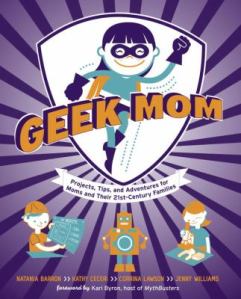
Geek MomGeek Mom by Natania Barron, Kathy Ceceri, Corrina Lawson and Jenny Williams.
Geek Mom is a blog on Wired Magazine, related to the Geek Dad blog. Geek Dad the book came out a couple of years ago (my love got it for Father’s Day, and there are two others that we don’t have), and now there’s also a Geek Mom book. This, too, is full of projects and ideas for geeky parents, but written by the moms. It looks like I never reviewed it, and my memory is a bit hazy, the projects in that book looked awesome, but maybe requiring a bit more oomph in the supplies acquiring and time setting aside than we usually have. Geek Mom has more crafty, cooking and reading adventures than I remember from Geek Dad. There are still projects that involve electronics, explosions and computers, so don’t go thinking that being from moms makes the projects less cool in any way. There is the occasional fun sidebar, with topics like “10 Geeky Instruments We Wouldn’t Want to Live Without”. The first five were the accordion, ukulele, theremin, keytar, and Moog synthesizer. I will note that the lute made the list, but the harp did not. Their Imagination chapter includes making a secret lair, steampunk and superhero costume ideas, learning about history through comics, exploring fandom with kids, and roleplaying with kids including recommended roleplaying systems. Here my love opines that the Icons gaming system is much more kid-friendly than the Mouse Guard system they recommend, which is based on cute comic book mice but not especially simple. The Curiosity and Learning chapter includes lots of preschooler-friendly ideas, which can be tricky in books like these. It includes things like cartography, hosting a time travel party, topology, and linking classical and rock music. “Mothers and the Digital Revolution” covers a host of computer-related topics, including internet safety, screen time limits, website building, a history of computers (going back to when it was a job title!), and using tech for fitness. “Science at Home” has a lot of very fun projects, including self-propelled boats, a DIY lava lamp, a blob, making plasma in the microwave (only for use with microwaves you’re willing to risk losing) and much more. They use borax crystals to make a Cthulu rather than snowflakes. “Food Wizardry” includes directions for fixing a hobbit feast, catching wild yeast for sourdough bread, and a tetris cake and cephalopod cupcakes. Also, an essay on the pleasures of loose tea – yum. The sewing and crafting chapter includes felt monsters, a crocheted amigurumi, natural tie-dye, battery-operated LED sculptures, and electric component jewelry. (Didn’t you make jewelry out of the resistors in high school physics?)

That was a very long list, and at that, just a sampling of the many cool projects. They are clearly described, with cost, age, time, and difficulty given at the start of each. Most of the projects are in the $5 to $10 range, with some more expensive and some with ranges depending on how much you want to put into them. The projects start working from about age 3, and some would be interesting up through the teen years, but most are aimed at elementary school aged kids. Yes, there were a few projects that I wasn’t interested in myself, some advice I didn’t quite agree with, but not enough to outweigh the many good ideas. This is an approachable book chock full of appealing ideas for active families to have all sorts of geeky fun together.

Posted in books | Tagged , | 1 Comment

Goblin Secrets

Steampunk fantasy for kids in an entirely fictional city – and it won this year’s National Book Award. I checked it out with a bunch of books before it won the award, and had forgotten I had it by the time the awards were announced.

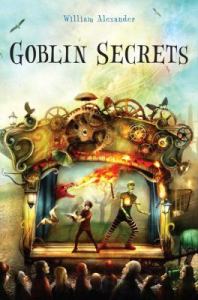
Goblin Secrets Goblin Secrets by William Alexander.
Rownie doesn’t have much memory of time before he was one of Graba’s gang of children. Graba feels like a sister to Baba Yaga, with a house that moves around on its own around the city of Zombay, though the chicken legs are clockwork and on her rather than on the house. She has a flock of unwanted, hungry children, most of whom don’t even know their real names. Rownie’s own name, as the one girl with a real name, Vass, tells him, is just a diminutive of Rowan, his missing older brother. Rowan disappeared some months ago after taking part in a play, which it is illegal for humans to do. For masks are magic, and only goblins, who are Changed from being human, can count as not-human enough to perform plays. As our story opens, a wagon of goblins comes into town. So desperate is Rownie to see their play that he buys a ticket with Graba’s money. Then he is desperate enough to ask the actors about his brother. And then Rownie is in trouble. He acts on the stage, without being Changed – and the Guards, with terrifying gears in their eyes, are after him. He has stolen from Graba, and Graba is after him. In desperation, he turns to the goblins, who take him in and treat him kindly despite their alarming appearance. The goblins are also concerned about Rowan, whom they said was a fine actor.

The actors wear masks, and the masks have power, power to make people believe that the wearer is who the mask says they are, and also power to subtly change the world around them. As Rownie wears a mask to conceal himself, he feels the power of the fox running through him. And Rownie and Rowan’s safety is not the only issue – Graba and the Goblins both feel that floods are coming, that the river that runs through Zombay will soon overrun its banks and wipe out large portions of the city. The city itself is a character in the book, divided between the geometric streets where the wealthy live in their large, clean houses on the north side, and the teeming, tangled streets of South side, which Rownie knows inside out.

Though there are lots of steampunk elements, including clockwork horses that run on coal made from fish hearts, the city guards fitted with gears, and Graba’s mechanical chicken legs, these are not the focus. This is a story of a search for belonging, of the power of words and belief to change the world, and the importance of trust and care. Rownie’s story is definitely an adventure, but it’s one with heart, and it’s the humanity of it that makes it so magical, at a level that works for both kids and adults.

Posted in books | Tagged , | 1 Comment

The Scrapbook of Frankie Pratt

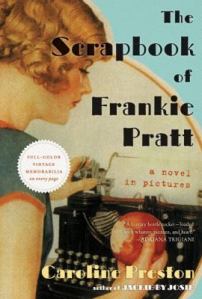
Scrapbook of Frankie PrattThe Scrapbook of Frankie Pratt by Caroline Preston.
This is a novel told as a scrapbook, telling the story of Frankie Pratt in her own words. We follow her life for eight years, starting with her graduation from high school in 1920. Her Corona-typed captions narrate pages filled with vintage pictures, postcards, and some photos. Frankie really wants to be a writer, but is helping to support her widowed mother by working as a caretaker for an elderly neighbor. That neighbor’s son, more than a decade older than Frankie, is the shaky but handsome World War I veteran Jamie Pingee, towards on whom Frankie develops a crush. Soon, however, she’s sent to Vassar on scholarship. There she rooms with rich girl Allegra Wolf, and becomes her protégé, also befriending Allegra’s brother Oliver. As well as wanting to be a writer, Frankie is an avid reader, and one realizes afresh just how much was going on in the 20s as Frankie discusses the hot new writers of the day – so many of them still famous today. There’s even a life-changing conversation with the poet Edna St. Vincent Millay (Vassar 1917), whom Frankie meets through her work as the editor of Vassar’s literary magazine. Following graduation, Frankie spends two years in Greenwich Village and two in Paris, always trying to further her career. She’s in Paris when the Eiffel Tower is the tallest building in the world and witnesses Lindbergh’s landing there before she must return home to care for her mother. All through the book, Frankie shares her trials at romance, her various friendships and fallings-out with girlfriends, and notes on the fashions and momentous events happening around her.

This barebones plot outline doesn’t do much to convey how very well this all works together. This is a graphic novel really, though it doesn’t seem to have been sold as one. Usually, though, a graphic novel has an artist or team of artists who can work to provide a unified feel for the artwork, and show the characters and their surroundings to fill in for the physical descriptions you’d find in a prose novel. This book didn’t have that option. The words are few, and the story is told through vintage ephemera – meaning there’s some sense of style there just in the time period it was put out, but that Preston had an editor’s control rather than an artist’s. The author must have spent hundreds of hours combing through vintage pictures and postcards looking for just the right ones to tell the story, and the efforts paid off. Despite very limited text and the lack of control over the pictures, Frankie and her companions come through loud and clear as real people. The presentation makes this a good choice for people who wouldn’t normally go for graphic novels, as there’s neither the cartoon-like feeling of traditional comic artwork nor the difficulty of decoding traditional panels for those new to it. Fans of historical women’s fiction and/or paper crafts will fall in love.

Posted in books | Tagged , | 2 Comments

Circular Knitting Workshop

Mittens were the first thing that I wanted to knit when I took knitting up again as an adult almost a decade ago. That means I’ve been knitting in the round for a really long time. I wouldn’t have taken this book home if it hadn’t been for Kelley Petkun’s recommendation on the KnitPicks Podcast.

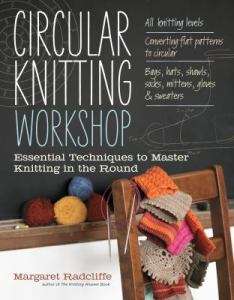
Circular Knitting WorkshopCircular Knitting Workshop by Margaret Radcliffe.
This is a big book with in-depth coverage of my favorite way to knit, in the round. The title says that it’s a workshop, and it’s really laid out that way, first introducing basic circular knitting techniques and then knitting small-sized samples of things beginning with bags and hats and working up to socks, mittens, and sweaters. All the patterns use Lorna’s Laces yarn, a brand I’ve often heard of and never tried. Radcliffe starts with showing how to do circular knitting on double-pointed needles, circulars, or one or two extra-long circulars. She has lots of advice on how to solve standard problems like twisting stitches when you first join the round or ladders between needles. Just as an example of how detailed the coverage is, she includes three ways to get jogless stripes, avoiding the visible stair step when you change colors in what is really a big spiral. There are also instructions for the trickier problem of avoiding visible joins with lace or texture patterns. She introduces a technique I’d never heard of called helix knitting, for knitting with two colors continuously. Once you get to the pattern sections, while everything is tiny and presented one way, she includes instructions for knitting every pattern both top-down and bottom-up, along with why you might or might not want to do it that way. Each also tells you how to adapt the pattern for different yarn and sizes that the original, so you could knit a full-sized garment. My favorite hat was a purple witch hat that started with a bit of i-cord and worked its way down in a spiral with just one increase a round. The sweater section includes all the basic sweater types – raglan, set-in sleeve, yoked – as well as how to turn pullovers into cardigans via steeks – and, utilizing those steeks, a very cool helix-knit sweater knit side to side, so the little stripes end up vertical. There’s a lot in here even for the experienced knitter, both in the new techniques and the problem-solving. Beginning knitters working their way through the book will not stay beginners for long.

Posted in books | Tagged | 1 Comment

Counting to Christmas

Yesterday, I linked one of my very first holiday book posts up to holiday book round-up at What Do We Do All Day. I realized a) that my holiday posts seem to very poorly tagged, which is bad for me remembering how to find the books to take home from the library again, let alone any readers and b) I’ve never reviewed this, which we bring out and love every year.

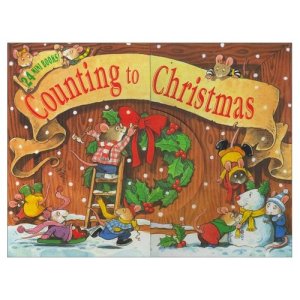
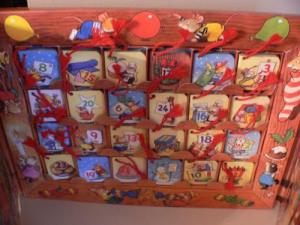
Counting to ChristmasCounting to Christmas by Gillian Chapman. Illustrated by Peter Stevenson. (2001) This is an Advent calendar with 24 tiny board books, each with its place in the cardboard tray and a loop to hang it on the Christmas tree. When all the books are pulled out, a larger picture is revealed underneath. As you can see from the cover, all the books feature the same group of active little mice, every day doing something different to get ready for Christmas. They make their fruitcake, go caroling, write letters to Santa, wrap gifts, buy their holiday fruit, and pull crackers, among other things. As the books are 3 cm a side, the text is brief – often only a sentence or two per book. The illustrations, however, fill in the details to make each story funny. The sentence “While the cake is baking, the Counting to Christmas insidemice clean up” shows Papa mouse asleep by the wood-burning oven while the little mice pelt each other with flour and candied fruit. Singing “Silent Night” under a street lamp starts out reverently but devolves into a snowball fight, while “We Wish You a Merry Christmas” becomes raucous with the addition of more and louder electronic instruments. More than one year, I’ve used the little mice to keep my own holiday planning on schedule. It’s a British celebration of Christmas, though more by the British Christmas traditions than any potentially confusing vocabulary.
This is out of print, though I was able to find several reasonably priced copies on the Amazon Marketplace. I bought this for myself before I had children at all, but my children love it. My three-year-old will spend twenty minutes at a time looking at all the little books, and more than once a day at that. The eight-year-old boy is still charmed by the mice, and wants to hear only the books up the appropriate day – no reading ahead.

Posted in books | Tagged , | Leave a comment

The Odyssey

My eight-year-old son has listened to and loved all the Percy Jackson books, plus lots of other fantasy and myths that we’ve read to him. So when I found this new, brightly illustrated edition on the back shelves of the library, I knew I had to read it to him.

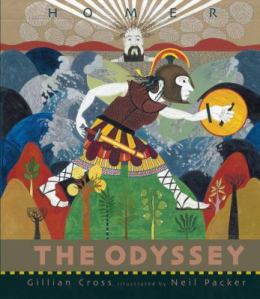
The OdysseyThe Odyssey by Homer. Translated by Gillian Cross. Illustrated by Neil Packer.
This is a brand-new translation of the classic. It’s written in strong, beautiful language that doesn’t feel either ponderous or trendy. Cross preserves the repeating phrases that have worked their way into our subconscious, like “the wine-dark sea”, as well as the bloody details of the stories. We follow Odysseus over the years as he travels from shore to shore and island to island, sometimes making bad decisions himself, sometimes having his crew make bad decisions that override his, and, in the famous case of the Cyclops, bringing down the deadly wrath of its father Poseidon on him for the rest of the journey. The men that fill many ships when they start out get killed off in groups large and small, until at the end, only Odysseus is left to return home. Meanwhile, his faithful wife Penelope is told that she must remarry if her husband is dead, as he must be after all these years. My son and I had a nice discussion about women’s rights over this – because why should Penelope get married if she doesn’t want to, whether or not her son is old enough to take over the kingdom? The full-color illustrations are an amazing mix of styles that manage to look both very modern and clearly inspired by Greek art. The thick outlines and the profiles all look ancient, and the saturated colors look like they’d belong on Grecian pottery. But Hermes wears a running suit, and Packer plays tricks with perspective that I don’t think would have been done in period. The illustrations really pulled the whole book together into a vivid, hard-to-forget whole. My son loved it all, and even stayed put to look over the back material: the Greek alphabet with corresponding Roman letters, and the author’s essay on Homer and why the Odyssey is still compelling, so many millennia later. This would probably not go over well with a sensitive child, but for the many children who’ve been introduced to Greek mythology courtesy of Percy Jackson, those interested in exciting mythology, or adult wanting to brush up on their classics, this should go over very well indeed.

For comparison, you could also try the classic translation by Robert Fagles, or the Children’s Homer by Padraic Colum, which I read some years age, or take a peek at the Greek mythology section, 292.13 at your local library.

Posted in books | Tagged , , | 1 Comment

The Shoemaker’s Wife

“Why do you pick so many books set in Olden Days for me?” my son asked recently. Umm… “Because now is such a short time compared to all the time that has been. And because we like to listen to fantasy, and until recently, most fantasy was historical fantasy.”

Shoemaker's WifeThe Shoemaker’s Wife by Adriana Trigiani. Narrated by Annabella Sciorra and Adriana Trigiani.
I’ve enjoyed many Adriana Trigiani books in the past – Rococo is the only one I’ve reviewed here, but I’ve read 5 or 6 others that I can think of off the top of my head. Naturally, I went for this one, though I waited for the hold list here at the library calmed down a little.

This one is an epic based on the lives of her grandparents that Trigiani has been researching for 20 years. We meet Enza and Ciro as they are both teenagers in Alpine Italy. Enza is the responsible oldest daughter of a large brood; Ciro is the youngest of two, left with his brother at a convent after their father dies. It’s love at first sight when Enza and Ciro first meet as Ciro is digging Enza’s baby sister’s grave, but before they can meet again, Ciro is to emigrate to America. Enza and her father travel to America somewhat later, knowing nothing of Ciro’s fate. They are just hoping to earn enough money in the U.S. to build their family a house before returning home. In America, Ciro is apprenticed to a shoemaker in Little Italy, while Enza labors in a sweatshop in New Jersey, before finding a better job in the Metropolitan Opera’s costume shop, sewing for Caruso. After years of working, romances with other people, and Ciro fighting in World War I, they finally marry, but decide to stay in America rather than trying to return to Italy. As there are plenty of shoemakers in New York City, they move to the Iron Range in Minnesota, where Ciro and his fellow former apprentice become the only shoemakers to the miners.

Maybe if I’d remembered more of the reviews I read, I wouldn’t have been disappointed – but I was expecting Enza and Ciro to be married for most of a book titled “The Shoemaker’s Wife.” Instead, they got married about disc 9 of 12. Somehow, I was strongly reminded of L.M. Montgomery’s Anne of Green Gables series, and wished that this, too, divided the independent life, the courting, starting married life and having children into separate books. While I enjoyed the earlier parts, I felt like the last part, the part that was what I was expecting the book to be about, was rushed through, with years skipped over without transition. There were a few instances – Ciro’s first romance, and every upholstered item being covered in chenille – where I wondered about the historical accuracy, though it’s obvious that a lot of research went into it. Trigiani writes here, too, with a more emotional style than in her other books. I’m sure it’s deliberate, but sometimes when I could hear the violins in the background, it was a bit much for me. Writing along the lines of “If only Enza had known that she would never see her mother again, she would have hugged her longer” as part of a whole paragraph along those lines. It was Trigiani’s decision also, apparently, to switch to narrating the book partway through. I understood this decision a little more when I listened to her talk about it in the interview at the end, but it was initially very jarring to hear the characters talking in completely different voices, with New York accents while being described in the text as having strong Italian accents. That being said, while I personally preferred Sciorra’s narration, Trigiani read more expressively than many authors I’ve heard.

Despite its flaws, I sincerely cared about Ciro and Enza and their friends. Along with the Trigiani elements that I’d expect – the Italian family in America, the food, and the transformational trip back to Italy – there’s a lot of Caruso love, and a strong feeling both for the hardships that drove Italians to immigrate and the experience they had when here. If you’re in the mood to curl up with a historical novel set mostly only a hundred years ago, this is a fine choice.

Posted in books | Tagged | Leave a comment

Starry River of the Sky

Yesterday I added my post from last week on “I Kissed the Baby” to the Kid Lit Blog Hop at Mother Daughter Book Reviews. Please hop over there and take a look at all the other great posts that are up!

Kid Lit Blog Hop

Starry River of the SkyStarry River of the Sky by Grace Lin
Lin, whose Where the Mountain Meets the Moon was a Newbury Honor Book, returns to the mystical China of long-ago with Starry River of the Sky. It features entirely different characters, but the same lovely story-telling method where the narrative includes the characters telling lots of stories, presented as fictional, but which later affect the story. As our story begins, a young boy named Rendi has run away from home and gets left at the inn in the Village of Clear Sky, far away from anywhere else. Although he’s less than thrilled by the idea, Rendi takes a job as the inn’s chore boy to earn his keep, much to the distress of the innkeeper’s daughter, Peiyi, just a little younger than Rendi. She’s upset both at having to put up with the unfriendly boy and at her beloved older brother’s absence, which makes a chore boy necessary in the first place. While Rendi learns to do chores, his sleep is disturbed every night by a deep moaning that he discovers no one else can hear. Then, the beautiful Madame Chang comes to stay at the inn. She starts telling stories every evening, and is able to draw Rendi out enough to tell some stories of his own. Other interesting characters include the sometimes confused, sometimes wise and sharp old man Mr. Shan, who comes to the inn for lunch every day, and the widow and her daughter on the other side of the inn’s fence. Peiyi and the daughter are secret friends despite their parents’ long-ago feud. There are themes of learning and forgiveness woven through the beautiful folk tales, as well as recurring characters: Magistrate Tiger, the wise old sage who lives on the mountain, the moon lady, and a man with the character for “strong” on his forehead, who shows up as both man and tiger in various roles in different stories. It’s hard to capture how well the various strands weave together, but this is close to perfection as one could hope for.

The lyrical language and the folk tales bring this together with Where the Mountain Meets the Moon, but it is also different. You’ll have noticed, of course, that we have a grouchy boy instead of a cheerful girl for our main character. Where her first book was filled with mythical characters, here everyone is an ordinary person, at least at first glance. There’s also the use of two different Basic Plots: the Person Goes on a Journey plot vs. A Stranger Comes to Town. Lin says in her interviews that the first book was about the moon and this second one about the mountain, though I think the titles are a bit confusing for this purpose. I’d listened to the previous book with my son, which adds the personality of voice but takes away the physical pleasure of the book – I had no idea that there were illustrations! The typography switched to a lovely decorative typeface for the stories, delightful. I most especially loved Lin’s saturated paintings, so reminiscent of the glossy color plate illustrations in classic books. My son enjoyed the first book (perhaps not quite so much as I did), and I very much look forward to sharing this with him as well. The book is ideal for middle grade students, but anyone who enjoys traditional tales will love it as well.

I just hopped over to Grace Lin’s blog to find out the stops on her blog tour, and discovered that she’s having a special where you can order signed books from her local book store. Do I regret taking everything but the harp off my wish list? I will make sure that somebody gets this for Christmas, even if it’s not me. Anyway, there was a blog tour when the book first came out in October. There are lovely interviews with her at all of these blogs:

Bookie Woogie
Enchanted Ink Pot
Jama’s Alphabet Soup
Pragmatic Mom
Abby the Librarian
Charlotte’s Library

Posted in books | 5 Comments