Economix

Yeah, it probably belongs in with the real economics books… but I bought this for our adult graphic novel collection, just figuring more people would see it.
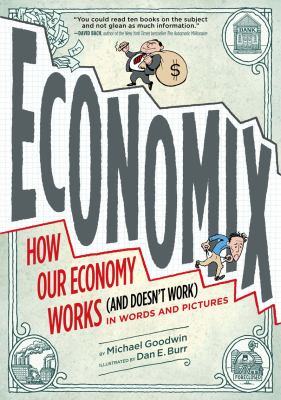
EconomixEconomix by Michael Goodwin. Illustrated by Dan E. Burr. This is a graphic novel/comic retelling of economic history and theory, from the time people first started thinking about it as such, through 2011. It’s in the graphic novel collection here at the library, but this really isn’t a novel and, while on a serious topic, is has a lot of jokes in it, so calling it a comic is more accurate. It starts with Adam Smith’s The Wealth of Nations (1776). All I could recall of Adam Smith’s theories was the bit about the “invisible hand”, and it turns out both that I’m not alone in remembering just that part, but also that remembering just that part is a radical simplification of his theories. Ideas like overlarge companies stifling the natural competition and too much profit being bad for the markets seem just as relevant now as they were 300 years ago. The graphic format makes it easier to keep track of the multiple dead white guys and their various theories, as their caricatures are all very distinct. Goodwin is scholarly enough to put actual quotes in quotes and italics, making it easy to distinguish what someone actually said from Goodwin’s paraphrasing of their ideas. Complicated ideas like derivatives are also easier to understand with pictures. In addition to economists, Goodwin looks at the effect on the economy of things like government policy (especially since the turn of the last century), wars, and international bodies like the World Bank. He notes truthfully that his writing gets more controversial as he gets into present-day debates because the score isn’t settled yet: plenty of people used to be convinced that the economy would collapse if slavery was illegal. Similarly, he thinks that big business saying that paying for the environmental cost of doing business isn’t supportable, or Wal-Mart deliberately relying on the government to subsidize the wages of its lower-tier workers, are ideas that will fall out of fashion. Another interesting idea: from the 1930s through the 60s (I’m forgetting the end date here), government policy was designed to increase the size and wealth of the middle class. Since then, politicians of both parties have made and supported policies to funnel wealth to the wealthy and to large corporations. These policies also have been very successful. He also says that our current economic debate in the political arena is stuck in the 1970s. Many of these theories are no longer supported by economic scholars, but they are still cited as proven facts by politicians, and by extension, by people who pay more attention to what politicians say than what economic scholars say. That would be most of us, and even though I often disagree with politicians, it’s nice to know that there are other accepted theories out there. Interesting, controversial, yet definitely approachable.

My librarian self was very impressed by Goodwin’s work, researching so many texts and lots of history, in such a way that it would be easy to follow up with the originals if I wanted to. Major credit goes to the artist, Burr, as well, though. This isn’t an easy topic, and his pictures illuminate tough ideas, keep a vast array of characters distinct, and do so while being funny. Funny enough and clear enough that my eight-year-old was able to understand the bits of it that I read to him. As the history ends on something of a downer if one is neither wealthy nor a corporation, he includes some of his thoughts on the future and what someone interested in a more level economic playing field might do. Well, it’s nice, but I wish there were more. I appreciated his annotated bibliography at the end, too. I’ll confess that I had to renew it from the library once before I worked up the courage to tackle it, and it was definitely something to read with brain cells turned on. Once I got started, I had a very hard time putting it down. Anyone looking to understand economics, whether for the first time or as a refresher, would be well served by reading this book.

Here’s an audio interview with Michael Goodwin from Graphic Novel Reporter.
Posted in books | Tagged , | Leave a comment

The Seven Tales of Trinket

Happy Thanksgiving, and thank you to all my readers! I am so very grateful to all of you! Also, many thanks to the many authors who support my reading addiction.

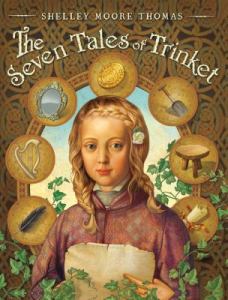
The Seven Tales of TrinketThe Seven Tales of Trinket by Shelley Moore Thomas

This gem-like book weaves new takes on many traditional Celtic stories together with that of a young girl in search of her father. Young Trinket, 11, was abandoned by her father, James the Bard, years before. He left on his travels, as bards will, and broke his promise to come back. Her mother now dead, Trinket decides to set off looking for her father. She takes with her the old and cryptic map of his journeys, and her friend, the slightly younger Thomas the Pig Boy. They find themselves in a Gypsy camp, and befriend a young Gypsy fortuneteller. She encourages Trinket to learn seven stories, so that she can stay a week in a place and have a new story to tell to each night in exchange for her keep. She also turns out to have heard the lullaby that Trinket’s father composed for her from a travelling bard long ago, so that Trinket is sure she is on the right trail, however cold. Now Trinket adds finding seven tales to her mission, along with finding her father. As she and Thomas travel, they hear of several other travelling bards, but none going by James the Bard. They do, however, have one adventure after another, including meeting with Selkies, a banshee, and a Pookah. All of them Trinket turns into stories or poems, and all except the first story of the Gypsy girl were takes on stories that were familiar to me, though Trinket’s stories tend to have happier endings. As she travels, and has more and more stories to tell, Trinket becomes known as the Story Lass. I would be remiss in failing to mention that she acquires, and learns to play, a harp! on her journeys, so she is a musical bard as well as a story-teller.

Even as exciting as Trinket’s adventures are, her reflections on who she is, who she’s becoming, and what kind of relationship she could have with her father should she find him still alive take up nearly equal time. The well-developed characters and beautiful writing make this a natural choice for people who appreciate these things. It feels nicely old-fashioned – I thought the cover represented this well. The way the stories wove in and out of the narrative reminded me of Where the Mountain Meets the Moon and Starry River of the Sky (review forthcoming.) It would also tie in well with anthologies of Irish, Scottish and Welsh traditional tales, all of which feature in this book.

Posted in books | Tagged , | 2 Comments

My colleagues were asking for my notes from the recent Michigan Library Association conference, so here’s my notes from an inspiring program on teen programming from one of our former interns and, you know, some other teen librarian she’s good friends with.  This was the last session of the day and ran way over because people couldn’t stop asking questions.

Beyond Duct Tape
Teen Programming with Kricket Hoekstra and Sarah Jones
MLA 2012

Sarah – $6500/yr budget; Kricket $1000/yr

Kricket says make friends with Gordon Food Services! There are kids who don’t get enough to eat at home even in wealthy communities.

For K. teen is 13-18; for Sarah 6-12th grades.

K. says college kids can come if they help

Both say no parents or adults

Get ideas from teens, your own interests and steal, steal, steal!

  • Give full-sized candy bars for good, legit program ideas

Get used to failure

Sarah’s successful programs channeling her interests:

  • cat toys
  • circus training
  • cupcake decorating

Best programs

      Hunger games summer reading finale – 216 teens

      • Cornucopia game
      • Tracker jacker shake-off
      • Popsicle stick, rubber band & Q-tip bow & arrows
      • Laser tag
      • Mellark’s cupcake decorating
      • $1600 price tag

Anime club & Graphic novel book club – 2x per month and annual prom

      • “bad” teen interested in manga reformed as club leader
      • “Comicon” every other newsletter cycle
        • 80-100 teens
        • Costume contest early in the event
      • Include wacky prizes so low-cost costumes have a chance
      • Video game music
      • Candy sushi-making station
      • Manga drawing
      • Origami station

D&D

      • 2 groups, 1-2 times per week, splitting to 3 groups soon
      • College kids as DMs
      • Munchkin an easier alternative

Pizza and Paperbacks (with Wal-Mart grants)

      • Show Nerdfighter videos
      • Pick books the leader likes, not just off lists

Writer’s Workshop

      • Now 10-15 kids coming
      • Book spine poetry
      • Exercises from teen writing books
      • NaNoWriMo meetings, including adults

After hours parties

      • Hide and seek and sardines over capture the flag

Teen bands – Noise@ the Library

      • Remind performers to come early for set-up
      • Keep stage moms low-key

Failure

      • Craft club
      • Movie night
      • Lego club
      • Teen-created zin
      • Martial arts demo
      • Shadow puppet workshop

Keep VOYA envy in check!

Be there after school every day!

Marketing

      • Newsletter
      • Facebook – both teen & adult pages
      • Posters/chalkboard in teen zone
      • In-library TVs

Prizes

      • Teens want candy & money
      • Have teens help with shopping

Rules

    • Keep them short and simple:
      • Don’t bother others
      • Language
      • Leave things the way you found them
Posted on by Katy K. | Leave a comment

Saga

SagaSaga. Volume 1. by Brian K. Vaughan. Art by Fiona Staples.
Brian K. Vaughan is such a popular author that of course I had to buy his latest book, even if I never quite got into Y: the Last Man myself. This one, however, looked like fun for me as well as a necessary addition to the collection. Alana and Marko are both soldiers from planets that have been warring for generations. They fall in love and marry when Alana is assigned to be Marko’s jailer, but when we meet them, Alana is giving birth to their child. They are on the run from the authorities of both their planets, as such fraternization with the enemy is illegal. Their baby is born with wings like her mother and buds that will be horns like her father’s. Observant readers will note that Alana is breastfeeding her on the cover, and does so frequently and without hoopla through the story – unlike me, creating hoopla here for normalizing breastfeeding, at least among winged humanoids. They must flee immediately, however, and Marko’s resolution to give up violence for good is severely tested. Their pursuers include two high-profile assassins, one human and one scary woman-topped arachnid. Escape means making a hard bargain with the current residents of the bombed-out planet they’re on, in hopes of finding the perhaps legendary Rocket Forest. The universe they’re travelling in is full of odd things, including a ruling class of TV-headed nobility, such as Prince Robot IV. Most of the characters have at least some human aspects, but that doesn’t mean they’re normal-looking by a long shot. The art is beautiful and glossy and as realistic as such fantastical creatures could be, with some really beautiful images. Commentary is provided by the baby, which is somewhat disconcerting but at least provides assurance that she makes it to be old enough to tell her own story. While the characters we’re following don’t have the time to get kinky, one of the assassins pays a visit to the planet Sextillion, whose shop windows have models engaged in just about everything. There is blood and gore on a regular basis. Those make this decidedly adult fare, yet for those who can deal with the blood and sex (I’m afraid it’s more of a “get past” in my case), this is the start of a galaxy-crossing adventure, starring our star-crossed lovers and their sweet baby. There’s a small amount of time to think in all this, about the energy put into preventing the thought of peace by the powers, and the violence this tiny family needs to keep itself safe.

Posted in books | Tagged , , | 1 Comment

I Kissed the Baby

I’ve submitted this post to the Kid Lit Blog Hop at Mother Daughter Book Reviews. Please hop over there and take a look at all the other great posts that are up!

Kid Lit Blog Hop

I Kissed the BabyI Kissed the Baby by Mary Murphy.
Bold pictures, mostly white on a black background, with shots of bright yellow and pink, illustrate this story. Pond animals including fish, birds, a squirrel, and insects, all join to welcome a new baby. Each spread features two animals, the first asking the other a question about the baby: “I tickled the baby! Did you tickle the baby?” “Yes! I tickled the baby, the wriggly giggly thing!” Finally, at the end, we meet the adorable duckling that everyone is so excited about. Though it isn’t rhymed text, lots of attention is paid to the sound of the words for reading aloud. The short text and bold images make it perfect for reading to babies and toddlers, but it was still fun enough for my eight-year-old to want to read it to his sister, and she both asked for it and read it to herself over and over again. I get asked about recommended books for new baby gifts often, and this is a great one. It’s still in print in board book, which is ideal for the target age, and you can still find it in hardcover if you look.

Here are other board book favorites about baby love just right for new babies:
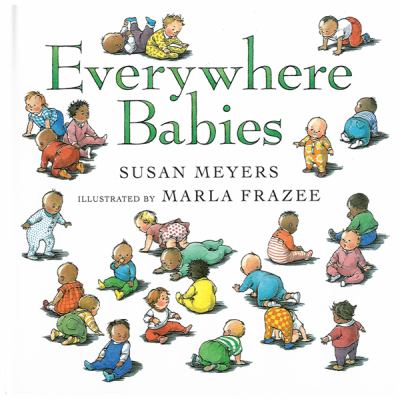
Everywhere BabiesEverywhere Babies by Susan Meyers. Illustrated by Marla Frazee.
Hush, Little Baby by Marla Frazee.
Snuggle Puppy by Sandra Boynton.
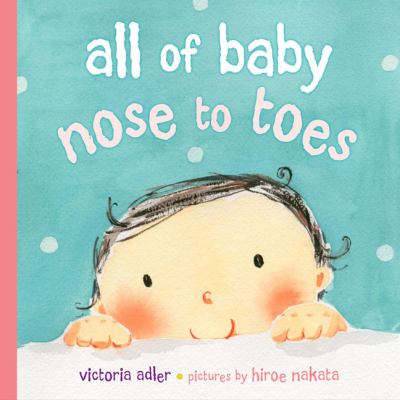
All of Baby Nose to Toes by Victoria Adler. Illustrated by Hiroe Nakata. All of Baby Nose to Toes

This book was a gift from our head children’s librarian at my son’s shower. It has 44 wonderful picture books in it, with color-coded age guidelines at the bottom of all the pages and in the table of contents. We take it with us whenever we travel and are able to stay entertained for weeks with no other books for the children. If you have the budget for a big book gift, this is a great choice.
The 20th-Century Children’s Book Treasury edited by Janet Shulman.

What are your favorite books to give to babies?

Posted in books | Tagged , | 3 Comments

The Language of Flowers

Image

My friend and colleague Miss S. will leave book presents for me on my desk, sometimes for my children, and sometimes, as this one, for me.

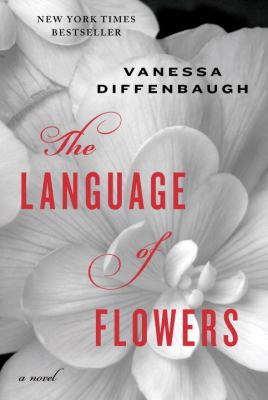
The Language of Flowers by Vanessa Diffenbaugh

Victoria was abandoned as a baby and grew up in series of foster houses and group homes.  Not surprisingly, growing up without real attachment to anyone, she’s never cared to invest herself in succeeding in school or looking for a career.  Now 18, she’s aged out of the foster care system and is on her own, homeless and with no one to turn to.  When her small start-up fund runs out, she lives under a bush in the park, making a small garden with plants she steals from around town. The flowers are her link back to the one foster mother who really cared, Elizabeth.  We learn about her past with Elizabeth in chapters that alternate with her presence, Elizabeth who understood Victoria’s prickliness and who taught her the Victorian language of flowers.  Back in the present, Victoria’s knowledge of flowers gains her a part-time job at a trendy San Francisco flower shop, Bloom, and a small room to stay in via the owner’s sister.  On early-morning flower market runs, Victoria meets Grant, who sends her messages in flowers that no one who didn’t know the language of flowers could understand.  Even when things seem to be going well, both in the past, as Elizabeth makes plans to adopt Victoria, and in the present, as Grant faithfully pursues her, things go wrong.  Most often, heart-breakingly, it’s Victoria shutting things down before she can be abandoned again.  I read this book over breaks at work, and more than once had to go and talk to Miss S. about it, how crazy that I had get back to work, leaving poor Victoria in such an unhappy situation.  It was beautiful, and heart-wrenching for me in places that are too spoilery to talk about, but though some things can never be fixed, it was in the end ultimately redemptive. 

Knowing the redemption was coming made it possible for me to finish the book.  Diffenbaugh does an amazing job of making us care about Victoria, despite the considerable effort she puts into screwing up her own life.  Normally I just get frustrated with characters like that, but it’s clear that Victoria never had the chance to learn any better.  Diffenbaugh makes it clear in the introductory material that she’s an experienced foster mother herself, and how difficult it is for foster kids who age out of the system and don’t have the support that so many young adults need to be successful.  Even though things turn out hopefully for Victoria, I was left wondering (I’m sure quite deliberately) about the many kids for whom life never improves.  Is Victoria’s story not real enough, even if I couldn’t have borne it any tougher?  In any case, this reminded me that I’m planning to knit scarves for the Red Scarf Project (at least once my kids are old enough that a scarf isn’t a four to six month commitment.), run by a foundation that provides support for former foster kids going to college.  Diffenbaugh also started the Camellia Network  to provide all kinds of support to kids aging out of the foster care system, college-bound or not.  The book is well worth reading in any case, and would be a natural pick for a book club, thoughtful without being as depressing as many book club selections seem to be.  It has some sex with consequences, which makes it appropriate for older teens as well as adults. 

Posted in books | Tagged | 2 Comments

Penny and Her Song

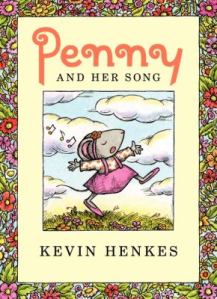
Penny and Her Song Penny and Her Song by Kevin Henkes
Henkes creates another winning little mouse character, this time in a short-chaptered easy reader book. Penny comes home from school with a Song, a song that fills her up and demands to be sung. But the mouse babies are sleeping, and her parents both tell her to be quiet. Singing to herself in the mirror or to her little glass animals is just not the same. When they finally wake up, it’s supper time, and singing at the table is also not allowed. Will Penny forget her song before she has a chance to sing it to an audience? Finally, after supper, Penny sings her song, and then teaches it to the family. Penny’s winsome personality, passionate about her need to perform without becoming pushy (this post brought to you by the letter P), together with the loving family dynamics made the parts of the book add up to more than the simple plot. The language is about the same level as Frog and Toad, the whole book two chapters long. It’s just enough for the emerging reader to feel accomplished without it moving it up to the early chapter book category. My struggling second-grader was able to read it, and my three-year-old carried it around with her and asked for it over and over again. I enjoy Henkes’ work so much that I hate to give it gender limits, but must honestly say that my son, not as interested in music and babies as my daughter, did not appreciate the story as much as she did. The second book, Penny and Her Doll, has even more girl appeal. That makes me sad for my son, but happy to see girly books that aren’t all princesses and Barbies. Those in that audience will likely love it as we did, and those looking for Kevin Henkes books to appeal to both boys and girls could try these picture book titles, a few of my favorites from his extensive catalog:

Kitten’s First Full Moon
Owen
Wemberly Worried

Posted in books | Tagged | 3 Comments

Liesl and Po

Liesl & PoLiesl & Po by Lauren Oliver.
Orphaned Liesl is living in the attic where her stepmother has locked her when she meets a ghost. Po is clearly a child but doesn’t remember what sex it used to be and doesn’t care anymore. It’s accompanied by Bundle, an adorable little pet ghost of indeterminate species. Liesl is instantly curious, both about Po and about how it came from the Other Side, because she never got a chance to say good-bye to her very recently deceased father. Though Po is fairly certain it can’t be possible, it finds her father on the other side, and he does have a message for Liesl. At the same time, a young alchemist’s apprentice named Will is running errands for his master, as usual, going far out of his way to look for Liesl sitting in her attic window. Chronically exhausted (like me, but with a much less adorable human alarm), he accidentally leaves the box containing the most powerful magic in the world behind at one of his stops, taking instead the box of Liesl’s father’s ashes. The magic was intended for the Lady Premiere, who is most put out when it does not work as promised. Liesl, meanwhile, steals the box of what she believes to be her father’s ashes and runs away to take them to her mother’s grave. Liesl, Po, Bundle and Will all end up on the same train out of the big city, pursued by Liesl’s stepmother, the Lady Premiere, the alchemist, and the Lady Premiere’s kind-hearted but slow-witted guard, who just wants to give poor shivering Will a warm hat.

It’s all set in a smoggy grey world of indeterminate time period, somewhen between the early 20th century and now. There are trains and factories, lots of child laborers, and the sun has not shone for a very long time. Our brave children and their ghostly friends are surrounded by looming adults, nearly all of whom wish them harm. There are no powerful adults on their side, which is sad for me as a mother, but which the children seem to take for granted. Neither Will nor Liesl has much self-confidence, but together they are able to see the strengths of the other. There’s plenty of excitement, with all the mix-ups and the chases, but it has a core of sober reflection on grief. Liesl is dealing both with the fresh grief of losing her father without being able to say good-bye, and with the older grief of losing her mother years earlier. This is handled masterfully, neither whitewashing the depth of the pain nor ever making it seem that Liesl wouldn’t be able to go on with life because of it. Oliver talks in an afterward about how this book was a reaction to loss in her own life, and it shows. I never felt like Oliver was putting her characters through unnecessarily tough times just to entertain me the reader or to get them where they next needed to be. This is dealing with a tough topic in a sensitive way, all buried under an adventure and starring characters that will appeal to both boys and girls. I’d say this is best for older elementary kids. This is a beautiful tale with staying power.

Posted in books | Tagged | Leave a comment

Goldilocks and the Three Dinosaurs

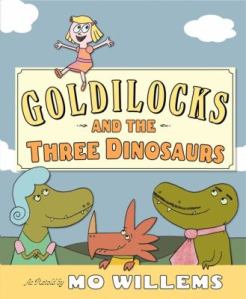
Goldilocks and the Three DinosaursGoldilocks and the Three Dinosaurs by Mo Willems
Here is a picture book that had both my eight-year-old and my three-year-old giggling, looking at it on their own, and asking for it to be read aloud over and over again. In characteristic Willems style, he narrates the familiar story of Goldilocks and the Three Bears with a twist. Papa Dinosaur, Mama Dinosaur, and the small dinosaur who just happens to be visiting from Norway make delicious chocolate pudding in three temperatures and leave the house with the door open, just as a “poorly supervised” little girl named Goldilocks happens to come walking by. One might hear the sound of dinosaurs laughing as she follows the signs to the house –but really, that would be terribly unlikely. Chocolate-filled little girls are dinosaurs’ favorite treats, but Goldilocks keeps falling into one obvious trap after another. Will she escape in time??? This could have the potential to become scary, except that it’s told in such a campy way. It’s easy to root for both our fellow human and for the dinosaurs, who after all, are only taking advantage of an exceptionally rude and potentially stupid person. Really, after all the damage Goldilocks did to those poor friendly bears, too. The endpapers all feature crossed-out suggestions for titles: Goldilocks and the Three Musketeers or Goldilocks and the Three Accountants, all so funny that my children made me read them all aloud and then went back and puzzled them out again. Preschoolers through younger elementary kids who are familiar with the original are the natural audience for this, as well as adults who appreciate a good snarky tale.

Posted in books | Tagged , | 2 Comments

Guinea Pig: Pet Shop Private Investigator: Hamster and Cheese

Robin over at No Flying, No Tights turned me on this series – the fifth volume came out this year. But, as I hadn’t heard of it before, I took volume one home to share with my boy.

Guinea Pig, Pet Shop DetectiveGuinea PIG: Pet Shop Private Investigator. Volume 1: Hamster and Cheese. By Colleen AF Venable. Illustrated by Stephanie Yue.

This is a mystery graphic novel series for the elementary school set. Our setting is a pet shop. Young Hamisher the hamster who thinks he’s a koala is in a panic – Mr. Venezi, the pet store owner, has promised to banish all the “koalas” from the pet store if the sandwich he sets down in their cage every day doesn’t stop disappearing. (The store owner, it transpires, does not know his animals very well at all, and has mislabeled many of his animals, including finches labeled llamas and mice called walruses.) He turns to the sarcastic and world-weary guinea pig Sasspants for help, because the “g” has just fallen off of her sign and Hamisher believes that Sasspants is a PI – the pet shop’s own private investigator. Sasspants would really rather get back to her book, but as Hamisher refuses to leave her alone, she helps. Many of the pet shop animals are nocturnal, and the thefts happen during the day, so witnesses are scarce. The dauntless pair interviews a shifty snake (with a very suspicious square bulge in his body), some vain chinchillas, and a tank of goldfish with very short memories. The clues were there all along, but the answer wasn’t obvious even to me. The illustrations express the animals and their characters beautifully in a straightforward style, and the friendly and talkative Hamisher plays beautifully off of the cynical and reserved Sasspants, even in the short length of the story. The boy and I both enjoyed it. It’s animal fantasy of the type where the fantasy is that the animals can talk and think like humans, though there isn’t any magic. It’s somewhat above what he can read to himself, but most kids who are comfortable reading by themselves should do fine, and the characters are appealing to both boys and girls.

Posted in books | Tagged , | 1 Comment