Here’s a quartet of library picture books that we recently enjoyed.
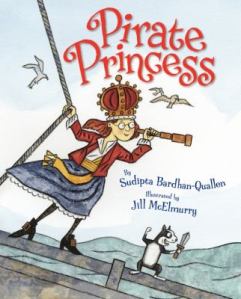 Pirate Princess by Sudipta Bardhan-Quallen. Illustrated by Jill McElmurry.
A princess who scorns fancy clothes longs to be a pirate in his rhyming tale: “Princess Bea was not the kind/ Of princess you’d expect/….And especially she couldn’t face/ A life wed to some prince.” One day, she takes a stroll down to the harbor and finds a pirate ship docked there! Sure her dreams are about to come true, Bea and her little dog walk right onto the ship and ask for work. Though she’s given a chance, when she turns out to be horrifically bad at deck-swabbing, cooking, and being a look-out, she is sentenced to walk the plank. Can she find a real pirate skill in time to save her life? There is a lot to like in this book, from the purple-haired Captain Jack and his diverse crew, which seems to be evenly split male to female. I’d guess the artwork to be crayon outlines with watercolor fill, and they are quite appealing, as is Princess Bea. My only reservation is that Princess Bea’s pirate skill turns out to be finding treasure – and since she starts out with a bulky jewel-encrusted gold crown, I wasn’t sure why she’d need to be a pirate to get treasure. That being said, pictures books featuring pirate princesses are in relatively short supply, and both my eight-year-old boy and three-year-old daughter enjoyed this one.
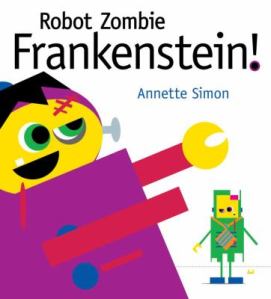 Robot Zombie Frankenstein! by Annette Simon
Here is a silly cumulative story featuring two robots, both made out of neon-bright, simple shapes. More and more shapes keep being added to the robots as they dress themselves up: they start as robots and end up as Robot zombie Frankenstein pirate superhero-in-disguise outer space invader CHEFs!… with pie. The cumulative nature and big type made it one that my beginning reader was eager to read himself, always a plus. For added DIY fun, the shapes used are printed by themselves in the endpapers, labeled as shapes in the front and robot parts in the back.
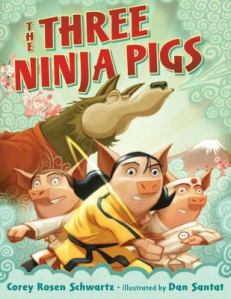 The Three Ninja Pigs by Corey Rosen Schwartz. Illustrated by Dan Santat.
Thanks to Kate Coombs at Book Aunt for her initial recommendation on this one. In this variation of the Three Little Pigs, each of the three pigs, tired of being bullied by the Big Bad Wolf, decides to take up martial arts at the new Dojo in town. Each one picks a different technique – aikido, jujitsu, and karate. The strong acrylic paintings show them practicing at a school filled with other animals – a panda, turtle, monkey, musk ox, goat and crane, all somewhat reminiscent of Kung Fu Panda. However, much as they have varying levels of patience for house building, so too do the pigs have various levels of patience with studying martial arts. The two younger pigs give up quickly and are just as quickly defeated by the Big Bad Wolf, but big sister pig sticks with it until she gets her black belt, and victory is hers. This is fun for young martial arts enthusiasts, with an underlying message on the value of practice and dedication.
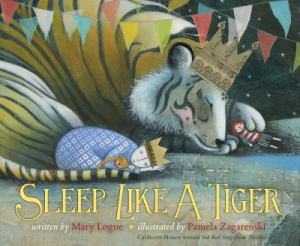 Sleep Like a Tiger by Mary Logue. Illustrated by Pamela Zagarenski.
“Once there was a little girl who didn’t want to go to sleep, even though the sun had gone away.” The story walks through the evening as the little girl’s parents tell her that of course she doesn’t have to sleep if she’s not tired, but she does have to put on her pajamas, wash her face and so on. As she gets ready, the girl and her parents talk about sleeping animals from their own pets to a variety of wild animals – if they are sleeping now, how they sleep, and if they are nocturnal, when they do sleep. Finally, the girl is curled up asleep in her bed, hugging her toy tiger and dreaming of a tiger with a doll. The peaceful words combine with fabulous collage-style pictures, which combine the real and the imagined and repeat fantastical element – buntings, trains, wheels on moving creatures, gold crowns on living things – creating a magical world out of the ordinary events. This is a bedtime book to be enjoyed over and over again.
I hope you are enjoying the holidays! Coming soon – the books we gave for the holidays, and reflections on my favorite books of 2012.

 Tiger’s Curse. by Colleen Houck. Read by Annika Boras and Sanjiv Jhaveri.


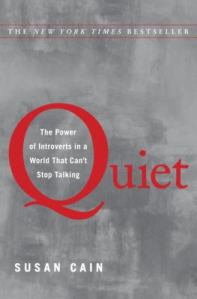 Quiet: The Power of Introverts in a World That Can’t Stop Talking by
 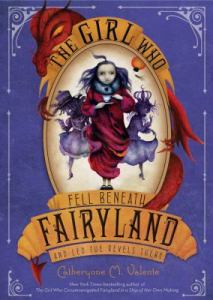 The Girl Who Fell Beneath Fairyland and Led the Revels There by Catherynne M. Valente. Illustrated by Ana Juan
 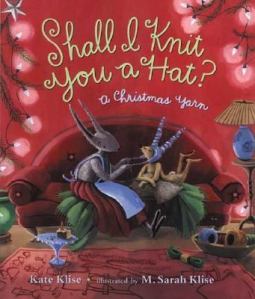 Shall I Knit You a Hat? by Kate Klise. Illustrated by M. Sarah Klise.
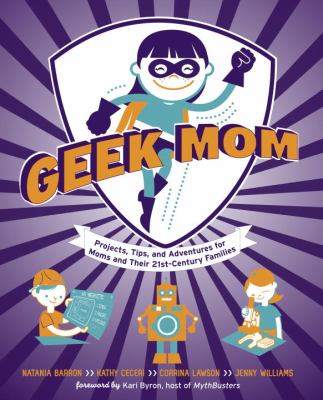
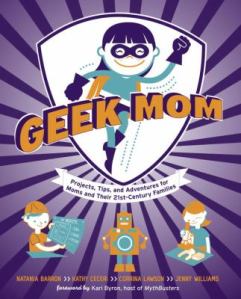 Geek Mom by Natania Barron, Kathy Ceceri, Corrina Lawson and Jenny Williams.
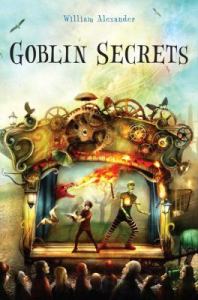 Goblin Secrets by William Alexander.
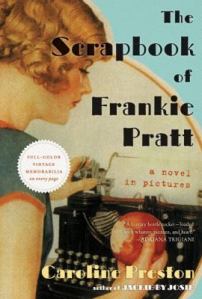 The Scrapbook of Frankie Pratt by Caroline Preston.

 alibrarymama