Circular Knitting Workshop

Mittens were the first thing that I wanted to knit when I took knitting up again as an adult almost a decade ago. That means I’ve been knitting in the round for a really long time. I wouldn’t have taken this book home if it hadn’t been for Kelley Petkun’s recommendation on the KnitPicks Podcast.
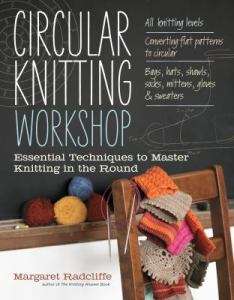
Circular Knitting WorkshopCircular Knitting Workshop by Margaret Radcliffe.
This is a big book with in-depth coverage of my favorite way to knit, in the round. The title says that it’s a workshop, and it’s really laid out that way, first introducing basic circular knitting techniques and then knitting small-sized samples of things beginning with bags and hats and working up to socks, mittens, and sweaters. All the patterns use Lorna’s Laces yarn, a brand I’ve often heard of and never tried. Radcliffe starts with showing how to do circular knitting on double-pointed needles, circulars, or one or two extra-long circulars. She has lots of advice on how to solve standard problems like twisting stitches when you first join the round or ladders between needles. Just as an example of how detailed the coverage is, she includes three ways to get jogless stripes, avoiding the visible stair step when you change colors in what is really a big spiral. There are also instructions for the trickier problem of avoiding visible joins with lace or texture patterns. She introduces a technique I’d never heard of called helix knitting, for knitting with two colors continuously. Once you get to the pattern sections, while everything is tiny and presented one way, she includes instructions for knitting every pattern both top-down and bottom-up, along with why you might or might not want to do it that way. Each also tells you how to adapt the pattern for different yarn and sizes that the original, so you could knit a full-sized garment. My favorite hat was a purple witch hat that started with a bit of i-cord and worked its way down in a spiral with just one increase a round. The sweater section includes all the basic sweater types – raglan, set-in sleeve, yoked – as well as how to turn pullovers into cardigans via steeks – and, utilizing those steeks, a very cool helix-knit sweater knit side to side, so the little stripes end up vertical. There’s a lot in here even for the experienced knitter, both in the new techniques and the problem-solving. Beginning knitters working their way through the book will not stay beginners for long.
Posted in books | Tagged | 1 Comment

Counting to Christmas

Yesterday, I linked one of my very first holiday book posts up to holiday book round-up at What Do We Do All Day. I realized a) that my holiday posts seem to very poorly tagged, which is bad for me remembering how to find the books to take home from the library again, let alone any readers and b) I’ve never reviewed this, which we bring out and love every year.

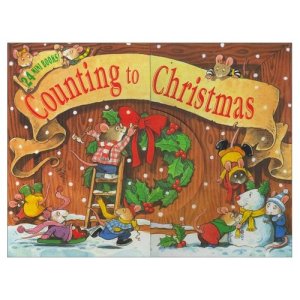
Counting to ChristmasCounting to Christmas by Gillian Chapman. Illustrated by Peter Stevenson. (2001) This is an Advent calendar with 24 tiny board books, each with its place in the cardboard tray and a loop to hang it on the Christmas tree. When all the books are pulled out, a larger picture is revealed underneath. As you can see from the cover, all the books feature the same group of active little mice, every day doing something different to get ready for Christmas. They make their fruitcake, go caroling, write letters to Santa, wrap gifts, buy their holiday fruit, and pull crackers, among other things. As the books are 3 cm a side, the text is brief – often only a sentence or two per book. The illustrations, however, fill in the details to make each story funny. The sentence “While the cake is baking, the Counting to Christmas insidemice clean up” shows Papa mouse asleep by the wood-burning oven while the little mice pelt each other with flour and candied fruit. Singing “Silent Night” under a street lamp starts out reverently but devolves into a snowball fight, while “We Wish You a Merry Christmas” becomes raucous with the addition of more and louder electronic instruments. More than one year, I’ve used the little mice to keep my own holiday planning on schedule. It’s a British celebration of Christmas, though more by the British Christmas traditions than any potentially confusing vocabulary.
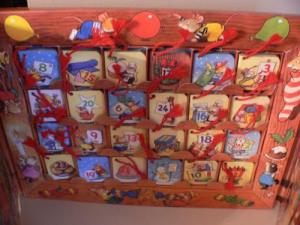
This is out of print, though I was able to find several reasonably priced copies on the Amazon Marketplace. I bought this for myself before I had children at all, but my children love it. My three-year-old will spend twenty minutes at a time looking at all the little books, and more than once a day at that. The eight-year-old boy is still charmed by the mice, and wants to hear only the books up the appropriate day – no reading ahead.

Posted in books | Tagged , | Leave a comment

The Odyssey

My eight-year-old son has listened to and loved all the Percy Jackson books, plus lots of other fantasy and myths that we’ve read to him. So when I found this new, brightly illustrated edition on the back shelves of the library, I knew I had to read it to him.

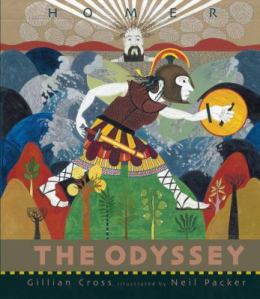
The OdysseyThe Odyssey by Homer. Translated by Gillian Cross. Illustrated by Neil Packer.
This is a brand-new translation of the classic. It’s written in strong, beautiful language that doesn’t feel either ponderous or trendy. Cross preserves the repeating phrases that have worked their way into our subconscious, like “the wine-dark sea”, as well as the bloody details of the stories. We follow Odysseus over the years as he travels from shore to shore and island to island, sometimes making bad decisions himself, sometimes having his crew make bad decisions that override his, and, in the famous case of the Cyclops, bringing down the deadly wrath of its father Poseidon on him for the rest of the journey. The men that fill many ships when they start out get killed off in groups large and small, until at the end, only Odysseus is left to return home. Meanwhile, his faithful wife Penelope is told that she must remarry if her husband is dead, as he must be after all these years. My son and I had a nice discussion about women’s rights over this – because why should Penelope get married if she doesn’t want to, whether or not her son is old enough to take over the kingdom? The full-color illustrations are an amazing mix of styles that manage to look both very modern and clearly inspired by Greek art. The thick outlines and the profiles all look ancient, and the saturated colors look like they’d belong on Grecian pottery. But Hermes wears a running suit, and Packer plays tricks with perspective that I don’t think would have been done in period. The illustrations really pulled the whole book together into a vivid, hard-to-forget whole. My son loved it all, and even stayed put to look over the back material: the Greek alphabet with corresponding Roman letters, and the author’s essay on Homer and why the Odyssey is still compelling, so many millennia later. This would probably not go over well with a sensitive child, but for the many children who’ve been introduced to Greek mythology courtesy of Percy Jackson, those interested in exciting mythology, or adult wanting to brush up on their classics, this should go over very well indeed.

For comparison, you could also try the classic translation by Robert Fagles, or the Children’s Homer by Padraic Colum, which I read some years age, or take a peek at the Greek mythology section, 292.13 at your local library.

Posted in books | Tagged , , | 1 Comment

The Shoemaker’s Wife

“Why do you pick so many books set in Olden Days for me?” my son asked recently. Umm… “Because now is such a short time compared to all the time that has been. And because we like to listen to fantasy, and until recently, most fantasy was historical fantasy.”

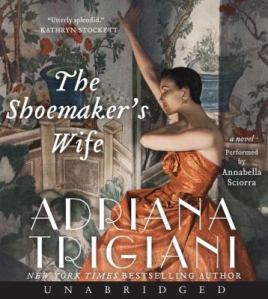
Shoemaker's WifeThe Shoemaker’s Wife by Adriana Trigiani. Narrated by Annabella Sciorra and Adriana Trigiani.
I’ve enjoyed many Adriana Trigiani books in the past – Rococo is the only one I’ve reviewed here, but I’ve read 5 or 6 others that I can think of off the top of my head. Naturally, I went for this one, though I waited for the hold list here at the library calmed down a little.

This one is an epic based on the lives of her grandparents that Trigiani has been researching for 20 years. We meet Enza and Ciro as they are both teenagers in Alpine Italy. Enza is the responsible oldest daughter of a large brood; Ciro is the youngest of two, left with his brother at a convent after their father dies. It’s love at first sight when Enza and Ciro first meet as Ciro is digging Enza’s baby sister’s grave, but before they can meet again, Ciro is to emigrate to America. Enza and her father travel to America somewhat later, knowing nothing of Ciro’s fate. They are just hoping to earn enough money in the U.S. to build their family a house before returning home. In America, Ciro is apprenticed to a shoemaker in Little Italy, while Enza labors in a sweatshop in New Jersey, before finding a better job in the Metropolitan Opera’s costume shop, sewing for Caruso. After years of working, romances with other people, and Ciro fighting in World War I, they finally marry, but decide to stay in America rather than trying to return to Italy. As there are plenty of shoemakers in New York City, they move to the Iron Range in Minnesota, where Ciro and his fellow former apprentice become the only shoemakers to the miners.

Maybe if I’d remembered more of the reviews I read, I wouldn’t have been disappointed – but I was expecting Enza and Ciro to be married for most of a book titled “The Shoemaker’s Wife.” Instead, they got married about disc 9 of 12. Somehow, I was strongly reminded of L.M. Montgomery’s Anne of Green Gables series, and wished that this, too, divided the independent life, the courting, starting married life and having children into separate books. While I enjoyed the earlier parts, I felt like the last part, the part that was what I was expecting the book to be about, was rushed through, with years skipped over without transition. There were a few instances – Ciro’s first romance, and every upholstered item being covered in chenille – where I wondered about the historical accuracy, though it’s obvious that a lot of research went into it. Trigiani writes here, too, with a more emotional style than in her other books. I’m sure it’s deliberate, but sometimes when I could hear the violins in the background, it was a bit much for me. Writing along the lines of “If only Enza had known that she would never see her mother again, she would have hugged her longer” as part of a whole paragraph along those lines. It was Trigiani’s decision also, apparently, to switch to narrating the book partway through. I understood this decision a little more when I listened to her talk about it in the interview at the end, but it was initially very jarring to hear the characters talking in completely different voices, with New York accents while being described in the text as having strong Italian accents. That being said, while I personally preferred Sciorra’s narration, Trigiani read more expressively than many authors I’ve heard.

Despite its flaws, I sincerely cared about Ciro and Enza and their friends. Along with the Trigiani elements that I’d expect – the Italian family in America, the food, and the transformational trip back to Italy – there’s a lot of Caruso love, and a strong feeling both for the hardships that drove Italians to immigrate and the experience they had when here. If you’re in the mood to curl up with a historical novel set mostly only a hundred years ago, this is a fine choice.

Posted in books | Tagged | Leave a comment

Starry River of the Sky

Yesterday I added my post from last week on “I Kissed the Baby” to the Kid Lit Blog Hop at Mother Daughter Book Reviews. Please hop over there and take a look at all the other great posts that are up!

Kid Lit Blog Hop

Starry River of the SkyStarry River of the Sky by Grace Lin
Lin, whose Where the Mountain Meets the Moon was a Newbury Honor Book, returns to the mystical China of long-ago with Starry River of the Sky. It features entirely different characters, but the same lovely story-telling method where the narrative includes the characters telling lots of stories, presented as fictional, but which later affect the story. As our story begins, a young boy named Rendi has run away from home and gets left at the inn in the Village of Clear Sky, far away from anywhere else. Although he’s less than thrilled by the idea, Rendi takes a job as the inn’s chore boy to earn his keep, much to the distress of the innkeeper’s daughter, Peiyi, just a little younger than Rendi. She’s upset both at having to put up with the unfriendly boy and at her beloved older brother’s absence, which makes a chore boy necessary in the first place. While Rendi learns to do chores, his sleep is disturbed every night by a deep moaning that he discovers no one else can hear. Then, the beautiful Madame Chang comes to stay at the inn. She starts telling stories every evening, and is able to draw Rendi out enough to tell some stories of his own. Other interesting characters include the sometimes confused, sometimes wise and sharp old man Mr. Shan, who comes to the inn for lunch every day, and the widow and her daughter on the other side of the inn’s fence. Peiyi and the daughter are secret friends despite their parents’ long-ago feud. There are themes of learning and forgiveness woven through the beautiful folk tales, as well as recurring characters: Magistrate Tiger, the wise old sage who lives on the mountain, the moon lady, and a man with the character for “strong” on his forehead, who shows up as both man and tiger in various roles in different stories. It’s hard to capture how well the various strands weave together, but this is close to perfection as one could hope for.

The lyrical language and the folk tales bring this together with Where the Mountain Meets the Moon, but it is also different. You’ll have noticed, of course, that we have a grouchy boy instead of a cheerful girl for our main character. Where her first book was filled with mythical characters, here everyone is an ordinary person, at least at first glance. There’s also the use of two different Basic Plots: the Person Goes on a Journey plot vs. A Stranger Comes to Town. Lin says in her interviews that the first book was about the moon and this second one about the mountain, though I think the titles are a bit confusing for this purpose. I’d listened to the previous book with my son, which adds the personality of voice but takes away the physical pleasure of the book – I had no idea that there were illustrations! The typography switched to a lovely decorative typeface for the stories, delightful. I most especially loved Lin’s saturated paintings, so reminiscent of the glossy color plate illustrations in classic books. My son enjoyed the first book (perhaps not quite so much as I did), and I very much look forward to sharing this with him as well. The book is ideal for middle grade students, but anyone who enjoys traditional tales will love it as well.

I just hopped over to Grace Lin’s blog to find out the stops on her blog tour, and discovered that she’s having a special where you can order signed books from her local book store. Do I regret taking everything but the harp off my wish list? I will make sure that somebody gets this for Christmas, even if it’s not me. Anyway, there was a blog tour when the book first came out in October. There are lovely interviews with her at all of these blogs:

Bookie Woogie
Enchanted Ink Pot
Jama’s Alphabet Soup
Pragmatic Mom
Abby the Librarian
Charlotte’s Library

Posted in books | 5 Comments

Economix

Yeah, it probably belongs in with the real economics books… but I bought this for our adult graphic novel collection, just figuring more people would see it.

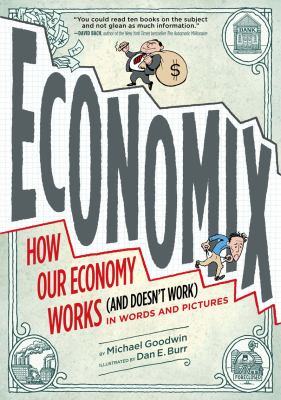
EconomixEconomix by Michael Goodwin. Illustrated by Dan E. Burr. This is a graphic novel/comic retelling of economic history and theory, from the time people first started thinking about it as such, through 2011. It’s in the graphic novel collection here at the library, but this really isn’t a novel and, while on a serious topic, is has a lot of jokes in it, so calling it a comic is more accurate. It starts with Adam Smith’s The Wealth of Nations (1776). All I could recall of Adam Smith’s theories was the bit about the “invisible hand”, and it turns out both that I’m not alone in remembering just that part, but also that remembering just that part is a radical simplification of his theories. Ideas like overlarge companies stifling the natural competition and too much profit being bad for the markets seem just as relevant now as they were 300 years ago. The graphic format makes it easier to keep track of the multiple dead white guys and their various theories, as their caricatures are all very distinct. Goodwin is scholarly enough to put actual quotes in quotes and italics, making it easy to distinguish what someone actually said from Goodwin’s paraphrasing of their ideas. Complicated ideas like derivatives are also easier to understand with pictures. In addition to economists, Goodwin looks at the effect on the economy of things like government policy (especially since the turn of the last century), wars, and international bodies like the World Bank. He notes truthfully that his writing gets more controversial as he gets into present-day debates because the score isn’t settled yet: plenty of people used to be convinced that the economy would collapse if slavery was illegal. Similarly, he thinks that big business saying that paying for the environmental cost of doing business isn’t supportable, or Wal-Mart deliberately relying on the government to subsidize the wages of its lower-tier workers, are ideas that will fall out of fashion. Another interesting idea: from the 1930s through the 60s (I’m forgetting the end date here), government policy was designed to increase the size and wealth of the middle class. Since then, politicians of both parties have made and supported policies to funnel wealth to the wealthy and to large corporations. These policies also have been very successful. He also says that our current economic debate in the political arena is stuck in the 1970s. Many of these theories are no longer supported by economic scholars, but they are still cited as proven facts by politicians, and by extension, by people who pay more attention to what politicians say than what economic scholars say. That would be most of us, and even though I often disagree with politicians, it’s nice to know that there are other accepted theories out there. Interesting, controversial, yet definitely approachable.

My librarian self was very impressed by Goodwin’s work, researching so many texts and lots of history, in such a way that it would be easy to follow up with the originals if I wanted to. Major credit goes to the artist, Burr, as well, though. This isn’t an easy topic, and his pictures illuminate tough ideas, keep a vast array of characters distinct, and do so while being funny. Funny enough and clear enough that my eight-year-old was able to understand the bits of it that I read to him. As the history ends on something of a downer if one is neither wealthy nor a corporation, he includes some of his thoughts on the future and what someone interested in a more level economic playing field might do. Well, it’s nice, but I wish there were more. I appreciated his annotated bibliography at the end, too. I’ll confess that I had to renew it from the library once before I worked up the courage to tackle it, and it was definitely something to read with brain cells turned on. Once I got started, I had a very hard time putting it down. Anyone looking to understand economics, whether for the first time or as a refresher, would be well served by reading this book.

Here’s an audio interview with Michael Goodwin from Graphic Novel Reporter.

Posted in books | Tagged , | Leave a comment

The Seven Tales of Trinket

Happy Thanksgiving, and thank you to all my readers! I am so very grateful to all of you! Also, many thanks to the many authors who support my reading addiction.

The Seven Tales of TrinketThe Seven Tales of Trinket by Shelley Moore Thomas

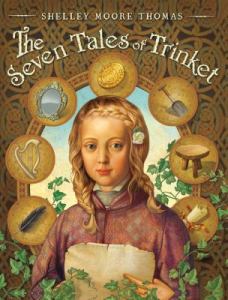
This gem-like book weaves new takes on many traditional Celtic stories together with that of a young girl in search of her father. Young Trinket, 11, was abandoned by her father, James the Bard, years before. He left on his travels, as bards will, and broke his promise to come back. Her mother now dead, Trinket decides to set off looking for her father. She takes with her the old and cryptic map of his journeys, and her friend, the slightly younger Thomas the Pig Boy. They find themselves in a Gypsy camp, and befriend a young Gypsy fortuneteller. She encourages Trinket to learn seven stories, so that she can stay a week in a place and have a new story to tell to each night in exchange for her keep. She also turns out to have heard the lullaby that Trinket’s father composed for her from a travelling bard long ago, so that Trinket is sure she is on the right trail, however cold. Now Trinket adds finding seven tales to her mission, along with finding her father. As she and Thomas travel, they hear of several other travelling bards, but none going by James the Bard. They do, however, have one adventure after another, including meeting with Selkies, a banshee, and a Pookah. All of them Trinket turns into stories or poems, and all except the first story of the Gypsy girl were takes on stories that were familiar to me, though Trinket’s stories tend to have happier endings. As she travels, and has more and more stories to tell, Trinket becomes known as the Story Lass. I would be remiss in failing to mention that she acquires, and learns to play, a harp! on her journeys, so she is a musical bard as well as a story-teller.

Even as exciting as Trinket’s adventures are, her reflections on who she is, who she’s becoming, and what kind of relationship she could have with her father should she find him still alive take up nearly equal time. The well-developed characters and beautiful writing make this a natural choice for people who appreciate these things. It feels nicely old-fashioned – I thought the cover represented this well. The way the stories wove in and out of the narrative reminded me of Where the Mountain Meets the Moon and Starry River of the Sky (review forthcoming.) It would also tie in well with anthologies of Irish, Scottish and Welsh traditional tales, all of which feature in this book.

Posted in books | Tagged , | 2 Comments

My colleagues were asking for my notes from the recent Michigan Library Association conference, so here’s my notes from an inspiring program on teen programming from one of our former interns and, you know, some other teen librarian she’s good friends with.  This was the last session of the day and ran way over because people couldn’t stop asking questions.

Beyond Duct Tape
Teen Programming with Kricket Hoekstra and Sarah Jones
MLA 2012

Sarah – $6500/yr budget; Kricket $1000/yr

Kricket says make friends with Gordon Food Services! There are kids who don’t get enough to eat at home even in wealthy communities.

For K. teen is 13-18; for Sarah 6-12th grades.

K. says college kids can come if they help

Both say no parents or adults

Get ideas from teens, your own interests and steal, steal, steal!

  • Give full-sized candy bars for good, legit program ideas

Get used to failure

Sarah’s successful programs channeling her interests:

  • cat toys
  • circus training
  • cupcake decorating

Best programs

      Hunger games summer reading finale – 216 teens

      • Cornucopia game
      • Tracker jacker shake-off
      • Popsicle stick, rubber band & Q-tip bow & arrows
      • Laser tag
      • Mellark’s cupcake decorating
      • $1600 price tag

Anime club & Graphic novel book club – 2x per month and annual prom

      • “bad” teen interested in manga reformed as club leader
      • “Comicon” every other newsletter cycle
        • 80-100 teens
        • Costume contest early in the event
      • Include wacky prizes so low-cost costumes have a chance
      • Video game music
      • Candy sushi-making station
      • Manga drawing
      • Origami station

D&D

      • 2 groups, 1-2 times per week, splitting to 3 groups soon
      • College kids as DMs
      • Munchkin an easier alternative

Pizza and Paperbacks (with Wal-Mart grants)

      • Show Nerdfighter videos
      • Pick books the leader likes, not just off lists

Writer’s Workshop

      • Now 10-15 kids coming
      • Book spine poetry
      • Exercises from teen writing books
      • NaNoWriMo meetings, including adults

After hours parties

      • Hide and seek and sardines over capture the flag

Teen bands – Noise@ the Library

      • Remind performers to come early for set-up
      • Keep stage moms low-key

Failure

      • Craft club
      • Movie night
      • Lego club
      • Teen-created zin
      • Martial arts demo
      • Shadow puppet workshop

Keep VOYA envy in check!

Be there after school every day!

Marketing

      • Newsletter
      • Facebook – both teen & adult pages
      • Posters/chalkboard in teen zone
      • In-library TVs

Prizes

      • Teens want candy & money
      • Have teens help with shopping

Rules

    • Keep them short and simple:
      • Don’t bother others
      • Language
      • Leave things the way you found them
Posted on by Katy K. | Leave a comment

Saga

SagaSaga. Volume 1. by Brian K. Vaughan. Art by Fiona Staples.
Brian K. Vaughan is such a popular author that of course I had to buy his latest book, even if I never quite got into Y: the Last Man myself. This one, however, looked like fun for me as well as a necessary addition to the collection. Alana and Marko are both soldiers from planets that have been warring for generations. They fall in love and marry when Alana is assigned to be Marko’s jailer, but when we meet them, Alana is giving birth to their child. They are on the run from the authorities of both their planets, as such fraternization with the enemy is illegal. Their baby is born with wings like her mother and buds that will be horns like her father’s. Observant readers will note that Alana is breastfeeding her on the cover, and does so frequently and without hoopla through the story – unlike me, creating hoopla here for normalizing breastfeeding, at least among winged humanoids. They must flee immediately, however, and Marko’s resolution to give up violence for good is severely tested. Their pursuers include two high-profile assassins, one human and one scary woman-topped arachnid. Escape means making a hard bargain with the current residents of the bombed-out planet they’re on, in hopes of finding the perhaps legendary Rocket Forest. The universe they’re travelling in is full of odd things, including a ruling class of TV-headed nobility, such as Prince Robot IV. Most of the characters have at least some human aspects, but that doesn’t mean they’re normal-looking by a long shot. The art is beautiful and glossy and as realistic as such fantastical creatures could be, with some really beautiful images. Commentary is provided by the baby, which is somewhat disconcerting but at least provides assurance that she makes it to be old enough to tell her own story. While the characters we’re following don’t have the time to get kinky, one of the assassins pays a visit to the planet Sextillion, whose shop windows have models engaged in just about everything. There is blood and gore on a regular basis. Those make this decidedly adult fare, yet for those who can deal with the blood and sex (I’m afraid it’s more of a “get past” in my case), this is the start of a galaxy-crossing adventure, starring our star-crossed lovers and their sweet baby. There’s a small amount of time to think in all this, about the energy put into preventing the thought of peace by the powers, and the violence this tiny family needs to keep itself safe.

Posted in books | Tagged , , | 1 Comment

I Kissed the Baby

I’ve submitted this post to the Kid Lit Blog Hop at Mother Daughter Book Reviews. Please hop over there and take a look at all the other great posts that are up!

Kid Lit Blog Hop

I Kissed the BabyI Kissed the Baby by Mary Murphy.
Bold pictures, mostly white on a black background, with shots of bright yellow and pink, illustrate this story. Pond animals including fish, birds, a squirrel, and insects, all join to welcome a new baby. Each spread features two animals, the first asking the other a question about the baby: “I tickled the baby! Did you tickle the baby?” “Yes! I tickled the baby, the wriggly giggly thing!” Finally, at the end, we meet the adorable duckling that everyone is so excited about. Though it isn’t rhymed text, lots of attention is paid to the sound of the words for reading aloud. The short text and bold images make it perfect for reading to babies and toddlers, but it was still fun enough for my eight-year-old to want to read it to his sister, and she both asked for it and read it to herself over and over again. I get asked about recommended books for new baby gifts often, and this is a great one. It’s still in print in board book, which is ideal for the target age, and you can still find it in hardcover if you look.

Here are other board book favorites about baby love just right for new babies:
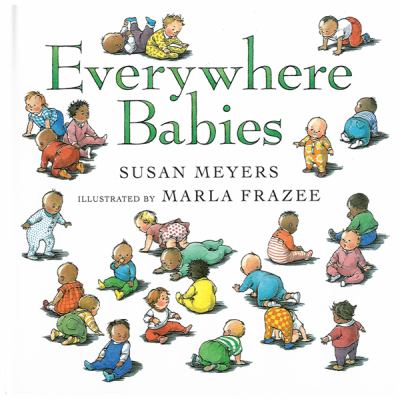
Everywhere BabiesEverywhere Babies by Susan Meyers. Illustrated by Marla Frazee.
Hush, Little Baby by Marla Frazee.
Snuggle Puppy by Sandra Boynton.
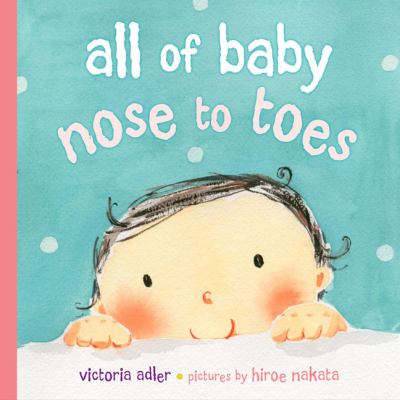
All of Baby Nose to Toes by Victoria Adler. Illustrated by Hiroe Nakata. All of Baby Nose to Toes

This book was a gift from our head children’s librarian at my son’s shower. It has 44 wonderful picture books in it, with color-coded age guidelines at the bottom of all the pages and in the table of contents. We take it with us whenever we travel and are able to stay entertained for weeks with no other books for the children. If you have the budget for a big book gift, this is a great choice.
The 20th-Century Children’s Book Treasury edited by Janet Shulman.

What are your favorite books to give to babies?

Posted in books | Tagged , | 3 Comments