
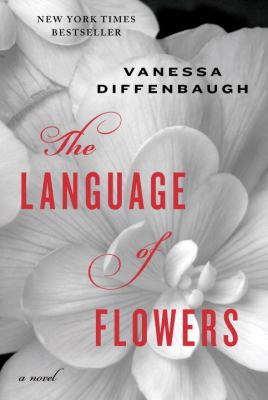
My friend and colleague Miss S. will leave book presents for me on my desk, sometimes for my children, and sometimes, as this one, for me.
The Language of Flowers by Vanessa Diffenbaugh
Victoria was abandoned as a baby and grew up in series of foster houses and group homes. Not surprisingly, growing up without real attachment to anyone, she’s never cared to invest herself in succeeding in school or looking for a career. Now 18, she’s aged out of the foster care system and is on her own, homeless and with no one to turn to. When her small start-up fund runs out, she lives under a bush in the park, making a small garden with plants she steals from around town. The flowers are her link back to the one foster mother who really cared, Elizabeth. We learn about her past with Elizabeth in chapters that alternate with her presence, Elizabeth who understood Victoria’s prickliness and who taught her the Victorian language of flowers. Back in the present, Victoria’s knowledge of flowers gains her a part-time job at a trendy San Francisco flower shop, Bloom, and a small room to stay in via the owner’s sister. On early-morning flower market runs, Victoria meets Grant, who sends her messages in flowers that no one who didn’t know the language of flowers could understand. Even when things seem to be going well, both in the past, as Elizabeth makes plans to adopt Victoria, and in the present, as Grant faithfully pursues her, things go wrong. Most often, heart-breakingly, it’s Victoria shutting things down before she can be abandoned again. I read this book over breaks at work, and more than once had to go and talk to Miss S. about it, how crazy that I had get back to work, leaving poor Victoria in such an unhappy situation. It was beautiful, and heart-wrenching for me in places that are too spoilery to talk about, but though some things can never be fixed, it was in the end ultimately redemptive.
Knowing the redemption was coming made it possible for me to finish the book. Diffenbaugh does an amazing job of making us care about Victoria, despite the considerable effort she puts into screwing up her own life. Normally I just get frustrated with characters like that, but it’s clear that Victoria never had the chance to learn any better. Diffenbaugh makes it clear in the introductory material that she’s an experienced foster mother herself, and how difficult it is for foster kids who age out of the system and don’t have the support that so many young adults need to be successful. Even though things turn out hopefully for Victoria, I was left wondering (I’m sure quite deliberately) about the many kids for whom life never improves. Is Victoria’s story not real enough, even if I couldn’t have borne it any tougher? In any case, this reminded me that I’m planning to knit scarves for the Red Scarf Project (at least once my kids are old enough that a scarf isn’t a four to six month commitment.), run by a foundation that provides support for former foster kids going to college. Diffenbaugh also started the Camellia Network to provide all kinds of support to kids aging out of the foster care system, college-bound or not. The book is well worth reading in any case, and would be a natural pick for a book club, thoughtful without being as depressing as many book club selections seem to be. It has some sex with consequences, which makes it appropriate for older teens as well as adults.
 Penny and Her Song by
  Liesl & Po by Lauren Oliver.
 Goldilocks and the Three Dinosaurs by Mo Willems
 Guinea PIG: Pet Shop Private Investigator. Volume 1: Hamster and Cheese. By Colleen AF Venable. Illustrated by Stephanie Yue.
  The Crown of Embers. Fire and Thorn Trilogy Book 2. by Rae Carson.

 Black Heart by Holly Black. Read by Jesse Eisenberg. This is the final book in the Curse Workers series. Cassel Sharpe is still meeting with the Feds, who are trying to get him to sign up as a permanent part of their program. His mother is hopefully just in hiding, after her botched attempt in Red Glove to seduce the governor and get him to stop anti-curse worker legislation. The love of his life, mob boss heir Lila Zacharov, has officially joined the mob herself and still hates him. When the feds have Cassel doing surveillance training with his older brother, Baron, he uses the time to track Lila. Meanwhile, back at school, his two best friends Sam and have miserably broken up, and Mina Lang, random unacquainted student, comes to him for help saying she’s being blackmailed. While he knows that she’s definitely not telling him the whole truth, he can tell that she is in some kind of bad trouble. And since new Cassel is trying to be good, he agrees to help her anyway. Then, when the Feds come to him with a job using his transformation abilities in exchange for amnesty for his mother, he agrees despite his misgivings. Being Cassel, he can’t just trust them, and his digging shows that he’s right not to. In all of the situations – his fraught relationships with his family members and Lila, his poor attempts at normal relationships with his school friends, and the problems with Mina and the Feds – he’s dealing with trying to find a difficult balance between what will work and what he considers ethical. There’s no margin of error, and people will end up dead at the worst and emotionally devastated at best. It’s deliciously noir, Cassel’s brief moments of happiness countered with almost immediate downturns, and kept from being unbearable by Cassel’s sarcastic humor. There’s also a nice character arc for Cassel as he realizes just how gray the world is.


 alibrarymama