
There have been a couple of books about parenting in other cultures recently that I just haven’t wanted to read. Just from the descriptions, I could tell both that the basic premise is “Americans are parenting wrong” (as if an entire nation could possibly all parent the same way) and that what they were advocating was a return to strict authoritarian parenting, which I am not interested in. This book, on the other hand, sent out a siren call.
 How Eskimos Keep Their Babies Warm by Mei-Ling Hopgood.
Hopgood is a southeast Michigan journalist who moved to Buenos Aires with her husband, also a journalist, and had her first child there. She started noticing that the Argentinean parents were breaking some of the hard and fast American parenting rules about giving children early and consistent bedtimes. She investigated further, talking to American sleep experts and her Argentinean friends and pediatrician, looking at sleep in other cultures as well. The Argentineans keep their children up late because everything happens late in Argentina – nine p.m. is typical dinner time. They say that it’s important for children to be with their families, and of course, a society that stays up so late also doesn’t get started as early in the morning as ours. The book has eleven chapters, each looking at different parenting practices and how they are treated in different cultures. Each has a primary focus on American vs. one other main culture, but other cultures are drawn in, too. She looks not only at the practices but the values that inspire them, looking at how other practices might and might not fit with typical American values, finally discussing what she took away to try with her own daughter. The sleep chapter, for example, brings in how the Western/American practice of insisting that children sleep in their own beds in their own room is quite rare globally. Americans want their children to become independent as soon as possible, and encouraging independent sleep is one way of doing that. Other cultures value togetherness more, and find the idea of leaving children and especially babies to sleep alone horrifying. Her chapters cover cultures and issues like the Chinese and early potty training, Kenyans and babywearing (aka going without strollers), the French and healthy eating, Mayans and working children, Lebanese Americans and keeping family close, Asian school success, Japanese letting children fight, Tibetans valuing pregnancy and (me forgetting the cultures) independent play & socialization by peer group, and super-involved fathers. For each issue, she looks at what she might I liked that there was a balance of attachment-parenting style issues like the babywearing and sleep schedules and things like keeping extended family close or the Japanese tolerance of children fighting that aren’t attachment parenting issues per say and that I haven’t seen discussed as often.
My shoulder hurts just thinking about her tale of trying an airport with a toddler and a ring sling, rather than any kind of two-shoulder carrier meant for older children, and I wished that she had found a Babywearing International person to consult on finding a better carrier for the purpose. However, I have finally learned, I think, how it is that babywearing cultures can keep babywearing so much longer than most Americans can manage: we are, collectively wimps. We start giving up on one-shoulder carries at about 15 pounds (this from my own wonderful babywearing advisor) and most people would consider a typical two year old too heavy to wear regularly. I know I find my thirty-pounder just too heavy. But the Kenyan mother she quotes, with a child a pound heavier, is used to carrying 50 and 60 pound sacks of grain; she considers him so light that she wouldn’t want to waste her money on a bulky stroller. I had mixed feelings about Hopgood’s conclusions from the French and eating chapter, too; she came to the conclusion that the solution is to expose children to real adult food earlier rather than later, to make time and space for eating and take it seriously – and to insist on children trying at least two bites of everything. I agree with everything except the last, based on the research of my favorite nutritionist Ellyn Satter, who advises the parents selecting the food, place and time and letting the children pick entirely how much and of what is on the table. On the topic of Asian school success, I was interested and gratified to read that it isn’t all a result of the Tiger Mother-style pushing whether or not kids are interested. Yes, there’s an element of “your success or failure reflects on the Family Honor” that doesn’t sit too well with American culture – but there’s also the aspect of Asians being convinced that success is mostly a matter of hard work, whereas American tend to believe that success comes from innate talent. The value of focusing on the effort rather than just the end result is something that has come up over and over in my research, from Montessori theories to Nuture Shock. It’s especially valuable for my family, as my son needs to know that the dyslexic label isn’t an excuse for failure but a guide to focusing his effort. And, quite curiously, I’d never heard about Japanese letting kids fight until quite recently, when I had two separate Japanese-American families talking about it. M., born in Japan but in the U.S. since high school, was shocked when she took her toddler to a Japanese play group. “They didn’t stop the children from hitting each other!” she said. K., an American who had her first child in Japan confirmed. “The schools are so strict – they just wait for the kids to start school and let them discipline them,” she said, adding that her child had a hard time attending both Japanese and American preschools, one where fighting wasn’t allowed and one where it was. But Hopgood, talking with educational experts, gives a different reason for allowing conflict: children need to learn that their behavior can upset people, and they’ll learn about real reactions best if they get to experience the real reaction. I don’t think I’d be rushing to send my child off to Japanese preschool myself with that philosophy, but at least it makes a little more sense.
The whole book is driven by curiosity and the message that there are millions of good ways to parent rather than judgment or a sense of parenting failure. I found it fascinating reading that’s light enough to be compelling and backed up with enough research (sources given!) to be legitimate.
 Roots of Empathy by Mary Gordon. The book describes the long-running school program of the same name (
 The Curse of Chalion by Lois McMaster Bujold. Read by Lloyd James. Lord Cazaril was once a castle-warder and a military captain. Now he is homeless and broken from brutal treatment on a Roknarri slave ship. He’s walked across Chalion on foot to get to the Provincara of the country estate where he was a page in his youth. He’s hoping for a place in the kitchens; instead, he is assigned to tutor the Royina Iselle, sister to the heir of Chalion, and her companion Betriz. Iselle is full of sixteen years of innocent passion and belief in justice, of the type that causes her to publicly expose a judge for suspected fraud. After a few months of trying to teach the girls diplomacy and caution along with the languages and geography of the surrounding countries, Iselle and her brother Tadez are both summoned to court. The king, their older half brother, is weak and ill and wants them to become familiar with courtly living. Unfortunately, returning to court for Cazaril also means facing the very men that Cazaril knows deliberately sentenced him to the galleys, now the king’s trusted advisers and the most powerful men in Chalion. Cazaril’s loyalty is tested to the utmost, as he becomes literally bound up with the curse that he learns is on all of the royal family of Chalion. He asks for the help of the Gods, and the Gods make it clear that they wish to work their will through him – if only he can figure out what their will is in time to save Iselle and Tadez. It was impossible not to hope for Cazaril not only that he would find his way through his dilemmas, but also that he could find a way to hope for a future for himself beyond his duty.
  Bigger than a Breadbox by Laurel Snyder. Our heroine Rebecca is about 14, I think, when her parents’ marriage starts really falling apart. Her father, an unemployed taxi driver and former teacher, has been absorbed in apathy, spending his time on the couch. Her mother, a hospital nurse, loses it in the middle of the week. She packs Rebecca and her little brother Lew, aged two, into the car and drives them from Baltimore to Atlanta to Gran’s house. She tells Rebecca that it’s just a temporary measure until she and Rebecca’s father get things sorted out, but she’s found a job and enrolled Rebecca in school. Rebecca, quite naturally, loves both her parents and would really like them to get back together again. She’s deeply betrayed both by the split and by her mother’s deciding to start a new life for all of them without so much as telling anyone ahead of time. She misses Baltimore and its seagulls as much as she misses her father and her best friend. While not speaking to her mother, she makes her way up to her grandmother’s attic, and it’s there that she finds, among a collection of old breadboxes, one that grants wishes. It takes a little bit to figure this out, of course, and to figure out the rules: she must wish for a tangible object that will fit in the breadbox. First it gives her an old Agatha Christie novel when she wishes for a book, which turns out to be perfect for taking her mind off the situation. But when she starts school and super-popular Hannah is assigned to show her around, it is perfect for giving her the cash and small gifts that will help her become the popular girl she never was at her old school. What Rebecca doesn’t realize at first is that even magic isn’t free. It takes her a while to realize the full truth about the breadbox magic, and even longer to figure out how to make things right again.
  The Books of Magic by Neil Gaiman. Illustrated by John Bolton, Scott Hampton, Charles Vess and Paul Johnson. This is an old Neil Gaiman, originally a 1993 miniseries, just brought back into print as a single graphic novel. Hooray for back in print Neil Gaiman! Twelve-year-old Timothy Hunter has magic potential, and a team of four mysterious (but probably familiar to DC fans) men in trenchcoats are watching him skateboard and deciding if they should offer him the chance to have a tour of the magic world. The men include John Contantine, Dr. Occult, and Mr. E. After Timothy’s yo-yo is turned into an owl, Timothy agrees to the demonstration/tour, following which he is to be offered a chance to start proper magical training or not. Each of the four mysterious men takes him to a different realm – past, present, Fairy and future. In each realm, he meets with famous people, some universally famous, like Merlin in the past and Baba Yaga and the Fairy Queen in Fairy, but also lots and lots of magic-using DC characters. I don’t read very many of the ongoing series type graphic novels, so most of these characters were familiar to me only from my work selecting graphic novels for my library, but while knowing them might have added to the story, I didn’t feel that I was missing anything not knowing them. (I’ve read only one short Zatanna comic book, but have seen lots of her on covers, and was quite tickled here to see that Timothy reacts with horror to the sight of her in her costume, when she changes out of her everyday clothes. Like most female superhero costumes, it’s ridiculously revealing and impractical.) In every realm, Timothy is in danger, both from the dangers inherent in traveling someplace one doesn’t really belong while wanting to get back to where one does belong, but also because Evil knows that Timothy is out there, and would like to either recruit or eliminate him. Timothy will witness things along the way that you probably wouldn’t want your twelve-year-old seeing – more along the lines of death than sexuality, probably fine for older teens and less sensitive younger ones, but still put in our adult rather than teen collection. This is a basic magical journey story, something that in the hands of a lesser person might be stereotypical. However, it’s Gaiman. It works beautifully, despite having a very limited amount of space to tell the story. All of the artists are top-notch as well, a different one for each of the original four comic books. It’s beautiful to look at just as art even while it’s art with a job to do: telling the story, maintaining continuity and the ability to recognize the characters from one volume to the next, at the same time as showcasing the artists’ distinctive styles. Any Gaiman fan will of course want to read this, as will those who enjoy a good fantasy yarn.
  Giants Beware! by Rafael Rosado and Jorge Aguirre. Graphic novels aren’t my favorites for reading aloud, but I was so excited about this one that I read it aloud to my son. (I read about it on
  The Scottish Prisoner by Diana Gabaldon. It must have been my very first year as a librarian, nearly ten years ago now, when a patron I was talking to put her hands on my shoulders, looked me in the eye, and said, “You have got to read the Outlander series. They are the best books in the world.” Well, I’m too fond of having lots of books to call any one series the best in the world, but for once, I took her advice and started the series. The books are addictive, long and involved, such a tight blend of historical fiction, time travel, and romance that the publishers originally decided to market them as romance mostly because romance had the biggest audience, though at the library, we shelve them in SciFi/Fantasy. Gabaldon now has a spin-off series and has done a graphic novel featuring the story from the first book from the point of view of the other main character. I haven’t kept up with all of these – I have a hard time justifying reading everything in a series as a librarian – but considering the volume of the output, I think that missing just one of the main series (which came out the same time my daughter was born) and one of the spin-offs is doing pretty well. Given all that, I was shocked to realize that I couldn’t find that I’ve ever reviewed a Gabaldon book here. However, there is again no way to review (or read) this book without massive spoilers for the first couple of those books.
 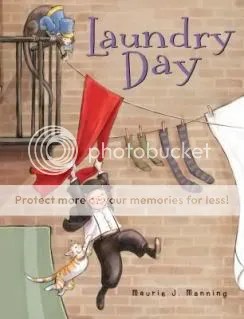 Laundry Day by Maurie J. Manning.
 The Microscope by Maxine Kumin. Illustrated by Arnold Lobel. I read this book to my son’s class in April, for Poetry Month. I like a funny poem for kids, especially, and this one is funny enough that I memorized for a high school poetry assignment, too. That time, I found it in a Cricket magazine, and though I have about half a bookcase devoted to my lifetime collection of Crickets, I couldn’t find the poem when I went looking for it a couple years ago. This year, I tried Google again, with better results. Now I have the perspective for the name Maxine Kumin to sound familiar. Right – former poet laureate and Pulitzer prize winner for poetry. Not only was the poem published as a picture book in 1984, but my library had it on the shelf, shelved with the biographies. It’s a tiny little thing, maybe 5 by 6 inches, so Teacher A. was kind enough to set up the document projector for me so the class could see the pictures. I’m not sure if this is irony or appropriate for the topic. In any case, we had fun.
  Storybound by Marissa Burt. Here is a book that called out to me from the shelf with its beautiful cover. It looked to have many things going for it – a lonely girl sucked into a strange magical world, a world where people study to become characters in books. Yay lonely girls, magic and metafiction! It was fun, but somehow not quite as perfect for me as I was hoping, in ways that I’m still trying to put my finger on.


 alibrarymama