Normally I read books with romance in them for the sweetness and warm fuzzies. While all of these books definitely have that, they also take a look at the role that love plays when times are hard and so, perhaps, is love.
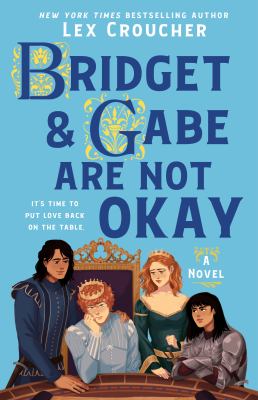

Bridget & Gabe Are Not Okay by Lex Croucher. Wednesday Books, 2026. ISBN 978-1250404800. Read from a library copy.
When we left our friends at the end of Gwen and Art Are Not in Love, things seemed to be in a good place. Enemies had been defeated, love acknowledged: cue the happy ending, right? Unfortunately, getting to that victory had a heavy cost. Gabe, who never wanted to be king, now is a teen king, feeling woefully out of his depth. He’s been having panic attacks, hiding in wardrobes to get away from all the meetings, and broke up with Arthur because he felt sure that all of his own pain would make Arthur miserable, too – only now both of them are miserable and apart from each other. Bridget, off on tournament tour, has not answered any of Gwen’s many letters, and keeps finding her focus shattered by memories of the horrific final battle of the first book. Into all of this come reports of happenings from old Arthurian legends around the country – sightings of the Questing Beast, the Green Knight, the Lady of the Lake, and the Holy Grail. Gabe’s new household and public relations manager, Lady Oakley, decides that the thing to do is to create a new Order of the Round Table and sent Gabe his knights around the kingdom to investigate these happenings and visit the new public schools he’s founded. And all that would be fantastic if it didn’t put Gabe, Arthur, Gwen, and Bridgett all so very close to each other, all the time.
As per usual when I’m reading an author I’ve read before, I did not read anything about this book before going into it, so even though the title puts it right out there, I was not really expecting the amount of time that the characters here spend being really not okay. Still, teens today have all been through a lot as well, and this mix of relatable tough issues and the maybe-magical adventures with gentle romance is a winning one.
Everything New Again by Renée Watson. Bloomsbury, 2026. ISBN 9781547605835. Review copy kindly sent by the publisher.
This tightly focused, thought-provoking book takes place over the two weeks of a Christmas break. 17-year-old Bliss has grown up in small-town Larch Heights, Oregon, somewhat isolated from her peers due to living above her family’s funeral home, wearing black, being comfortable with death, and her refusal to try to just fit in. She’s especially lonely over this Christmas holiday as her best friend Alex is spending the holidays in Mexico with her extended family. Solomon, meanwhile, is traveling to that same small town from Portland to finally meet his florist mother who left when he was a baby, even though spending Christmas without his father and stepmother is uncomfortable. He’s also uncomfortable with death, so that he’s clearly awkard the first time he meets Bliss while delivering flowers to the funeral home.
Within a couple of days, the two are exchanging phone numbers and spending time together, sharing deep thoughts. Solomon shares his passion for botany and the larches of Larch Heights, his dreams of college. Bliss shares her thoughts on life and death and wonders why it is that adults always ask teens what they want to be when they grow up, not who they are right now. Bliss is wrestling with several deaths in the community; hard despite her familiarity with death, as well as her parents’ overprotectiveness. Solomon’s relationship with his mother after such a long separation is fraught, especially as his mother is white while his father and the rest of the family he’s grown up with is Black. But while Solomon wants to be completely open with Bliss, Bliss knows that as much as she wants to share with him, she has a secret that she’s not yet ready to share…
This one had an ending that I thought I should have seen coming, but didn’t, so that I was very shocked. Without spoiling it, I’ll just say that it is beautiful and sad.
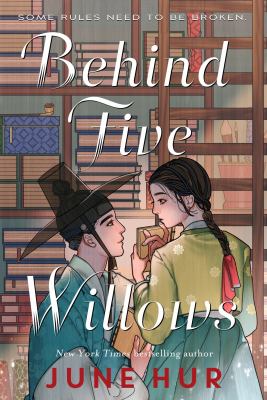
Behind Five Willows by June Hur. Feiwel & Friends, 2026. ISBN 9781250348081. Read from a library copy.
I was drawn to this book because of its setting in 18th century Korea, during the real period when the reading and writing of novels was banned. How could I resist a story of love between people connected by the secret fiction section of a bookshop under these circumstances? I didn’t know that it’s also a Pride and Prejudice remix, but that just added to the delight.
Haewon is the middle of three daughters, supplementing their family’s meager income and feeding her love for fiction by transcribing novels for the bookstore under the pen name of Magpie. She’s secretly thrilled that Magpie is the only one whom the novelist known only as Black Lotus has ever replied to, with a long string of intimate correspondance. Haewon’s beloved older sister, Jade, is just a month shy of the age when the law now declares she must be married or have the government choose a husband for her, a truly dreadful fate. And as the story opens, their younger sister, Yeonhee, has just run off to the local gibang, a courtesan establishment, to visit a friend, and must be rescued before their whole family’s reputation is destroyed.
Meanwhile, Lord Yu Seojun has been trying his hardest to focus on studying for the civil service exam and follow the law and his father’s wishes to set his love of fiction and writing aside, despite the stories burning inside him. One thing that’s kept him steady are his past correspondence with Magpie. No one must ever know that he is the Black Lotus. And both the Black Lotus and the Magpie assume that they are writing someone of the same gender, for such intimate letters between single young men and women would be horrifyingly improper. So when they first meet in person – Haewon trying to rescue her sister and Seojun determined to stay on his new fiction-free path – the dislike is instant.
This revisioning satisfyingly keeps a lot of the beats and major characters of the original, while adding in very realistic tension in the form of both the anti-spinsterhood edicts and the book banning. I loved how the strict rules of propriety translated so well from one culture to another, even as Jane Austen’s characters were not required to wear veils in public and could talk to men once they’d been properly introduced. This was a deeply satisfying take on the story – I’m sure fine if you haven’t read the book, but with an extra frisson of pleasure if you have.