
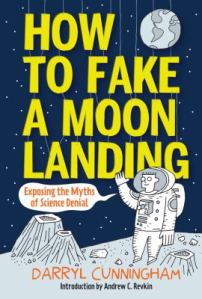
 How to Fake a Moon Landing: Exposing the Myths of Science Denial by Darryl Cunningham.
This is a collection of linked graphic essays. Cunningham delves into the science and history of a number of current controversies, with the comic book format making it both easier to understand the facts as well as more fun. If this seems like it might be dry, it isn’t. The controversies are all current ones, with passionate defenders on both sides. Cunningham is always passionate in his defense of the scientific method, if sometimes impatient in his criticism of deniers. I’d assumed that I, as an educated person, would find myself on his side, but it turned out that I sometimes did and sometimes didn’t, which made things even more interesting. Even Andrew C. Revkin, the scientist who wrote the introduction, says that he thinks that Cunningham is a little too harsh on the opposition in a couple of cases.
Cunningham starts off with the case from the title, the supposed faking of the moon landing in 1969. This he readily disproves, frequently using evidence from the MythBusters episode on the same topic as evidence. At this point, I’m feeling happy fuzzy feelings about the book. Then, he moves on to homeopathy. (I should clarify here that this is about strict homeopathy, usually dispensed as little round white pills, not home or herbal remedies, which are often confused.) Homeopathy relies, he says, on the memory of water, a theory which has never been duplicated and the results of which – homeopathic medicine – can’t be proven to be effective. He then goes on to cite cases of people dying because of their reliance on homeopathic medicine to cure things like cancer and malaria. Well! On the one hand, I find the whole water having memory thing suspect. On the other hand, I use homeopathy in ways which don’t fit his description of irresponsible use of homeopathy. I’ll start with homeopathy and move up the scale to herbs and then conventional medicine if I don’t find it working or I’ll take it as recommended by my doctor in combination with supplements and conventional drugs. I’d never rely on homeopathy instead of allopathic medicine in a life-threatening situation, but I have seen multiple cases of homeopathy working when conventional medicine didn’t. And, since it’s cheap and can work when conventional medicine doesn’t, I don’t care if it’s just the placebo effect at work. I had fewer problems with his next essay, on chiropractic. The only issue I saw was that he said that no method for reliably improving back pain has ever been found, when studies have been published that showed the admittedly low-profile Alexander Technique to be more effective than both conventional medicine and massage. The article on the MMR vaccine and the supposed link to autism had more and very damning information about Wakefield’s unethical studies than I’d seen before. But again, while I vaccinate my children, my friends who don’t have reasons that aren’t related to this disproved study and that are much more nuanced than presented in this article. The next article included fascinating proofs of evolution, such as the stage-by-stage development of eyes and the illogic of how whale fetuses first develop and then reabsorb limb buds. Next up is fracking, which the scientist in the introduction thinks is safer than Cunningham does. He goes into the myriad problems, including the documented health problems with many of the known chemicals (most aren’t disclosed) used in fracking (including benzene, lead, sulphuric acid and formaldehyde), and the vast sums that oil companies have put into covering up potential health and environmental problems and convincing state governments to change laws to protect them. This he likens to the similar situation with tobacco, and we can hope for similar results in the future. The article on climate change was solid, and was done through a conversation with a penguin. The final article goes over the scientific method, how it works and why science can be trusted. Here – well, Cunningham seems to be a die-hard imperialist, while I’m more a person who believes that science explains a lot of the world, and then we have things like religion and stories to help with other parts of the world.
The illustration style uses a mix of simple line drawings and deliberately pixelated photographs that morph to drawings. The regular grid pattern with text on top is easy to read even for those not used to the comic book format, but that doesn’t mean that Cunningham is just looking for graphics that fit marginally with his text. He’ll start with something like a picture of a duck on a lake at the beginning of a story, where the duck isn’t mentioned in the text at all, but reappears throughout the story and turns out at the end to have been a highly relevant example. The book is put together in a way that makes it easy to follow along with sometimes complicated ideas. I put it in the Adult Graphic Novel collection at my library, but this would be a great book to start conversations about science controversies with both adults and teens.
 The Tree of Mindala by Elle Jacklee.
 rim reality (as in early Harry Potter) or defer to the younger people (as in Prydain). Here, however, while Miranda eventually finds and implement a solution herself, a lot of essential action is taken by the adults who are much more experienced magic users and have been working against Thornton for years. I’m still trying to decide if it would be better for Miranda to have more agency or if it’s cool that Jacklee shows a more realistic adult-adolescent situation. Ultimately, while I enjoyed The Tree of Mindala, I didn’t love it. I think I’m alone in this opinion, though, as all the people on
  When The Tree of Mindala was first released, a friend and fellow mom said to me, “It’s a little like having another baby, isn’t it?” Of course, nothing can compare to the experience of becoming a mom, but it was hard to deny that, in some ways, she was right…
 Katy: What’s your elevator speech for Seven Against Mars? Do you have a specific audience in mind for it?
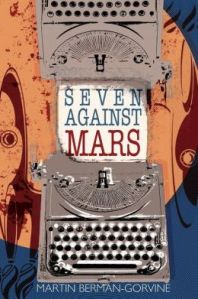 Seven Against Mars by
  Summer and Bird by Katherine Catmull.
 Hidden Voices by Pat Lowery Collins – for realistic fiction look at female musicians, this time in the eighteenth century
 The Birth of Venus by Sarah Dunnant – A tale of a young woman involved with an artist in Renaissance Venice, this features some forbidden romance, mystery and politics, just as Seraphina does.
 Music of the Renaissance by Giulio Ongaro – I’m not sure this would have the same kind of feeling as the novel, missing all the fictional elements.
 Dragonology: the Complete book of Dragons by Dr. Ernest Drake – not the same kind of dragons, but definitely high on the cool factor. This is one my library keeps copies of in both the youth and teen departments.
 learning to be a dragon hunter. The description says it has a dark atmosphere and a missing parent – it could work.
 La Rocque ‘n’ Roll: Popular Music of Renaissance France by the Baltimore Consort The Baltimore Consort has been performing early popular music since the early 1990s. This one seemed the closest to Seraphina’s music.
 Legend of Spyro: Dawn of the Dragon
 Owly. The Way Home & Bittersweet Summer by Andy Runton Owly helps baby worm find his way home. 4/16/13
 Three Thieves Book One. Tower of Treasure. by Scott Chantler.

 alibrarymama