Saffy’s Angel

This is the first book in a series popular among many bloggers I read, including The Book Smugglers and Charlotte of Charlotte’s Library. I snagged it for some comfort reading, and it pushed its way to the top of my TBR pile without my quite knowing how.
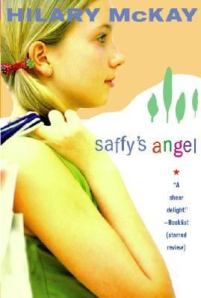
Saffy's AngelSaffy’s Angel by Hilary McKay.
Saffy’s Angel hearkens back to the old-fashioned heart-warming large family story, but with a quirky, modern sensibility. Eve and Bill Casson are both artists, which is why she named all of her children after paint colors. The children are Cadmium, Saffron, Indigo, and Permanent Rose. As the story opens, Saffy is about six, and learns for the first time that she is adopted – Eve is actually her mother’s sister. This revelation rocks her world. But we quickly fast-forward several years, to when Saffy is 13, ten years after her mother’s death. Their beloved grandfather dies, leaving behind a cryptic will. Bill, the father, is the most odious father I’ve ever seen in a cozy family drama. He decided some years before that a real artist couldn’t work with so many children around, so he rents a flat and a separate studio in London and only visits on weekends. So when Saffy wants to know what the angel she was willed was and where it is, Bill just tells her it either never existed or was lost and she should forget it. But Saffy can’t. Her friend down the street, a rebellious rich girl in a wheelchair named Sarah, concocts a plan to take Saffy to Saffy’s first home in Italy to do research, while her siblings make their own plans.

But this is a whole family drama, and all of the family members have their own stories going on, too. Eve, the mother, while perfectly affectionate, is a classic absent-minded artist, so the children alternately take care of things themselves and direct her. Caddy, the oldest daughter, is stretching out her driving lessons as long as possible because of her strong attraction to her teacher, Michael. Indigo is trying hard to cure his fear of heights by hanging out of an upper-story window, so he can be a polar explorer. I found myself caring intensely about the family and all its members (with the exception of Bill, who never really belongs), despite the neglectful parents and the high level of mostly-happy chaos that they live with. I found the blogger-love deserved, and went on to the next book immediately.

Other family dramas I’ve reviewed:
Five Little Peppers and How They Grew
The Penderwicks and The Penderwicks and Pointe Mouette.
Posted in books | Tagged , | 8 Comments

Dragons, Princesses and a Fairy

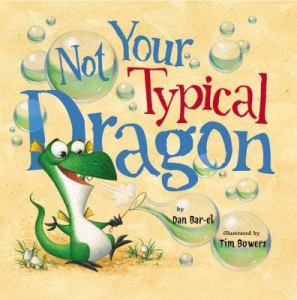
notyourNot Your Typical Dragon by Dan Bar-el. Illustrated by Tim Bowers.
Crispin Blaze is a young dragon looking forward to his seventh birthday, when dragons start to breathe fire. But when he tries to light the candles on his birthday cake, whipped cream comes out instead of fire. Only his little sister, Ashley, is happy about this (I love their names). His horrified father rushes him to the doctor the next day, and Crispin joins the fire-breathing training at school after that – but he breathes Band-Aids at the doctor’s office and marshmallows on the training field. Convinced he’s a disappointment to his family, he runs away, only to be found by a young knight whose father won’t let him come home until he’s slain a fire-breathing dragon. Sir George does his best to help Crispin, using his dragon manual, but nothing works. In the end, Crispin goes home and saves the day with his unconventional object-breathing. It’s illustrated in a goofy style that looks like a hybrid of computer graphics and watercolor, and the setting, too, is a mix of medieval and modern, as the Blazes live in a regular suburban house while Sir George wears plate armor. My three-year-old daughter loved this, and I read this to all of the second and third graders at my son’s school, who also loved it. The adults all loved the message of acceptance for people who don’t fit the standard mold, especially boys who aren’t aggressive or athletic.

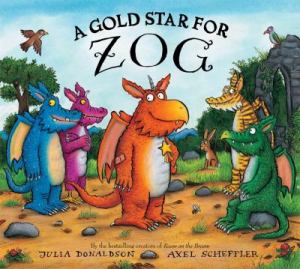
A Gold Star for ZogA Gold Star for Zog by Julia Donaldson. Illustrated by Axel Scheffler
Another tale of an unconventional dragon: Zog is a dragon who always tries his best at dragon school, but each year’s final assignment finds him pushing himself too hard. He flies into a tree, lights his own wing on fire, and so on. Each time he’s rescued by the same girl who patches him up and sends him on his way, until the year when he’s assigned to kidnap a princess. Then she reveals that she is a princess, hates palace life, and would much rather be a doctor to the dragons. The scansion on the rhymes faltered painfully, and my historical fashion sense was horribly violated by Pearl dressing in something like late 19th-century to early 20th-century schoolgirl clothes while the other people were dressed in late medieval to Renaissance style. Still, it has a good message with both girl and dragon breaking free of expectations to follow their dreams, and my daughter loved it.

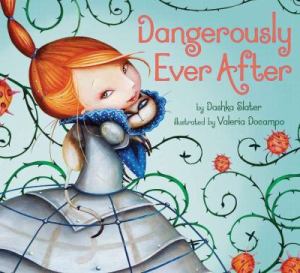
Dangerously Ever AfterDangerously Ever After by Dashka Slater. Illustrated by Valeria Docampo.
Princess Amanita loves everything dangerous, especially her garden full of dangerous and deadly plants. When a prince from a neighboring kingdom bikes over to visit, she’s not sure what to do with him. As the story unwinds, Princess Amanita finds herself biking through a dark and dangerous forest with a bouquet of nose flowers, realizing that danger isn’t quite so fun when she’s not controlling it, as well as learning about friendship. I got this (after reading many reviews from fellow book bloggers), mostly for my daughter who’s just starting to get excited about princesses. It turned out to be borderline too long for her. But my eight-year-old son and his classmates thought it was hilarious. My son especially appreciated Docampo’s fashion choices: Princess Amanita’s clothes are as full and frilly as you could want a princess’s dresses to be, but always blue and frequently with exposed metal hoops or studs, and her hair done up to look like a scorpion’s tail. The illustrations are lush and beautiful, and Princess Amanita is the rare princess who’s equally fun for girls and boys.

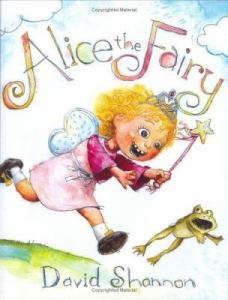
Alice the FairyAlice the Fairy by David Shannon. How can you go wrong with David Shannon? I had so much fun introducing my three-year-old to Alice, as I introduced her brother at a similar age. Alice describes her doings as a “temporary fairy” – turning her father’s chocolate chip cookies into hers, or making herself invisible. The words describe the magic while the pictures show the reality – her wands lets her reach the light switch. There’s no plot, and Alice makes the kinds of poor choices you’d expect a four-year-old to make, but somehow the book is still utter delight. We found the book-with-CD kit at the library, and my daughter listened until she had the whole thing memorized.

Posted in books | Tagged , , , | 7 Comments

Cabbage Soup, Princess Stories, and the Ballou Book Fair

It’s book fair time again at Ballou Senior High School! For those that haven’t heard of it, the community over at Guys Lit Wire has been working for a couple of years to build up a decent library for the kids at this inner city D.C. high school. The ALA recommends 11 books per child at school libraries; Ballou had less than one when Guys Lit Wire first hooked up with them. They’re now up to five books per kid, but there’s still a long way to go. They have a wish list over at Powell’s books, and lots of the books on the wish list are on sale. They are also fine with books in “standard used condition.” Buy your favorite teen books or buy what’s on sale – but please pause a moment to consider the horror of kids not allowed to feed a reading addiction and pick something out for them. Send them to:
Melissa Jackson, LIBRARIAN
Ballou Senior High School
3401 Fourth Street SE
Washington DC 20032
(202) 645-3400
From Chasing Ray: It’s very important that you get Melissa’s name and title in there – she is not the only Jackson (or Melissa) at the school and we want to make sure the books get to the library.
Read lots more about this at Guys Lit Wire and at Chasing Ray.

My daughter, at three and a half, is just getting old enough to ask for stories sometimes as well as music. Here is some of what we’ve tried.
Cabbage Soup
Cabbage Soup by Children’s Radio Theatre. It was not so long ago that my mother found this CD version of Cabbage Soup, which had been a favorite cassette when I was growing up in the 1980s. It has two stories on it. Cabbage Soup is a silly musical retelling of Rapunzel, while Beauty and the Beast is a straight-up radio drama of the original, both with full casts and soundtrack. In Cabbage Soup, the Rapunzel household is shared with a wise-cracking talking bear named Max, who occasionally interrupts the story to let the characters know that they are not following the story appropriately. The vegetables in the witch’s garden talk to Mr. Rapunzel; Mrs. Rapunzel’s craving is for cabbage soup, not rampion; the prince Rapunzel’s talking bird finds to rescue her wears thick glasses and hiking boots. It’s all punctuated with cute musical-style songs about the magical powers of cabbage soup and (from the witch) how tough it is being evil. I loved this so much as a child that I once inflicted the entire half hour on my birthday-party guests; my daughter listened to it endlessly for a couple of months and still asks for it frequently. The Beauty and the Beast retelling has only a couple of songs and much less to separate it from any other audio retelling, but my daughter seems to love it quite nearly as much, though it took us a few weeks of her asking for “Fairy on the Beach” to figure out what she wanted.

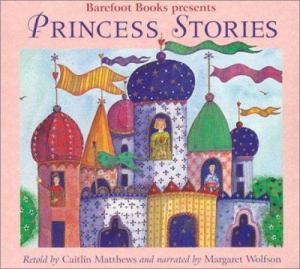
Princess StoriesBarefoot Books Presents Princess Stories retold Caitlin Mathews. Narrated by Margaret Wolfson.
I checked this one out from the library in a vain attempt to introduce some variety into my daughter’s audio fairy tale diet. This has seven stories from around the world, all featuring princesses. There are lovely harp and flute interludes between each of the stories. Here are the stories: the Princess and the Pea (Denmark), the Mountain Princess (Persian), the Princess Who Lost her Hair (Akamba), the Birdcage Husband (Central Asian), the Beggar Princess (Chinese), the Horned Snake’s Wife (Iroquois), and the Sleeping Beauty. I’ve been a fairy tale junkie since childhood – I read through nearly every anthology I could find at my childhood library – but only the first and last stories were familiar to me. There was a nice balance between more traditional princesses like the one in “Sleeping Beauty” and more active princesses like the one in “The Birdcage Princess”, who had to rescue her husband, as well as princesses who rescued themselves from bad husbands. The narrator has a rich voice that was very pleasant to listen to, though she didn’t do lots of voices for all the different characters. These are not necessarily gentle stories – the greedy husband in “The Beggar Princess” tries to murder her when he thinks he can find a better wife – but neither are they scarier than your average Disney fairy tale movie. Sadly, my daughter did not like them – I think the condensed amount of story-telling needed to fit seven fairly complicated tales onto one CD made them too hard for her to follow. I, however, enjoyed them very much, and think that she’ll be ready for them in a year or two, and at least up to age ten.

Posted in books | Tagged , | Leave a comment

The One and Only Ivan

A quick note to say that it’s Kidlit Blog Hop day today. I’ve put in my review on Dragonbreath from last week, but you should go over and check out the rest of the hop!

This is both the last book of my reading of the 2012 Cybils mg sf/f finalists, and the book that won this year’s Newbery. The way it always works in the library is that the books that win the Newbery and Caldecott medals develop an instant wait list as soon as the awards are announced. Sometimes I put my name on the list right away; this time I just waited for the demand to die down.

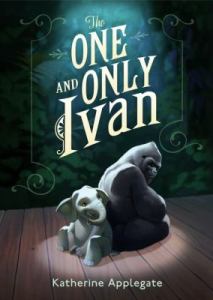
The One and Only IvanThe One and Only Ivan by Katherine Applegate.
Katherine Applegate is also one of the co-authors of the Animorphs series. This book, she says, is loosely based on the true story of a gorilla who was kept in a mall for many years before finally being moved to the Atlanta Zoo. Ivan, the narrator of our story, lives in the highway-side Big Top Mall, where he makes pithy observations on humans and their ways. A large billboard by the highway advertises “The One and Only Ivan, Mighty Silverback.” He writes, in brief, poetic chapters, of his life and friendships at the Big Top Mall and before. Initially, he is completely absorbed in the present. He talks of Stella the elephant and her stories, Bob the homeless dog who prefers to be free, and George the janitor, who brings his daughter Julia, who in turn provides Ivan with art materials, which he likes both for drawing with and for eating. The Big Top Mall is no longer doing well. Mack, the owner, can’t afford proper food or medical care for the animals, but decides that what he needs is a new baby elephant. When Ruby comes, heartbroken at being taken from her family, Stella and Ivan are determined to protect her. It is only for Ruby that Ivan remembers his past and the painful events that brought him to his cage in the mall. Finally, Ivan realizes that he has to help Ruby escape the slow death of the mall and find a better life.

It’s a deeply moving story with strong characters told in lyrical language – but I was still a little dubious when reading it that it would actually appeal to kids. Even the biggest, most dramatic events seem to happen slowly and are described very calmly by Ivan – actually probably a good thing for children reading of the deaths of gentle animals. And, though the thinking animals make it fantasy, the animals still behaved like animals, so it’s more like Charlotte’s Web-style fantasy than, say, Redwall. However, my son’s best friend read it with his class, and said that they liked it. G’s favorite character was Bob, the scrappy little dog. In short, if you’re looking for heavy action or magic, this isn’t the book for you. It’s still beautiful and well worth reading.

Just for reference, here’s the full list of the finalists:
Beswitched
The Cabinet of Earths
The False Prince
Geeks, Girls, and Secret Identities
The Last Dragonslayer
The Peculiar

Posted in books | Tagged , | 3 Comments

Bad Girls

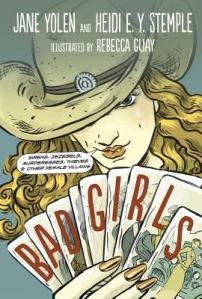
Bad GirlsBad Girls by Jane Yolen and Heidi E. Y. Stemple. Illustrated by Rebecca Guay.
I first heard about this on the Kidlit Celebrates Women’s History blog, and the teen librarian was kind enough to buy it for me. The basic premise is just so fun – the book gives brief prose biographies of famous “bad girls” from history, from Delilah and Jezebel to the women of crime who inspired Chicago. Following the bio is a one-page comic panel discussion between the authors – the famed Jane Yolen and her daughter, Heidi E.Y. Stemple – about whether the woman in question was a truly bad girl or just misunderstood by history. Each biography is preceded by a full-page portrait by Guay, which are breathtakingly beautiful and beg to be made into posters. The bios are told in zippy modern language – just enough to whet the appetite, with enough resources for a full school report listed in the back. I ended up being frustrated by what I’d thought would be my favorite part of the book, the mother-daughter debates. I still think the idea has potential, but unfortunately, they always take the same positions – Jane says that the women are misunderstood, and Heidi, with a criminal justice background, says that they are bad. I would really have liked to see some more nuanced discussion, with the two agreeing about a person one way or the other at least some of the time. Another slight but understandable disappointment is that the book covers only women from classical history and the West, with the single dubious exception of the Russian Madame Popova. On the one hand, I’d’ve liked to see a little more diversity; on the other, if the subject is famous bad girls, it’s much harder to dig for women whose notoriety hasn’t spread to us. In short, I ended up not loving this quite as much as I’d hoped I would, but it’s still a lot of fun. It’s good light reading (um, considering the number of murderesses covered) for teens and up, both for fun and as preliminary research for biography projects.

Posted in books | Tagged , , | Leave a comment

The Scorpio Races

The Scorpio RacesThis is me, resolving to read more books by authors I like, rather than trying to explore the maximum number of authors. Here, I continue my love affair with Maggie Stiefvater with a book that I didn’t quite get around to when it came out in 2011.
The Scorpio Races by Maggie Stiefvater. Read by Steve West and Fiona Hardingham.
In this standalone book, we travel to the remote British island of Thisby. There, every November, people train and race the deadly water horses called capaill uisce (pronounced “kapull ishka”) on the beaches. The narration alternates between Sean Kendrick and Kate “Puck” Connolly. Sean Kendrick, 19, effectively an orphan since his mother left for the mainland when he was tiny and his father was killed in the races when he was 10. Now he’s a four-time winner of the Scorpio Races, working for the breeding stables of rich Benjamin Malvern, and longing more than anything for a chance to own the red capaill uisce, Corr, that he’s ridden since his father fell off during the race. Puck, a couple of years younger, lives with her two brothers since they were orphaned when a capaill uisce took both of their parents from their fishing boat a year ago. Now they are barely making ends meet, as older brother Gabe has the only real job among them, working at the hotel, while Puck paints pottery for tourists and Finn bakes cookies for local stores. When their situation suddenly gets worse, Puck decides that the only solution is for her to race as well. It doesn’t even occur to her that she is the first girl ever to attempt it, or that the men who manage the races will do whatever they can to stop her.

It’s a dark and bloody story, filled with the crash of black water on cold, rocky beaches, the desperation of people determined to survive on the inhospitable island, the love of horses both natural and supernatural, the thrill of the race, and a wee bit of romance. Stiefvater has built a whole island culture around the sketchy existing myths, with rituals, charms, costumes, music, and food (there’s a recipe for the tantalizing November Cakes that appear in the books on her website. And while there, I found that the German version of the book is titled Rot Wie das Meer or Red Like the Sea – poetic but quite different.) Once again, I was drawn in by the audio version, featuring her original music and two narrators, just as she had for Shiver. She says in her author’s interview that she has music for every scene in her head, but she only writes down one tune for each book – surely I’m not the only one who wants them all. I think that when I get around to reflecting soberly on the matter, I might find that I prefer Raven Boys to this – but while caught up in this one, there’s no room for comparisons. Just go read it.

Posted in books | Tagged | 6 Comments

Dragonbreath

I’ve been waiting for a couple of years now for my son to be old enough to read this series, which I keep hearing about from Charlotte at Charlotte’s Library. Finally, I thought, we might be there. I brought it home from the library – but not quite yet. The handy Scholastic book leveler says that it’s a grade 4.3 or Guided Reading level R book, and my son is reading on target for late grade two. I read it aloud to him instead, and he gave it an enthusiastic thumbs-up.

Dragonbreath

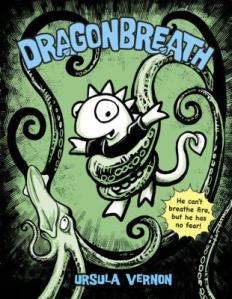
Dragonbreath by Ursula Vernon.
Danny Dragonbreath, 5th grader, is “the only mythical creature at a school filled with reptiles and amphibians.” He can’t breathe fire yet, though he practices frequently. This is the first of his adventures with his best friend, Wendell the iguana. He’s got some troubles at school with Big Eddy, a Komodo dragon who resents Danny says he’s a dragon, and keeps stealing his lunch. This time, Danny might be saved by a rogue potato salad. But he’s on to bigger problems – the report on the ocean that he made up in the bus on the way to school got an F, and Danny needs to rewrite his paper with some actual research fast. Wendell, a cautious critter prone to do things the traditional way, suggests a trip to the library, but Danny isn’t interested. Instead, he decides to pay a visit to his Uncle Edward, a sea serpent. Taking the handy bus that goes from their town to the Sargasso Sea, they are soon ringing Uncle Edward’s doorbell on the docks. He provides them with some breathing mints so they can join him underwater, and they are soon on their way, exploring a coral reef, skirting the guards around Atlantis, and visiting a shipwreck and the dark deep sea. Except for Atlantis, the information is realistic, and could inspire some trips to the nonfiction section of the library. It’s all exciting fun with a big sense of humor, perfect for grade school boys. (Not that girls wouldn’t enjoy it – I did – but for those looking specifically for books for boys, this is a good one.) In addition to spot illustrations, there are comic panels interspersed every so often – a little like Diary of a Wimpy Kid, but with segments that will go for a page or three, showing the most exciting parts of the story before switching back to prose. The blend of regular school mishaps, science adventure, and fantasy was a potent one for my boy. It made for fast reading aloud. We finished off the last half in under an hour while he was in bed with a fever, perfect entertainment for the situation. It’s a great choice for reluctant or beginning readers, and I’ll add it to my list of First Fantasy Chapter Books.

Posted in books | Tagged , | 12 Comments

Cold Fire

I actually bought this book for myself. It was sitting on the shelf waiting for the flow of library books to slow down enough to read it. Then my friend L asked for a steampunky book to take home right then, and I had nothing to give her but the first book in the series – so I had to start the second right away so I could be ready to loan it to her when she finished the first one.

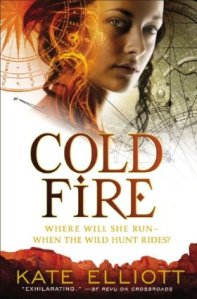
Cold FireCold Fire by Kate Elliott.
This is volume two in the series. When last we left our friends… well, honestly, it was a while ago and I didn’t have the first book on hand to look through and it took me a little while to get back in the swing of things. Cat, our heroine, her beautiful cousin Bee, and her half-brother (and saber-tooth cat) brother Rory are on the run from the mage house she married into. They take refuge in the law firms of some trolls that Cat befriended in the last book. Cat and Bee are initially hoping to find a job there, but things do not go as planned. The former and would-be future emperor Camjiata (who seems much like Napoleon, though he is from Spain) tells Bee that his now-deceased wife had told him of her. She, like the dead wife, walks the dreams of dragons, which shape the world. To walk the dreams is both to have knowledge of the future, and to be targeted by the Wild Hunt. He, of course, wants Bee and Cat to help him. But as Camjiata and his party hide, Cat’s husband, Andevai, comes, followed by a party of soldiers. Mass chaos and chasing ensue, followed by an interlude of prophetic conversation at the University Cat and Bee used to attend – and then a trip to the Underworld. When Cat resurfaces, she’s in the Caribbean. She has found out – to her horror – who her actual sire is. A lot of time has passed on Earth and she now has only a few months to figure out how to save Bee from the Wild Hunt. In Elliott’s reimagined Earth, most of the Caribbean is still the Taino empire, with European ownership limited to the sprawling city of Expedition.

There is really too much going on here to summarize it all. There is lots of excitement, both political and personal, and we learn more about the various people and cultures of the world, all interesting. In the hot Caribbean, the cold mages that rule in the cold north are considered mythical, and power goes instead to fire mages. Cat has some very close encounters with a fire mage who works for Camjiata. Cat and Andevai meet again, and I’m happy to say that their relationship in this book is much more satisfactory. In the first book it was all cruel words and thoughts of undeniable attraction – because men being deliberately unkind always make women want to kiss them, right? Here they’re able to avoid the love-hate relationship, and while the path to true love is still fraught with difficulties, it’s much more Cat trying to avoid attachment to Andevai because she’s on a dangerous quest. One of the cool things about this series is that while Elliott has mixed the cultures up in new ways, except for the troll culture, they are all real historical cultures. There isn’t much room for Cat’s religion, but she follows the traditional religion of the people who call themselves Kena’Ani and whom the Romans call Phoenicians. She prays to Ba’al and Astarte, gods whom I’d been familiar with only from the Bible where they are the Evil Enemies of all Good Israelites. You know, as opposed to the gods of Greece and Rome and the Norse, who don’t really figure in the Bible and whose mythology we read straight up. This perspective shift fascinates me, though it was really a tiny part of the book. Elliott still does an amazing job with keeping a large cast of characters and multiple plot lines straight, in this series, all told from Cat’s perspective. Even though there’s plenty of darkness what with constant danger, threats on people’s lives, and emotional uncertainty, I found this deeply satisfying to read.

Posted in books | Tagged , | 3 Comments

Crewel

Look! It’s a fiber-related dystopian fantasy/sci-fi novel!
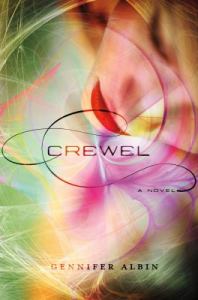
CrewelCrewel. Crewel World Book 1. by Gennifer Albin.
Albin takes some modern teen dystopia tropes and mixes them up with her own take on Greek mythology. Arras is an extremely patriarchal world, where most women are assigned work as secretaries, teachers, or nurses, with male bosses. They are assigned beauty routines and told how many children they may have. Marriage is required by 17, strictly through marriage profiles, as families live in gender-segregated neighborhoods to help enable the strict purity standards. The lucky few who escape this life are called Spinsters. They never marry and are given the best in clothing, food, and up-to-date beauty procedures as a reward for their work, weaving the world of Arras on their looms. Adelice has known since she was eight and started seeing the weave of the world around her that she had the skills – but her parents have trained her to fail at the tests that would take her away from them forever. Except that, during the last test, she can’t make herself fail and is taken anyway. Her father is killed trying to cover her escape, her mother and sister taken captive, while she is still taken to the Coventry to be trained as a Spinster.

Once at the Coventry, Adelice quickly learns both that her talents are unusual even among Spinsters, and that those in power at the Coventry will stop at nothing to gain her cooperation, even wiping out an entire girl’s school when she refuses to pull out the thread of a life that is starting to fray. But not everything is black and white. The woman in charge of recruits, Maela, is sadistic and power-hungry, while her mentor, Enora, is kind if reticent. Very oddly, there are two boys on staff – the gardener/valet Jost and Maela’s personal assistant and pretty boy Erik, both of whom befriend Adelice. Jost is both kind and seems to know about underground resistance to the powers that be, while Erik charms Adelice despite her belief that he’s nothing but Maela’s lap dog. Adelice knows from the beginning that her parents must have had good reasons for trying to keep her out of the Coventry, but finding out what those were and what exactly is rotten in Arras is difficult. She must be trusted enough that she can continue her Spinster training, and despite everything, she is deeply attracted to the beauty of the weave. But the more powerful she shows herself to be, the more tightly she will be controlled. And they have her sister.

I was first attracted to this because of the fiber arts aspect. She does mix her fiber metaphors a bit, as Spinsters ought to produce thread, not weaving – but I can forgive her that, as the conceit seems to work, for the most part. Both Adelice and the reader have to ask what is real, if Spinsters can pull out the thread of a person, give them different memories, and weave them back into a different family. It came off as fairly light most of the time, which made the few moments of unexpected violence that much more powerful. I could have done without the obligatory love triangle, especially since her attraction to Erik seemed dubious at best. As far as appropriateness, there’s nothing to make it inappropriate for younger teens or advanced middle grade readers in the way of sex or violence. I’ll note that there is a lesbian couple, mostly as this is still relatively rare in genre fiction like this, but sadly, we don’t really get to see much of that couple’s romance. For those who like their series complete, this does end with a jolt, and the second book is not due out until October. It probably won’t go on my all-time favorites list, but this was a quite enjoyable dystopian-with-romance.

Posted in books | Tagged , | 2 Comments

Potty Training Favorites

It’s time for my once-a-month Sunday booklist.
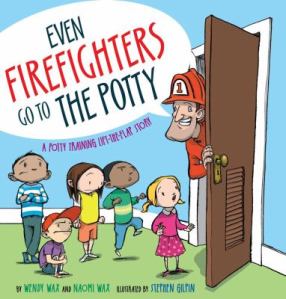
evenMy most recent request along those lines has been from my sister-of-the-heart, M. She was looking for toilet learning books for her two-year-old. As it happens, I have some potty training experience under my belt. Those of you happily past that time, feel free to move along or share your favorites.

This time, instead of first making my list a regular post and later converting it to a page for easier reference, I’ve made it a page right away. Here it is: Best Potty Training Resources. Please let me know what you think!

Posted in books, Movies | Tagged , | Leave a comment