The Last Dragonslayer

This was on the Cybils middle-grade sf/f shortlist (though my library shelves it in teen.) It’s the next-to-last book for me to read on that list, and I finished the last one, The One and Only Ivan, yesterday.

The Last DragonslayerThe Last Dragonslayer by Jasper Fforde.
Fforde is the author of the Thursday Next books, beginning with The Eyre Affair, which I have very much enjoyed. This is his first book for kids. Jennifer Strange, 15-year-old indentured foundling, runs Kazam Mystical Arts Management in the absence of its owner. In the old days, magic was plentiful and strong, and people lived in fear of dragons. Now, though, magic is hard to come by, and the proper forms must be filled out before performing any spells. Those gifted in the mystical arts are reduced to using magic to clean drains and rewire houses, while magic carpets are used for pizza delivery. Even those jobs are getting harder and harder to come by as magic dries up and drain cleaner becomes cheaper than magic. And then things change. Generations ago, the wizard the Mighty Shandar created the Dragonlands and set up the treaty that would keep humans and dragons separated, as well as establishing a Dragonslayer to enforce the treaty on both sides. Now, there are sudden surges of magic and multiple people having dreams and visions of Big Magic. They say that the last dragon is about to die, and that the last Dragonslayer will be the one to kill him. But when Jennifer finds out that she is the Last Dragonslayer, she doesn’t want to help the large corporations who are greedy to claim the Dragonlands for their own, and she especially doesn’t want to rush in and kill an aged dragon who’s never broken the treaty and who seems ready to die of old age anyway. Something must be done, and it’s up to Jennifer Strange, her fearsome pet Quarkbeast, and her new assistant and fellow foundling Tiger Prawns to figure out what. Continue reading

Posted in books | Tagged , , | 5 Comments

Will Sparrow’s Road

I’ve submitted this as part of the 13th Kid Lit Blog Hop:

Kid Lit Blog Hop

[Edited 4/3/13 to add Kidlit Blog Hop link.]

Will Sparrow's RoadWill Sparrow’s Road by Karen Cushman. Read by Katherine Kellgren.
This is the most recent audio book that my son and I listened to. I was excited for this books on two counts – a main character I thought he would easily identify with from historical fiction favorite Cushman, paired with narration by our favorite Katherine Kellgren. I was not disappointed. Young Will’s mother ran away when he was very young, and his alcoholic father has since sold him to the innkeeper for beer. When the innkeeper says he’s selling him as a chimney sweep, Will runs for his life. Life isn’t easy for a homeless and penniless boy in Elizabethan England. After quite a while of trying to make it on his own, having his few possessions stolen and living in turn mostly off of stolen green apples, Will discovers the Fair. Not only do the food booths there provide easier targets, but the many performers there offer a means of earning actual money. He’s gotten a job passing the hat for a juggler and met a kind man with a trained pig named Duchess when the juggler unexpectedly leaves, sending him to a Master Trumball, owner of the Oddities and Commodities stall. Master Trumball travels from fair to fair with his combination mini-museum and freak show, which includes a baby mermaid in a jar, a girl with a furry face like a cat’s, and a foul-tempered and ugly dwarf named Lancelot FitzHugh. Will travels England, getting to know the colorful regional fairs, which is quite a lot of fun. But as he gets to know the people he’s traveling with, he also learns a lot about himself, about prejudice and that a person’s nature isn’t necessarily matched to his or her appearance. He goes – slowly, with some painful lurching – from viewing the cat girl as a mostly cat monster, to seeing her as a friend and helping her in her quest for a human name (she decides to go from Graymalkin to Grace Wise) and a life apart from being an Oddity, for example, and has similar revelations about his other companions. Although some of the character revelations came sooner to me than to my son, we were both waiting anxiously to find out what would happen to Will Sparrow and Grace Wise. It’s told in energetic, language that strikes a graceful balance between being easy-to-understand and having the flavor of Elizabethan language – both my son and the three-year-old now frequently go around saying, “Nay – ne’er!” from listening to this. Real Elizabethan songs (mostly of the tavern variety) appear frequently, of course sung beautifully and accurately by Kellgren. (What to make of my boy being old enough to cover his face in embarrassment when Will sang his own variation on “Greensleeves” to Grace Wise?) I also noticed my son being more appreciative of always having enough to eat, even if he’s still a very cautious eater, as Will is always hungry, and lovingly describes every good thing to eat that comes his way. Cushman concludes with an author’s note about English fairs and provides historical background for the people and acts at her fairs. Will Sparrow’s Road is a tempting mix of an exciting historical setting and plot with strong, likeable characters and a not-medicinal dose of thoughtfulness.

Posted in books | Tagged , , | 11 Comments

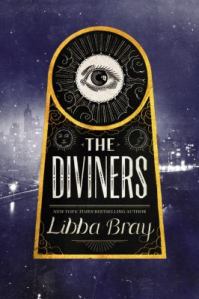
The Diviners

divinersThe Diviners by Libba Bray.
Libba Bray comes and goes for me – I loved Going Bovine, but tried and mostly failed with more than one of the A Great and Terrible Beauty. I wasn’t quite sure which way this new book would go, especially since so many other people did love her first fantasy series. Still, I heard so many things about it that I thought I’d give it a try, even though it is a commitment at almost 700 pages – the audio version is 15 discs long.

This is a book of contrasts, with the bright fun of the flapper culture in New York of the 1920s contrasted with the grim realities of life for the poor and immigration, bound together in a tale of a doomsday cult tying into magic that is darker and stronger than they realize. A group of diverse older teens comes together almost accidentally, but bond over their similar dark dreams and an assortment of occult powers that they keep secret, things like reading history in objects, healing, and prophetic dreams. We are introduced to one after another of them, most coming together gradually as the story goes on, including a would-be happy-go-lucky Evie from Ohio; her serious best friend and the daughter of political reformers, Mabel; an African-American poet and numbers runner named Memphis; and Ziegfield girl Theta and her gay composer roommate Henry. Evie comes and tries to shake things up at her uncle’s struggling museum, popularly known as the Creepy Crawly Museum, and quickly gets drawn into more serious things – a series of clearly ritual murders that look like the work of a Doomsday cult trying to raise the Beast. This is much more horror than I usually read – Bray gives us third-person narrative from the perspective of nearly all of the murder victims, to maximize the fright. She has one of the hallmarks of good horror, which is that though there are plenty of creepy supernatural elements, the scariest parts are all real, things that people really have done or believed. I had to keep reading for the characters, but this really was too scary for my sensitive soul, and I had to stop reading it at bedtime. The plot wraps up fairly tidily, but it’s clear that this is the first of a series. I’ll hope for a more cohesive knowledge of the team that’s implied in the name Diviners than actually came about in this book. This is a solid teen book – maybe a bit too scary and suggestive for younger kids, but nothing to make it inappropriate for teens. If you like atmospheric historical fantasy on the dark side, this is an excellent choice.

Posted in books | Tagged , , , | 1 Comment

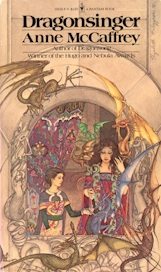
Dragonsinger

DragonsingerDragonsinger by Anne McCaffrey. Read by Sally Darling.

I love Anne McCaffrey’s Pern books, of which the Harper Hall trilogy was my favorite. Dragonsinger is my favorite of that trilogy. It doesn’t have the big sweeping drama of some of the other books, but it is a deeply satisfying coming-of-age story with lots of music and fire lizards. Menolly, our introverted, shy but extremely talented protagonist, has just arrived at Harper Hall as an apprentice. She was recruited by the Master Harper of Pern and brought on the back of a bronze dragon – but she quickly learns that things aren’t going to continue on that triumphant note. She’s housed with a group of snooty girls who are there as paid students, mostly with very low musical skills. The mistress of the cottage, Dunca, is terrified by Menolly’s fire lizards and sets out to humiliate Menolly and make her feel inadequate and unwelcome at every turn. The Masters who are assigned to test her skill levels seem convinced that she can’t possibly be as good as all that, and try to shame her out. Despite these barriers, Menolly has support from the beginning. The Masterharper, Robinton, tells her that the masters will be tough on her, but she just has to go through formalities. His journeyman, Sebell, is also supportive, and the headmistress of the house, Silvina, is a motherly figure. Menolly is also befriended by the youngest Harper Hall apprentice, Piemur, a curly-haired young scamp with an interest in fire lizards and talent for trouble. Over the course of a single week, Menolly navigates the social world, finds her musical place, and gains friends and self-confidence. She doesn’t have to win over the whole hall; she needs to comfortable herself and know that she has enough allies to make it.

There are a few things that felt off for me – I have always wondered why, for instance, Menolly’s Harper in her home hold would have considered proper breathing too difficult to teach himself. The treatment of Camo, the “half-witted” kitchen drudge, has always made me uncomfortable as well. It’s rare, of course, for people with serious mental disabilities to show up in fiction at all, and maybe some treatment is better than complete silence. Still, I have trouble figuring out why he’s there and how it benefits the story or the reader to have a character who can’t do anything but the most basic of jobs with close supervision and who is described as a “numb-wit” “half-wit” and “lack-wit.” Sally Darling I think had a bit more trouble reading this book. Harper Hall is a largely male establishment, and Darling does not quite manage to establish unique voices for all of the male characters, so they can run together a bit. Also, I know it’s harder in a book with made-for-the-book songs like this, but I really would have appreciated Darling actually singing the songs that appear at the beginning of each chapter and sprinkled throughout the book. I know not every reader can be Katherine Kellgren, but something like her reading of Bloody Jack, with all the songs appropriately sung would have been just perfect here. Despite these shortcomings, it’s still an excellent book, one I’ll keep rereading and recommending.

Posted in books | Tagged , , , | 5 Comments

3 Dead Princes

This one was recommended by Colleen over at Chasing Ray, and I had to interloan it from another library.

3 Dead Princes3 Dead Princes by Danbert Nobacon. With Illustrations by Alex Cox.

The subtitle says that this is an anarchist fairy tale, though the author’s idea of anarchy is different from mine. I wanted it for a novel of a strong and rebellious princess, because I generally enjoy that sort of book. I was a little put off at the beginning of the book by a number of misplaced apostrophes and overused all-caps, but these editing errors happily stopped and I was able to get into the story. Princess Alexandra Stormybald Wilson, or Stormy for short, is the only child of King Walterbald Wilson the Second of Morainia, a small mountain kingdom. Stormy does not get along with her stepmother, Queen Gwynmerelda, but it’s clear that this is more because Gwynmerelda is an authority figure and a Stormy newly a teenager than anything else. It’s a cozy, egalitarian kingdom where Stormy volunteers at the library and does scout training along with everyone else, while Gwynmerelda teaches yoga classes. As our story opens, King Walterbald is off to go exploring for ancient artifacts for the summer, leaving the Queen to manage the Princess, and the important state visit of the Queen and one of the three princes of neighboring and aggressive Oosaria. Just before they arrive, the court Fool initiates Stormy – the first female ever – into the Order of Accidental Adventurers, in which her father and grandfather are also members. Then the Queen and Prince arrive. They clearly intend to force Stormy into marriage to facilitate their takeover of peaceful Morainia (which they want for its rich mineral resources.) When Stormy retreats from the dance floor, the prince follows her into her bedroom, and he hits his head and dies when Stormy pushes away his Unwelcome Advances. But a dead prince is still a dead prince, so Stormy and the Fool make off to keep Stormy safe until things cool down, protect Morainia, find the king, and also investigate the strange and vivid dreams Stormy’s been having, involving giant birds and Giggle Monkeys. They meet the Witch in the Ditch and her daughter Glamour and the enormous black bird the Gricklegrack along the way, and learn many things about the creation of the world which goes against the official church’s orthodox opinion. Stormy’s first menses play a role (I mention this for Nobodyjones at Did You Ever Stop to Think and Forget to Start Again?) It’s illustrated with wobbly sketch-like pen and ink drawings that make the book more funny and casual.

3 Dead Princes is told as a slightly silly adventure, with the humor shading towards dark, as you might expect from the title, but not quite as dark as I would have expected, because Stormy only kills accidentally in self-defense and isn’t at all a bloodthirsty princess. It is not quite an allegory, but a story set out to tell a message (which is quite different from a story that ends up having a message along the way.) Nobacon has quite a long afterward where he explains his theories of anarchy and his post-apocalyptic fairytale world, though it’s not really clear until the end of the actual story that the world is post-apocalyptic as well as fairy tale. I have to agree with Colleen that the anarchistic message actually doesn’t come through nearly as strong as Stormy herself, not content to settle for what she’s told should be her happy ending and willing to do whatever it takes to find one that works for her and keeps her kingdom safe in the meantime. The story says it’s for all ages, but that’s a difficult target to hit – it’s on the simple side, plot-wise, for adults; Stormy is a bit young for most teen protagonists, though teens would probably best appreciate the idealistic message of anarchy; younger children (or their parents, anyway) probably don’t want to learn about rape, though the first dead prince doesn’t get far at all in his attempt and younger kids might read it as simple bullying. Maybe I’d say for middle schoolers and up, or somewhat younger with parental guidance? Checking in the state library catalog, it seems to be shelved in the adult collection, but has Juvenile Fiction as a subject keyword. At any rate, it was a fun and irreverent take on fairy tales, with some interesting thoughts on political systems for those who are interested.

Posted in books | Tagged , , | Leave a comment

The Cabinet of Earths

My reading of the 2012 Cybils middle grade sf/f shortlist continues with this one… next up will be Jasper Fforde’s The Last Dragonslayer. The furor around The One and Only Ivan from it winning the Newbery has finally died down enough for me to put my hands on it, and then I will have read them all.

Cabinet of EaerthsCabinet of Earths by Anne Nesbet.
The introduction… during World War II, a young boy who lives with his beautiful grandmother watches her instantly tire of life as she learns that one of her sons has killed the other. She takes from the Cabinet her bottle of Earth and opens it. Dark grains rush into her and she ages and dies before his eyes, leaving the boy as Keeper of the Cabinet. In our time, Maya and her extremely charismatic five-year-old brother James are moving to Paris with their parents for a year, to celebrate her mother being (hopefully) cancer-free. Maya is not at all happy about this; she doesn’t speak French or make friends easily and just wanted a return to normalcy. Normal is far from what she gets, however, as the creepily handsome man who introduces himself to the children on their first day turns out to be associated with the scientific group which arranged to bring her father over. They also meet Cousin Louise, a woman so drab that waiters don’t even notice her at restaurants. Maya finds strange old photographs showing glowing, three-dimensional children hidden in their apartment, and finds salamanders that only she can see moving on things like door knockers around the city. Soon Maya and the one friend she makes at school, Valko, are tangled in an adventure involving the intersection of magic and science, discussing the ancient (and real) conflict between scientists Fourtnoy and Lavosier. While there’s plenty of danger, there’s also deep thinking to be had around the value of charisma, popularity and immortality. Maya has some very tough choices to make, where what seems right and what will be good for those she loves are not necessarily the same thing. There are shades of C.S. Lewis’s The Magician’s Nephew in the depth of Maya’s worry for her mother, with a more nuanced outcome (heresy though it be to say this given my family’s deep loyalty to Lewis.) Nesbet does all this with the flavor of Paris and keeping firmly in the bounds of what’s appropriate for middle grade students. In short, this is a deeply impressive book, good for both the children it was written for and adult fans of children’s fantasy.

Posted in books | Tagged , | 5 Comments

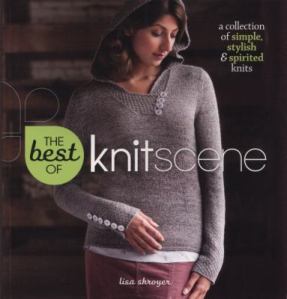
Best of Knitscene

Another yarny diversion:

Best of KnitsceneThe Best of Knitscene by Lisa Shroyer.
This book has the 20 most popular patterns from Knitscene magazine. The magazine seems geared to the young and fashion-conscious new knitter, and I am none of these things. However, I still enjoyed the book. It started out with profiles of knitting styles – Fair Isle, cables and so on – with their fashion history and how to incorporate them into a trendy wardrobe. This bit was laugh-out-loud funny. I can’t picture myself ever wearing purple satin shorts, but pairing them with a wool sweater as they suggest – when would the weather ever be right for wool on top and shorts below? There are also profiles of several of the included designers, with photos of some of their other designs. The designs are mostly sweaters (one lonely man’s sweater among them), with some hats, socks and shawls. A few of the patterns did strike me as so trendy that they’d no longer be fashionable by the time I finished knitting them, but I was pleasantly surprised by the number that I really did want to knit. The Central Park Hoodie is iconic by this time (I discovered it already in my Ravelry favorites when I went to add it), and the book version of the pattern includes expanded sizes. I also really liked the Tempest Beret, a cabled hat with the decreases cleverly and nearly invisibly worked into the cables; the Equinox Raglan, with a simply shaped design to show off the stripes of Noro Silk Garden; and the medieval-inspired Opulent Raglan. It was published May 2012, and it’s testament to its popularity here that I didn’t see it on the shelf until now, long after it ought to have been taken off the new book shelf.

Posted in books | Tagged | 1 Comment

Etiquette & Espionage

Finally a new steampunk book from the inimitable Carriger – this time for teens.

Etiquette and EspionageEtiquette & Espionage. Finishing School Book the First. by Gail Carriger.
This book starts a new series, set in the same world as the Parasol Protectorate series, but some years earlier. Sophronia Angelina Temminnick, aged 14 or 15, spends most of her time in the stables or taking household machinery apart. She’s horrified when her mother decides to send her to finishing school, packing her off within an hour of hearing of Mademoiselle Geraldine’s Finishing Academy for Young Ladies of Quality. In the carriage, she meets Dimity Ann Plumleigh-Teignmott, also headed to Mademoiselle Geraldine’s, and her younger brother Pillover, who is going to Bunson and Lacroix’s Boys’ Polytechnique. She soon learns that Mademoiselle Geraldine’s is no ordinary finishing school – as is obvious the moment she discovers it’s a school floating above the moors. She will indeed be taught how to curtsey and dance along with the best, but also how to include poison in her dinner budget and discreetly do off with only some of her guests. Right at the beginning, she learns of a missing prototype – an older classmate, Monique, has “mislaid” it, and both the teachers and some sky pirates are after it. Sophronia sets out to solve the mystery herself with assistance from Dimity, a coal shoveler named Soap with a winning smile and African dark skin under the coal dust, and Vieve, the young cross-dressing daughter of one of the teachers. Those familiar with the earlier series will recognize Sidheag and brief mentions of the Westminster Hive and Connal. There is adventure, humor, and the beginnings of a sweet cross-class interracial romance. Sophronia may be willing to bend societal expectations as far as associating with people of different classes, but Victorian propriety keeps any budding romance at a level appropriate for much younger than today’s teens, and certainly at a level where the romance doesn’t overwhelm the rest of the story. All in all, Carriger does not disappoint. Fans and those wishing to introduce teens or older middle-grade students to the pleasures of steampunk would do well to look into it.

Posted in books | Tagged , , | 3 Comments

Scarlet

This is Meyer’s second fairy tale/sci-fi/dystopian romance series.

ScarletScarlet by Marissa Meyer. Lunar Chronicles Book 2.
Cinder left our heroine, Cinder, in jail, exposed as a Lunar and a cyborg, and newly imparted with the knowledge that she is the missing Lunar Princess Celine, which means that the Lunar Queen Levana wants to kill her. She is also quite sure that handsome Prince Kai, her only friend after her stepsister Peony’s death, now despises her and will probably disregard the advice about Queen Levana’s plans that she risked her life to give him. Naturally, then, as the second book opens, Cinder is nowhere in sight. Instead, the story opens in the European Commonwealth with a new heroine, Scarlet. She runs a farm outside of rural Rieux, France, with her grandmother – except that Grandmother has now been missing for several days. The police are about to give up the search, convinced that the ripped-out ID chip on the table means that Grandmother ran away of her own volition. But Scarlet knows Grandmére would never leave her. When her estranged father appears, tearing through the house and raving about having been tortured to try to get his mother to confess, she knows she’s got to do something herself. But the only person who’s willing to help is a street fighter named Wolf, whose arm has a number tattooed on it, just like the number her father described tattooed on the arm of his torturer.

Meanwhile, Cinder acquires a sidekick with a somewhat functional ship, in the form of handsome and vain American criminal Carswell Thorne. Her robot Iko’s personality chip gets installed in the ship, and suddenly (while both Cinder and Iko miss the old Iko), Cinder has a ship with a dear and familiar personality. Instead of following her instructions to go to Africa to meet Dr. Erlund from the last book, she decides that she needs to find out more about where she came from and how she ended up a cyborg, a path that will lead her straight to Scarlet’s Grandmother in Rieux. Queen Levana’s horrible and somewhat unbelievable plan to take over the earth is further revealed, and Cinder ponders the ethics of the Lunar gift.

The whole story feels kicked up a notch from the last one. There are lots of chases, narrow escapes and Exciting Happenings. Scarlet and Wolf have a sweet romance going on, with the strong-willed and self-assured Scarlet taking the lead. Prince Kai is sadly mostly absent. I’m still not sure that the author or Cinder has quite figured out this Lunar gift thing – is there really an ethical way to use it? Queen Levana is also so very evil that it’s hard to believe that her own people, even controlled by her Lunar powers, would ever put up with her. But this didn’t stop me from caring very much about the main characters, and devouring this lengthy book in just a few days over my work breaks.

Posted in books | Tagged , , | 3 Comments

PIcture Book Parade

Here’s the latest batch of library picture books popular with both the eight- and the three-year-old, the ones that get asked for over and over and over.
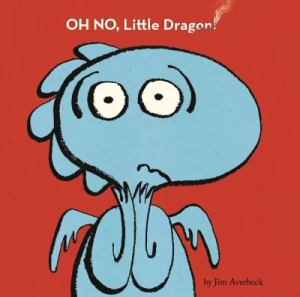
ohnoOH, NO, Little Dragon! by Jim Averbeck.
Thanks to Charlotte of Charlotte’s Library for this recommendation: Little Dragon loves his flames that go “PHOOSH!” and is sure his mother loves him for them. But when he’s in the bath washing off the soot one day, he splashes himself too hard putting out his Viking bath boat, and his flame goes out. Oh no! How will he get his spark back? This is a sweet story of maternal love, featuring an adorable cartoony dragon with beautifully realistic smoke and flames. Both my kids loved saying “PHOOSH!” along with little dragon.

Pete the CatPete the Cat: Rocking in My School Shoes by Eric Litwin. Art by James Dean.
I get lines of kids asking for Pete the Cat books every September, but I’d not read any until my daughter found this on one of her trips to the library with Daddy and started asking for it at least once a day. Pete is a groovy cat, wearing red sneakers and heading off to school for the first time. At regular intervals, he pulls his electric guitar out of nowhere and sings, “I’m rocking in my school shoes” three times through. There are lots of new situations and people, but Pete the Cat rocks along through it all. The words are simple, the pictures deliberately child-like, resulting in a book full of youthful energy.
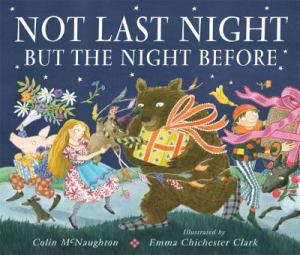
Not Last Night Not Last Night But the Night Before by Colin McNaughton. Illustrated by Emma Chichester Clark.
Thanks to Ms. S. at work for showing me this one. In this very British-feeling book told mostly in rhyme, our young narrator’s house is invaded by one nursery rhyme or fairy tale character after another. Each in turn knocks on the door, and then rushes in, usually bowling him over in their rush to get up the stairs. Characters include Goldilocks and the three bears, Miss Muffet and the spider, and Punch, Judy, their baby and a crocodile. These last were the only ones that weren’t familiar to my three-year-old daughter (are Punch and Judy shows still popular in Britain?) and so she would have missed the irony of characters known for their violence being the only polite ones in the book. Our hero doesn’t notice that all of the characters that come in are carrying gifts and flowers, and there is a very happy ending.

thereThere are cats in this book. By Viviane Schwarz.
Thanks to Nobodyjones at Did You Ever Stop to Think and Forget to Start Again for this recommendation. There Are Cats in This Book is an interactive book along the lines of, but predating, Press Here. It features three adorable cats: Andre, Moonpie, and Tiny, who talk directly to the reader, asking for the pages to be turned: there’s “lovely tangly yarn” on the next page. There are smaller cut-out pages: you can take the blanket off to discover the cats at the beginning of the book, or help them have a pillow fight later on. I could go on, but you’ll want to find out what happens yourself. Hidden cleverly in the fun, as Nobodyjones points out, is a lesson in how books and narrative work, from the frontispiece that says, “The cats aren’t on this page” to the end, where the reader helps tuck the cats in again. This book was so funny that my colleague and I were laughing out loud on the desk when I first found them. I took them home to my kids; my son loved it so much that he took it in to class, where his teacher read it aloud, and I had kids coming up to me at the end of the day telling me how funny it was.

therearenoThere are no cats in this book. By Viviane Schwarz. More interactive fun, this time with cats trying to get out of their book.
I found this one on the crowded “SCH” picture book shelves at the library before finding the first in the series. This time, as we come to the opening pages, the cats are busy stuffing important things like yarn and tins of fish into suitcases: they are trying to leave the book, as they want to see the world. The second book is an exercise in metafiction with paper engineering: how can the cats possibly leave a book that’s about them. Moonpie tries to push the edge of the page away, but succeeds only in stretching himself out. All three try jumping out of the book (into the reader’s face), but this effort also fails. Will the cats ever get out of the book? And what will happen to the book itself if they do?

Posted in books | Tagged , , , | 2 Comments