
The teen librarian gave me volume two of this series for adult, saying she didn’t think it was going out so well in teen. I thought it looked fun, and bought the remaining three volumes second-hand so people can read the complete series.
 Meridian. Volumes 1-4 by Barbara Kesel. Pencils by Joshua Middleton and Steve McNiven.
Sephie is the carefree and adventuresome daughter of the Minister of the floating city Meridian, on the planet of Demetria. As our story opens, her Uncle Ilahn, Minister of the (also floating) city of Cadador comes for a visit. As Ilahn and Sephie’s father are sharing a cup of wine, the brothers each suddenly acquire a glowing sigil on their skin. Sephie’s father soon falls down dead, and the sigil moves to Sephie, who is frantically trying to revive him. Ilahn initially persuades Sephie to leave Meridian and come with him to Cadador, to stay safe from whatever nefarious villains plotted her father’s murder. However, Sephie soon learns that Ilahn is the nefarious villain, with plans to control the whole planet. The sigils have given both of them power – Ilahn the power to destroy and Sephie the power to create. Determined not to let her uncle use her as a tool, she runs away and starts making plans to bring him DOWN – er, make sure that Demetria is controlled by forces who care about all the people, not just Ilahn’s personal power. As the story goes on, both Sephie and Ilahn gain allies. There are physical conflicts, but the story stays focused on the characters. There are shades in the prologue of this being more than a simple good vs. evil story, but what we see playing out is just that, though Sephie does uncover deeper motivations in her uncle over time.
 The world of Demetria is beautiful, with large city-islands floating over the surface. People travel from one island to the next via large sailboats – two details that could (and have been) described in text, but are just lovely to see drawn out. The pictures, done by Joshua Middleton in the first volume and Steve McNiven in subsequent volumes, are just beautiful, with flowing lines and glossy, blended full color. I love that Sephie, while admittedly well-endowed for a teen, is neither unrealistically so nor given to wearing deliberately skimpy clothing. (There is some wearing of skimpy clothing by other people, but their characters justify it.) This is a graphic novel somewhat heavier on the text than many. My son was so fascinated by it as I was reading it to myself that I found myself wishing that Sephie’s narration, a constant through the book, had been written in plain type rather than the scrolly, cursive writing they used, and which I think would give him difficulty. He has really enjoyed what we’ve read to him, however. As soon as I take it back to the library, I’ll suggest that we move it to youth. This series was originally published by Crossgen, which my brief research tells me was a short-lived publishing house that specifically aimed to make stories that would be appealing across multiple age ranges. So far, that seems to be the case, but I’ve found that kids are more open to reading books they haven’t heard about before. I’m hoping that moving this sweet fantasy adventure series one more time will help it find the audience it so richly deserves.
 Touch of Steel by Kate Cross.
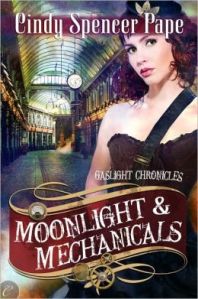 Moonlight and Mechanicals by Cindy Spencer Pape.
 The Cave of the Yellow Dog directed by Byambasuren Davaa. 2005.
 In the Wild – Mongolian Horsemen with Julia Roberts. On Nature – Horses. 1998. This is the movie about Mongolia that we own, and frequently, alas, threaten our children with putting in if they can’t decide on what to do for their screen time. It really is better than that, though – not adrenaline-filled, but interesting and beautiful. We get to see the star herself travel to Mongolia and live with a family in a ger for a few weeks while filming the show. She doesn’t speak Mongolian and doesn’t have access to a translator. Still, she’s friendly with the family and shares as much as she can learn about Mongolian life and culture. She learns to milk mares, and we see the poop stain on her jeans from kneeling by the mare for the rest of show, as there are no laundry facilities. She helps take the ger down and put it back up near her host’s father’s ger. The grandfather teaches her a traditional race game, played with sheep knuckle bones, and she teaches the children to play Ring Around the Rosie. She watches the men catch horses from their herd for the boys to ride in an upcoming race, and learns to ride in the hard wooden Mongolian saddle herself. Although decidedly low on the kinds of creature comforts she’s used to, Roberts finds the Mongolians generous and happy. This is a shorter special, only an hour long, and spends more time on fancy shots like watching the clouds move in fast time over the vast sky. The kids, of course, are most fascinated by the other children and want again to ride horses. I find it reassuring evidence of a big Hollywood star’s humanity, as Roberts is willing to be on camera without make-up or a styling team, just trying to get along in a place with no bathrooms where she doesn’t speak the language. It comes on a dvd with a special about horses in America, which we have never been interested enough to finish, though it’s probably great for horse-lovers. We came riding along (pun!) on my love’s Mongolia passion, and for an exploration of Mongolia, it’s fabulous.
 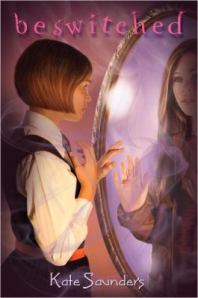 Beswitched by Kate Saunders.
 Dragonsong. Harper Hall Trilogy Book 1. by Anne McCaffrey. Performed by Sally Darling.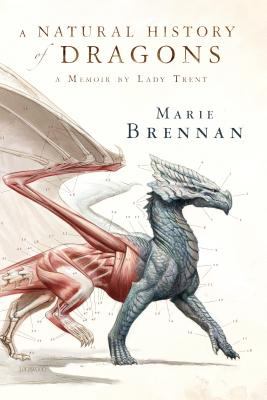
 Sock Yarn Studio by Carol J. Sulcoski.
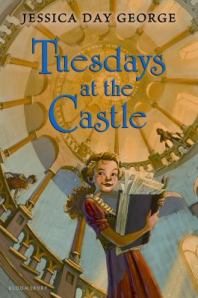 Tuesdays at the Castle by Jessica Day George.


 alibrarymama