The Cave of the Yellow Dog and Mongolian Horsemen with Julie Roberts

And now – visit far-away Mongolia! In family-friendly films!

This one was recommended by my friend P-, who walked up to me at work and said he thought we’d enjoy it. We did.

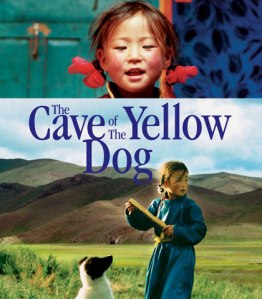
Cave of the Yellow DogThe Cave of the Yellow Dog directed by Byambasuren Davaa. 2005.
This is a mix of documentary and story, from the director of the award-winning “The Story of the Weeping Camel”. The dvd that we had from the library has the option of showing it subtitled or dubbed, which is vital in a film good for kids who can’t read yet. The basic story is that a young Mongolian girl (maybe about six?) finds a dog when she’s out taking care of the family’s sheep, and brings it home. But two of their sheep have recently been killed, and it’s not clear whether they’ve been killed by wolves or by abandoned dogs who’ve been living with wolves and adopted their habits. Her father is nervous that the dog might also kill their sheep, and forbids her to keep it. Somewhere in the middle, the girl visits with an elderly grandmother, who talks to her about reincarnation and tells her the old story of the Cave of the Yellow Dog. I didn’t know until I watched the Q&A with the director afterwards that it was filmed without a script. They just followed the Mongolian family around filming their daily life – the little girl is the oldest of three children. I think they were able to instruct the adults in a few key conversations, but she said they couldn’t and didn’t make the kids do anything. So there’s some plot, a few brilliant lines, a fair bit of awkward trying-to-act-normal-in-front-of-the-camera dialog, and lots and lots of scenes of beautiful Mongolia and traditional life. The little girl changes from her black and white school uniform into her traditional del. She is sent out with a basket-like backpack and a long wooden fork to gather dung for the fire – her attempts to aim over her shoulder into the basket had us all giggling. She goes to herd the sheep – by herself! On horseback! My children were very envious. Her mother makes cheese, slices it, and hangs the slices up to dry. The kids use the dung as building blocks, and warn each other off of playing with the Buddha. We get to see the inside of the ger (or yurt), floor covered with carpets, and filled with furniture painted in the traditional highly-ornamented orange. At the end, they disassemble the ger and load it onto wagons for their cows to pull to their next site, doing a ceremony of thanks for the old site before moving on. And there are lots and lots of shots of the beautiful Mongolian plains with the mountains in the distance and big open sky. The relatively short interview with the director (in flawless German, with subtitles) adds lots of insight into why she made the movie and what she considers important about the vanishing nomadic Mongolian lifestyle. We are especially interested in traditional Mongolian life, as we go camping in a ger every summer, but this is a heart-warming story set in Mongolia to interest anyone.

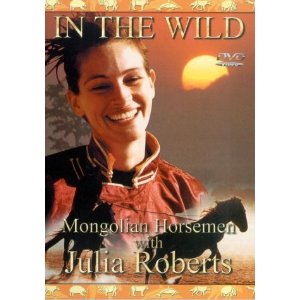
Julia Roberts & Mongolian HorsemenIn the Wild – Mongolian Horsemen with Julia Roberts. On Nature – Horses. 1998. This is the movie about Mongolia that we own, and frequently, alas, threaten our children with putting in if they can’t decide on what to do for their screen time. It really is better than that, though – not adrenaline-filled, but interesting and beautiful. We get to see the star herself travel to Mongolia and live with a family in a ger for a few weeks while filming the show. She doesn’t speak Mongolian and doesn’t have access to a translator. Still, she’s friendly with the family and shares as much as she can learn about Mongolian life and culture. She learns to milk mares, and we see the poop stain on her jeans from kneeling by the mare for the rest of show, as there are no laundry facilities. She helps take the ger down and put it back up near her host’s father’s ger. The grandfather teaches her a traditional race game, played with sheep knuckle bones, and she teaches the children to play Ring Around the Rosie. She watches the men catch horses from their herd for the boys to ride in an upcoming race, and learns to ride in the hard wooden Mongolian saddle herself. Although decidedly low on the kinds of creature comforts she’s used to, Roberts finds the Mongolians generous and happy. This is a shorter special, only an hour long, and spends more time on fancy shots like watching the clouds move in fast time over the vast sky. The kids, of course, are most fascinated by the other children and want again to ride horses. I find it reassuring evidence of a big Hollywood star’s humanity, as Roberts is willing to be on camera without make-up or a styling team, just trying to get along in a place with no bathrooms where she doesn’t speak the language. It comes on a dvd with a special about horses in America, which we have never been interested enough to finish, though it’s probably great for horse-lovers. We came riding along (pun!) on my love’s Mongolia passion, and for an exploration of Mongolia, it’s fabulous.
Posted in Movies | Tagged , , | 1 Comment

Beswitched

I continue my reading of the Cybils Middle Grade SF/F shortlist with this one that had totally slipped under my radar before.

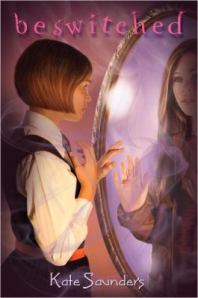
BeswitchedBeswitched by Kate Saunders.
Flora Fox is a modern teen on her way, very grumpily, to boarding school for the first time. Her parents are remodeling their flat so that her ailing grandmother can move in with them. Flora is used to having her own way in everything, doesn’t like her grandmother, and is determined not to like boarding school. On the train there, however, she falls asleep and dreams of shadowy girls reciting a spell. When she wakes, she’s still on a train headed to boarding school – but quickly discovers that she’s switched places with another Flora Fox, this one headed to a much different boarding school in 1935. When she gets there, her roommates (roommates! The horror!) turn out to be the very girls who did the spell, which they say was to call a helpful demon from the future. Her roomates are sweet Dulcie, smart Pogo and Pete, just as resentful of Flora as she is to be there. Flora starts out very grumpy, determined to make them do all her homework for her, especially since the subjects are so different. Naturally, this doesn’t work out so well. For the first time in her life, Flora really has to pull her own weight and work hard to make and keep friends. This sounds preachy, but isn’t, as Flora is so straightforward about it. Meanwhile, doing research, the girls figure out that Flora will go back to her own time once she has figured out who she is supposed to help and how to do so. Maybe she’s supposed to help someone avoid some pitfall from future history – but modern Flora’s memory is all mixed up with Flora from the past’s memory and many things that she used to know are to blurry to recall. Her kind prefect Virginia is Jewish, and Flora knows she shouldn’t go back to her mother in Austria, but can’t remember why. Flora also manages early on to alienate Consuela Carver, a bully who also has it in for Pete. Flora finds lots about 1935 both to hate and to love, from the horrible bland food and carbolic soap on the one hand to the freedom of young teens being sent out to the beach alone all day on vacation. There are lots of details of boarding school life and the characters there. It would be very interesting to know more than a sentence about 1935 Flora’s experiences coming to the present, but perhaps that’s material for another book. I also wasn’t really surprised by the big final revelation, but the journey there was immensely enjoyable all the same. Set in an all-girls boarding school, this is aimed squarely at girls. It’s a thoughtful, character-oriented story sure to appeal to older elementary and middle school girls, a satisfying book that begs for a comfy chair and an apple.

Posted in books | Tagged , , , | 4 Comments

Dragonsong

This is a book (well, ok, a series) that I read and re-read growing, starting from about 10. I’d never tried the audiobook before, however.

DragonsongDragonsong. Harper Hall Trilogy Book 1. by Anne McCaffrey. Performed by Sally Darling.
This is a classic coming-of-age story, set on McCaffrey’s planet of Pern. (McCaffrey always insisted that her books were science fiction, not fantasy, perhaps because science fiction was considered more prestigious when she was first writing. Some of the books in the series feel more like science fiction to me, but this one, with more of the dragon-like fire lizards and fewer star ships and discovering ancient technologies the original settlers abandoned feels more like fantasy.) Menolly is a young teen, the youngest daughter of closed-minded sea holder Yanus. Her gift and passion is for music, but when the Hold’s old Harper, Petieron, dies, she’s left with no one to understand her. She has to teach the children their songs, because no one else in the Hold can do it during the lengthy wait for a new Harper to be sent to them, but as girls are not supposed to be Harpers, she’s forbidden ever to play any of her own tunes. Music is hard to repress, though, and her father catches her playing a single chord of a new tune that bubbles out of her. She’s beaten severely, her instruments taken away. When the new Harper arrives, she’s not permitted to speak to him or even sing in front of him, even though Petieron had sent some of her tunes to the Master Harper of Pern. When she cuts her hand badly gutting fish, her mother tells her that she’ll never play again and should put such foolishness behind her. Eventually, she runs away and finds that she can live outside of a Hold, even with the intermittent but deadly danger of Thread-fall. By the end of the book, she has Impressed nine fire lizards and is on her way to the Harper Hall (which might be a spoiler, except that you might infer as much from the title of the series.)

This first book has always been the hardest for me, because of Menolly’s abuse and her subsequent depression in the first part of the book. As a child raised with old-fashioned spanking, I considered Menolly more misunderstood than abused. Now, as a mother opposed to corporeal punishment, Menolly’s parents are appalling. They are meant to be, and Menolly’s survival and later success are all the more brilliant because of the lack of support she has early on. I was a lonely, shy and musical child, and found introverted Menolly a kindred spirit. Listening now, I found myself caught up in the story all over again. I really appreciate how she finds a way for herself without becoming extroverted, and that, though she does gain in self-confidence, there is no sudden flip of the switch. My eight-year-old son, seeing the fire lizards on the cover, wants to listen to it, too; while I know he’ll be upset by the beating, there’s nothing else objectionable in this shorter sub-series. There is some evidence of what I always took to be Robinton’s alcoholism, but so brief that it isn’t here apparent as such. The sexism of the original Dragonflight (published eight years before Dragonsong) which I found so troubling when I went back to it as a college student is not here at all. There are several references to the events of the first two books to come out, but not so that you’d need to read them first – which is good, as those are significantly less appropriate for younger readers. The central struggle is about Menolly finding a place to use the gifts she’s been told aren’t appropriate for a girl. There’s still plenty of cross-gender appeal (if boys can get past the usually girly covers) as everyone, boy or girl, wants a fire lizard. This would even work for “survival book” assignments that come up from the schools every so often, as the central portion of the book goes into some detail on how Menolly survives in the wild, alone except for the nine fire lizards she has to feed. Sally Darling reads expressively, even if I’d read it so often to myself that her slightly old-fashioned accent and some of her name pronunciations were at odds with my own mental rendition. I’m now halfway through Dragonsinger, the next book, and enjoying it heartily as well.

Posted in books | Tagged , , | 7 Comments

A Natural History of Dragons

A Natural History of DragonsA Natural History of Dragons: a Memoir by Lady Trent by Marie Brennan
I’m not the first to say it, but A Natural History of Dragons feels much like a combination of Naomi Novik and Elizabeth Peterson, with an intrepid lady explorer in what feels like the 18th century. Isabella, Lady Trent, is writing her memoir of her younger days and how she became a famous dragon naturalist. Even as a child, she was mad about dragons. She captured and learned how to preserve the tiny sparklings, cousins of dragons that were at the time considered to be insects. After subtly encouraging her father to buy it for her, she pored over the only reference work on dragons then available, and when she came out, considered herself beyond fortunate to find a man, Jacob Camherst, who shared her interest in dragons and would share his library with her. Their relationship was tested early on when she heard about a dragon-studying expedition headed to the wilds of Eastern European-like Vystrana. At first, she was content to cultivate the friendship between her husband and Lord Hilford, the leader of the expedition. Then, she talked him into allowing her to come along. In Vystrana, they find their host missing, the villagers unwelcoming, and the dragons both unexpectedly aggressive towards humans and elusive. Because of this, the expedition that was meant to be focused on dragons turns into a mystery in large part, with less focus on the dragons. It was still largely enjoyable, though more dragons would have been fun. As she came along as secretary and artist, the book includes her sketches of Vystrana and the rock-wyrms they were researching. I was shocked by an unexpectedly tragic ending after the lightness of the preceding adventures.

However, there are some issues with the book. It’s set, it says, in Scirland and other neighboring countries, but though the provide maps showed some global differences, culturally and climate-wise, there was no difference between England and Scirland. (It’s possible that the dominant religion is Judaism rather than Christianity, but I’m inferring this from one brief reference.) Naomi Novik proved that you don’t need to move things out of England to have dragons; why bother to confuse the reader with remembering which city is an analogy of London if you’re not going to do something different with it? More importantly, as Thea of the Book Smugglers so eloquently describes at Kirkus, all of the prejudices against those of other cultures and classes that one would expect an 18th century Englishwoman to have are preserved. Also, it takes a good while for her to get through her childhood and actually go on the dragon-researching expedition. She spends a lot of time saying that this was just the first of her adventures. I hope that her memoirs are continued and that they have more in the way of dragons and of challenges to Lady Trent’s worldview.

Posted in books | Tagged , | 1 Comment

Sock Yarn Studio

And now for a brief foray into yarniness….

Sock Yarn StudioSock Yarn Studio by Carol J. Sulcoski.

I’m a big fan of sock yarn: you can get just one skein and know you’ll be able to knit a pair of socks or mitts from it. It’s easy to carry around in progress, and ends up with something useful. But even if your yarn isn’t superwash or blended with nylon for durability, or in case you’ve tired of knitting socks, there’s still plenty to knit with sock yarn. Here is a whole book of non-sock patterns to knit with sock yarn, most modeled in hand-painted yarns. The patterns are from a variety of designers whose names were familiar to me, including Wendy D. Johnson, Veronik Avery, and Franklin Habit. There are patterns for scarves, cowls, gloves, little shawls, hats, sweaters for babies and children, and even a magnificent but intimidating full-sized patchwork blanket. My favorites included the Furbelow shawl, a simple triangle knit in a tonally variegated cashmere blend with ruffle in a contrasting mohair yarn; the sweet and simple Poppy Beret; the Alexander street hat, which alternates vertical stripes of solid and handpainted yarn; and the Habitude scarf, an argyle scarf done in lace to form the only manly lace scarf I’ve ever seen. Each pattern included beautiful photographs and charts when used, along with the instructions and notes. The book is separated into “one-skein” and “two-skein projects and so on, but I noticed that those numbers referred to the number of different kinds of yarn called for, rather than the total number of skeins. That was a bit confusing for me, but a small downside to a book that I really enjoyed and which was eagerly passed around my knitting group.

Posted in books | Tagged | Leave a comment

First Fantasy Chapter Books

Recently, my friend C- was asking for fantasy book recommendations for her five-year-old son, who’s just getting old enough to listen to chapter books. Here are books that my son and I enjoyed (or plan to enjoy soon), beginning when he was four. Most of them we listened to as audio books in the car; I have noted the few titles here that aren’t available
Igraine the Brave
A Bear Called Paddington
by Michael Bond
Charlotte’s Web by E. B. White
Earwig and the Witch by Diana Wynne Jones (print only)
Half Magic by Edward Eager
Igraine the Brave by Cornelia Funke
Kenny and the Dragon by Tony DiTerlizzi
The Magic Tree House series by Mary Pope Osborne
My Father’s Dragon by Ruth Stiles Gannett (print only)
Odd and the Frost Giants by Neil Gaiman
Pippi Longstocking by Astrid Lindgren
The Scarecrow and his Servant by Phillip Pullman
The Spiderwick Chronicles by Holly Black and Tony DiTerlizzi
Tuesdays at the Castle by Jessica Day George (print only)
The Wind in the Willows by Kenneth Grahame
Winnie-the-Pooh by A.A. Milne
Young Fredle by Cynthia Voight

What are your favorite introductory fantasy books?

Posted in books | Tagged , , | 9 Comments

Geeks, Girls and Secret Identities

This was on the short list for the Middle Grade Science Fiction and Fantasy Cybils award – I checked out or put on hold all the ones on the short list that I hadn’t already read.

I realized my recent statement about books I bought after reading from the library was low – I also bought books not just for me but to share with my children, Penny and her Song and Starry River of the Sky.

Geeks, Girls and Secret Identities
Geeks, Girls and Secret Identities by Mike Jung.
In Copperplate City, crime has been under control for decades because of efforts of Captain Stupendous. Other cities have their own superheroes, of course, but none of them are quite as awesome as Captain Stupendous. He’s so popular that there are four Captain Stupendous fan clubs of various stripes, including the smallest. Our hero Vincent is the president of the tiny but hardcore Unofficial Captain Stupendous Fan Club. Vincent and the other two members, George and Max, take their fandom very seriously, spending their time watching and analyzing old Captain Stupendous videos. Vincent even finds a way to make every school report he gives focus on Captain Stupendous. It’s a normal life on the edges of middle school until the day when an evil giant robot kidnaps Vincent’s crush, Polly Winnicott-Lee, right in front of him. Captain Stupendous saves her, of course, but immediately after, for the first time ever, he fights poorly and has to flee the robot. It’s up to Vincent and his club to figure out what’s going on and help Captain Stupendous defeat the evil Professor Mayhem and his giant robot. Polly also plays an active role, and Vincent’s mother’s boyfriend, the police liaison to Captain Stupendous, is also helpful.

This book has so much good stuff in it! Vincent is biracial, with a Chinese-American father and a blond mother. His parents are divorced, and while they clearly aren’t best friends, there are neither attempts to get them back together nor to turn one or the other of them into a villain. Max is Jewish and Polly Korean-American; there’s also a good spread of income levels among the characters. Overall, it’s great diversity, but without Jung ever making a big deal of any of it; some of these details don’t even come out until late in the story. There are also tough real-life social issues as the fan club members have to negotiate more serious things than they have before, and Vincent trying to learn how to negotiate relationships across the gender divide, so vast at that age. The story is told with clever phrasing, sly references to classic comics for fans (I caught the name of the elementary school; my love also caught Excelsior Pizza as a reference) and comic-style illustrations. The kids all feel like real, sympathetic middle-schoolers, involved in a fabulous adventure involving superheros, giant robots, and aliens. What more could you want?

Well, OK, it’s a little long and dense for my dyslexic eight-year-old to read to himself, though he saw the book and was very disappointed about that. He’d do fine having it read to him, though, and a reader slightly more advanced in age or skill should be fine. Both my husband and I had a great time with it.

Posted in books | Tagged , , , | 14 Comments

Tuesdays at the Castle

I heard about this one from Charlotte at Charlotte’s Library over a year ago. It sounded delightful from the start, so I’m not sure why it took me so long to actually locate it on the library shelves and check it out. At least I can console myself with the knowledge that the sequel, Wednesdays in the Tower is coming out in May, so I won’t have too long to wait.

Tuesdays at the CastleTuesdays at the Castle by Jessica Day George.
Welcome to Castle Glower, a magical castle that changes itself regularly, usually on Tuesdays. It redecorates, creates new rooms, and moves other ones around at will. It’s an intelligent castle, and the people of the kingdom are used to heeding its advice on who should rule the kingdom. The current king has four children, and the castle made it clear, by filling the oldest brother’s room with astrolabes and other wizardly tools, that he should train to be a wizard, while Rolf, the next youngest son’s room was moved closer to the throne room, as an indication that he would be the next king. Celie, the youngest of the bunch, has a close understanding with the castle, and her ongoing project is creating an atlas of the castle, trying to keep it up-to-date as the castle constantly reinvents itself. Lilah, the older girl, does not so far seem to have any castle-prescribed destiny, but while of an age to start being interested in boys, avoids Susanish tendencies. I introduce the characters first because I loved them so much (the castle counts as both character and setting here), but the plot kicks off quite nicely, too. The king and queen go off to fetch their oldest son home from Wizard School, but the carriage is ambushed on the way back. After a very brief search, the king, queen and prince are all declared dead. The three children left at home don’t believe it – surely the castle would let Rolf know if he were king – but the council believes otherwise and forces the children to hold a funeral. An unwelcome guest at the funeral who refuses to leave afterward, the sinister Prince Khelsh makes it clear that he has plans to become the next king of Glower himself. As the council appears to have turned traitorous (for reasons that are never gone into), it’s up to the three children, with help from the Castle, to save the castle and find their parents. Their only dubious magical power is Celie’s bond with the castle, which means it’s up to the three of them to come up with their own plans as well as following the lead from the clues the castle gives them. I enjoyed it heartily (even more than Princess of the Midnight Ball), felt certain that my elementary-aged self would have adored it, and very much hope to share it with my eight-year-old – either reading it to him or having him read it to me – sometime in the near future.

Posted in books | Tagged | 13 Comments

The Brides of Rollrock Island

I’m a little late linking this time, but I’ve linked my post on the Borrowers to the KidLit Book Hop. There’s a whole bunch of posts on kid lit books just waiting to explore!

Kid Lit Blog Hop

Brides of Rollrock IslandThe Brides of Rollrock Island by Margo Lanagan.

Here is a darkly beautiful, multigenerational tale of selkies and the human families they marry into from the author of Tender Morsels. The narrative voice switches among a number of characters, with the notable exception of the selkies themselves. We hear from the sons and husbands of the selkie brides, from the sisters and wives of men gone seal-mad, and from the witch, Miskaella Prout, who runs a business of producing seal women for would-be suitors. Rollrock becomes an island of human men and selkie women over the course of a generation. All of the many narrators come to life, their reasoning believable, the tale carried from one to another to form a beautiful and yet monstrous whole. For the myths never really say that the selkie women are never given a choice. Their husbands and sons adore them – and yet their skins must be hidden, as they would return to the sea if they could. Lanagan tells a story of magic with a look at the meaning of love that’s highly relevant today.

Posted in books | Tagged | Leave a comment

The Raven Boys

This is the book that I loved so much that I begged my love to buy it for me as soon as I’d finished my library copy, because I was disappointed every time what I was reading wasn’t it, and there holds on all the library copies. For the record, the last book I had to turn around and re-read was Ready Player One, and I went out and bought The Night Circus right after finishing it so I could lend it out to friends.

The Raven Boys The Raven Boys. Book 1 of the Raven Cycle. Read by Will Patton. by Maggie Stiefvater

“There are only two reasons a non-seer would see a spirit on St. Mark’s Eve,” Neeve said. “Either you’re his true love . . . or you killed him.”

Sixteen-year-old Blue Sargent has grown up the only non-psychic in a family of psychic women, but with the unique ability to strengthen other people’s psychic powers. The “family” includes an assortment of aunts by blood and friendship, including Blue’s newly-arrived half-aunt Neeve. Every psychic Blue has ever met has told Blue that if she ever kisses her true love, he will die. So Blue has made rules for herself: stay away from boys, because boys are trouble. Even more, stay away from Aglionby Academy boys, because they are even worse. But this year, things start to change. At the Death Watch in a ruined church on St. Mark’s Eve, there just to help Neeve see the spirits of the future dead as they walk by, Blue sees the shadowy spirit of a boy, whom she can tell by the raven on his sweater is an Aglionby boy, and who says his name is Gansey. Soon, they meet in person, and Blue is integrated into the small team of his friends, despite her distrust of his family money, good looks, and charisma. (Go Blue! Way to not be instantly swept off your feet by money with a handsome face!) Instead, she’s drawn to one of Gansey’s other friends, Adam, a quiet boy whose accent in unguarded moments reveals him to be a local (poor) boy, unlike the usual wealthy Raven Boys. The other two boys in the group include the angry, shaved-head Ronan (featured on the cover of the second book) and shy and “smudgy” Noah. They are all bound together by Gansey’s passionate quest to find the ley line he believes runs through Henrietta, which he believes will lead him to the sleeping Welsh king Glendower. Continue reading

Posted in books | Tagged , | 12 Comments