Zita the Space Girl

This is one I’d been meaning to read for a while, and only put an actual hold on it when I flipped through the newly published sequel on our backroom new book shelf. Zita the Space Girl
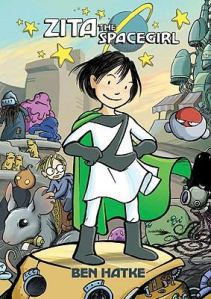
Zita the Spacegirl
by Ben Hatke.

When we meet Zita, she’s running through the woods being chased by her friend Joseph, whose notebook she’s stolen. Then something falls from the sky and crashes. She climbs into the small crater it left – it’s a large silver disc with a big red button. The timid Joseph urges her to leave it alone, but Zita is not the cautious type. She pushes the red button, which opens up a portal to a different planet. The terrified Joseph is sucked in immediately, and after some hesitation, Zita jumps in afterwards to rescue him. She finds herself in a crowded alien marketplace, with no sign of her friend. She is bright and friendly, so though this is clearly not a safe place for unattended children, she befriends a large porter, a giant mechanical mouse, and a somewhat shifty minstrel named Piper. It turns out that the planet they are on is going to be destroyed by a large asteroid in the near future. Everyone who can get out, is, while the aliens who own the planet believe that Joseph is the child of prophecy who is key to stopping the destruction. Even as Piper tells her that the castle where Joseph is being held is too far and the aliens too fierce for one girl to possibly make a difference, Zita sets out. Can she save both Joseph and the planet??? While Zita’s got courage in spades, it’s her kindness and friendliness that will win the day in the end. While you already know there are sequels (one just out, one due next fall), the story arc wraps up nicely in this book, even as it leaves room for Zita to still be the Spacegirl. Hatke both writes and illustrates this full color graphic novel. Zita and her friends are simply adorable, while the alien planet is populated by a wide array of aliens and robots that range from also adorable to adorably creepy. There are some short Zita webcomics up at for you to get a feel for it. This is the kind of wonderful all-ages story that’s perfect for both boys and girls, with action and character enough to satisfy a broad range of ages. Try Giants Beware for another scrappy girl hero and her friends in a fast-paced graphic novel adventure, or Korgi for slightly sweeter adventurous fare. I’m expecting Zita to end up on our permanent book shelf.

Posted in books | Tagged , | 8 Comments

The Storm Makers

Storm MakersThe Storm Makers by Jennifer E. Smith
Ruby and Simon are twelve-year-old twins who have recently moved from Chicago to a farm house in Wisconsin. Their parents are supposed to be supporting the family by farming while waiting for their Creative Pursuits to take off, but the crops are doing poorly due to a drought and the creative ventures aren’t going so well, either. Ruby, a budding scientist who loves helping their inventor father, hasn’t made friends here in the country, while Simon fits right in with the baseball crowd. This leaves Ruby feeling isolated from her twin for the first time. Such is the scene when Simon gets a fever that coincides with an enormous thunderstorm. Even when he recovers, he starts shorting out appliances and cars just by touching them. While Simon’s in the hospital with the fever, a kind-looking man with a battered hat named Otis introduces himself. He says that he, like Simon, is a Storm Maker, and he is here to help Simon, coming into his powers unusually young, learn to control them. He gives Ruby a tiny barometer whose dial shows events on the way rather than weather. But by the time Simon is awake, Otis is gone, and another Storm Maker comes to their rendezvous instead. His name is Rupert London. He tells Simon that he has the potential to be the most powerful Storm Maker ever, and invites Simon to come back to Chicago with him for training at the official secret Storm Maker headquarters. Simon is flattered by his attention, but Ruby takes an immediate dislike to him when he burns down a farmer’s field as a demonstration of his power. Meanwhile, the twins have taken a summer job together helping out the local mechanic, Daisy, who also turns out to be a Storm Maker. Will Simon and Ruby find out who to believe – and how to control Simon’s powers – before it’s too late?!

This was a pleasant read, though it didn’t knock my socks off. It was nice to see Ruby and Simon get closer to each other again over the course of the book. It was of course obvious from the beginning who the bad guy was, and Simon makes and Ruby allows a quite dangerous decisions fairly early on. Kids of the intended age will likely enjoy it just fine, especially if they are interested in weather and mechanical science.

Posted in books | Tagged | Leave a comment

Runemarks

Image

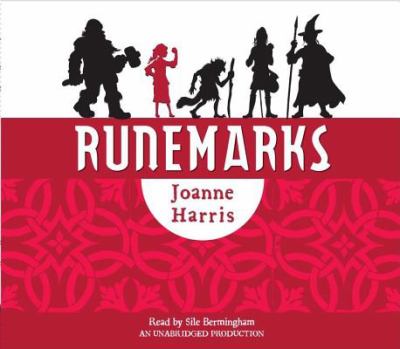
Runemarks by Joanne Harris. Read by Sile Birmingham.

Once upon a time the Aesir ruled the Nine Worlds from their home in Asgard.  After Ragnarok, though, both the Aesir and their fellow gods the Vanir disappeared from the worlds.  500 years later, a girl named Maddy is growing up in the country, far from civilization but still not free from the influence of the Order.  The Order teaches that all the “Seer-folk” were wicked demons, and that people or animals born with their evil “ruin marks” on their skin should be killed.  Also, everyone should avoid dreaming to keep from being taken over by demons while they sleep.  Luckily for her, Maddy’s ruin-mark only makes her an outcast in her village.  Her only friend is the old traveling man who calls himself One-Eye.  He tells her that her “ruin mark” is actually a rune, an ancient sign of power.  He tells her the old forbidden stories of the gods, and teaches her to make and throw runes of power with her hands, as well as cantrips and charms.  As the village is invaded by more and more goblins, he tells her that war is coming.  Someone, for very unclear reasons, wants to destroy what’s left of the gods and any magic left in the world.  Maddy is the only one who can take the gateway under the large horse carved into the hillside, to travel to World Below and bring him back the ancient oracle known as the Whisperer.  There, Maddy meets a charming red-haired boy who calls himself Lucky. 

I listened to this book with my son, who could not be convinced that Maddy was dealing with Odin and Loki.  It seems like it must be taking place in the Middle Ages to the Renaissance, but Maddy has quite modern sensibilities.  It seems that my Norse mythology was not quite as solid as I’d realized, because I was unaware of the difference between the Vanir and the Aesir, and trying to form a new alliance between gods I’d always thought of as part of the same pantheon takes a lot of time in the book.  Prophecy plays a major role, with the Whisperer telling the same prophecy different ways to different people, and other people putting yet different spins on it.  The book didn’t entirely work for me.  Bits that were mentioned briefly at the beginning and never came up again turned out to have major significance at the end.  The difference between runes, cantrips and charms wasn’t explained so I could understand it, though it felt like it would have been helpful to understand it.  Sile Bermingham read in an array of lilting British and Irish accents, which was lovely but a bit puzzling for a book about Norse people.  And while I enjoy character-driven stories, the whole thing felt like it was moving too slowly. It was 14 discs long, and things did not really start to heat up until the last two or three.  However, the premise was interesting and Maddy a likably sturdy and free-thinking girl, and my son really enjoyed it.  It’s rated for teens, probably for the length and a small amount of foul language (nearly all from Loki.)  The violence is certainly no more than in books like the Percy Jackson series.  Fans of those books who are interested in other books about forgotten gods in a more modern setting and don’t need the breakneck pace should enjoy this as well. 

Posted in books, Uncategorized | Tagged , | Leave a comment

Shadow and Bone

The year I lived in Germany, I thought I’d try to learn a language that I couldn’t learn back home in the states.  I picked Czech.  (I’ve since regretted not taking Mittelhochdeutsch, or medieval German, which would have been useful for my early music performing.)  I didn’t make much headway with Czech, though I made some of my best friends there in that class and enjoyed our field trip to Prague.  I remember a handful of things: that the nouns have four genders; that “r” is considered a vowel; the lovely onomotopic word “sprcha,” which means “shower” and sounds like it; and how to introduce myself.  I learned that the suffix “ova” is added to the end of every female’s last name, even mine as a foreigner.  And while Czech isn’t Russian, I’m fairly sure that the same holds true for Russian.  That’s why it bothered me every time I read the name “Alina Starkov” in this book.  Clearly, Bardugo did a lot of research on Russian history and culture, and it isn’t really supposed be Russia, but a similar fantasy nation, so I feel a little bad about harping on this one thing.  And yet, it threw me out of the story every time I encountered it, even as I mentally renamed our heroine “Alina Starkova”. 

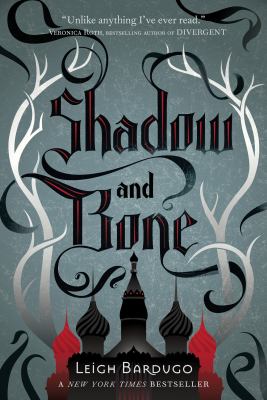
ImageShadow and Bone by Leigh Bardugo

Our story takes us to the realm of Ravka, which feels like late nineteenth- or early twentieth-century Russia (without Russian folk tale motives).  It’s a world that’s been at war for decades.  Not only is it threatened by the neighboring kingdoms, but there is the large area of permanent magical darkness known as the Fold.  What used to be rich farmland is now barren desert filled with man-eating monsters that make it very dangerous to cross.  Our heroine, Alina Starkov, was orphaned in the war and taken in by a wealthy landowner.  Her best friend since then is Mal.  Now they are in the army together – Alina working as a (not very good) cartographer, while Mal is the Best Tracker Ever, and popular with the opposite sex to boot.  On their way through the Fold, they are attacked by Volcra.  They are about to rip Mal away when Alina, desperately trying to cover him with her body, summons a sun-bright flare of light that drives the Volcra off.  Mal and the rest of the people on board the land ship are saved, but Alina’s life is about to become much more complicated.  She’d always been wary of the magic-users, or Grisha, who form their own separate division of the military, headed by the truly frightening Darkling.  Now she is summoned to meet with the Darkling in person.  He tells her that she is a Sun Summoner, whose powers when trained could destroy the darkness of the Fold.  She’s rushed to the capital to train with other Grisha, where she’s both envied for her closeness to the Darkling and despised for her difficulty using her powers, since all the other Grisha have been training since childhood.  And while the Darkling is making every effort to smooth her way and to make himself likeable, it’s also clear that he’s an experienced politician as well as a powerful magician, willing and able to do whatever it takes to keep the Tsar under his control and the Grisha the most powerful force in the nation.  There is a creepy Apparat, some kind of high priest, who distrusts the Grisha and keeps following Alina around trying to give her warnings, but she never listened to enough of these for me as a reader to know whether she should have listened more or less.  The story went along, went along, and then suddenly – flip, flip, flip – it was all wrapped up and done and looking completely different as a finished story than it had along the way, like Elizabeth Zimmerman’s famous Baby Surprise Jacket.  I could see the plot going either of two ways – which I can’t really elaborate on without complete spoilerage – and it zipped off in a third direction, leaving me feeling a little stunned with the speed of it all.  I’m not sure if something about the book didn’t quite work for me, or if it would work for me if I read it again and thought about it some more.  However, I quite liked both the setting and Alina as a character.  For teens and up who like somewhat historical fantasy, this is a good choice. 


Posted in books, Uncategorized | Tagged | Leave a comment

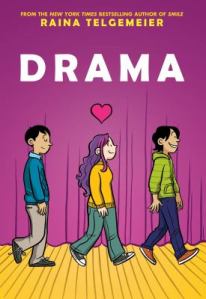
Drama

“Did you want to read this?” I asked my love, waving this as part of a stack of library books I was done with. I of course was on the hold list as soon as it was in the library catalog system, because I am in love with Raina Telgemeier, as I’ve mentioned before.
“No,” he said. “I was a band geek, not a drama nerd. Besides, that cover looks like a love triangle.” Then he picked it up and read the first couple of pages while scrambling our breakfast eggs. “I changed my mind,” he said. Over breakfast and after dinner that day, I heard him chuckling over it. He was done before breakfast the next day.

Drama
Drama by Raina Telgemeier.
Raina Telgemeier is back after 2010’s Smile. Where that was autobiographical, Drama takes us to a fictional middle school inspired by Telgemeier’s experiences. Eighth grade Callie, a winsome lass with long purple hair, loves musicals, and is thrilled to hear that her school will be putting on “Moon over Mississippi.” She doesn’t aspire to the stage – she knows she has a terrible voice. She and her group of nicely ethnically diverse friends, including best friend Liz, work backstage. Now that she’s in eighth grade, she’s put in charge of set design. She has grand dreams, the biggest of which is building a real exploding canon for the stage. But there’s plenty of drama of the middle school romance type as well. Her longtime crush Greg was has long been dating a snotty girl, but kisses Callie after they break up. Then Callie is crushed when he immediately starts avoiding her at school. Disappointment is short-lived, though, when two cute twins join the drama group. Outgoing and talented Justin tries out for a major role in the musical, but is up-front with Callie: he’s gay, so while he likes hanging out with her, he’s never going to be interested in her that way. Callie’s never met anyone gay in person before, so this takes a little mental adjusting. Shy Jesse, however, might still be available. He joins Callie in the backstage crew and bonds with her over beautiful books about the golden age of musicals. It’s a great balance of deep thoughts and laugh-out-loud funny moments. Even when lovesick, Callie throws herself wholeheartedly into the theater project, falling asleep over her canon experiments in the garage. On top of those two major themes, she still has to deal with regular homework and an overly curious little brother. Telgemeier presents serious topics in an engaging, light-hearted but never flippant way. Her drawings are a nice mix of Western and Japanese style, expressive and easy to follow. There is nothing more explicit than a little kissing, making this perfect for older middle grade students and up.

I thought really hard about readalikes for this and came up with a blank. Novels that address homosexuality for teens, sure – but middle schoolers are I think still not supposed to have any sexual feelings at all, straight or gay. That’s too bad, because I have vivid memories of some intense crushes at that age, but the more explicit teen romances would have been too much. If any of you, dear readers, can think of a book that would be a good fit, please let me know.

Posted in books, Uncategorized | Tagged | 2 Comments

Mail Order Ninja

I’ve had this happen a couple of times now…. I read a book with my boy and we both enjoy it. Then I meet the author, rave to him (always a him) about how we loved it… bring my son over to Meet the Author!, and he has no memory of the book. Sigh. This one I went back and re-read with him after the incident, and he begged for the sequel.

Mail Order NinjaMail Order Ninja by Joshua Elder. Illustrated by Erich Owen.
Timmy McAllister has a tough life. He’s bullied on the way to school, rich mean girl Felicity Huntington makes the life of anyone who isn’t willing to be her toady miserable there, and at home, his bratty little sister is determined to make their parents declare her their favorite. What’s a boy to do? He orders famous ninja Yoshida Jiro from the Jacques Co. catalog. (Timmy is familiar with Jiro from reading the manga series about him.) With Jiro backing him up, bullies are no longer a problem, and Timmy is cool enough to defeat Felicity in the race for school president, making the school safe for nerds everywhere! In volume two, though, Felicity orders a whole evil ninja clan from the same catalog and takes over the town. Jiro is defeated, the adults all brainwashed, and it’s up to Timmy (and the bratty sister and his best friend) to save the day. The whole thing is filled with references to things like classic sci-fi that will make adults smile without being inappropriate. It’s illustrated with expressive and perky manga-style drawings. These hilarious, high-action books are perfect for elementary school-aged boys, but it’s safe to say they’d find fans with a much broader audience. Sadly, they are out of print, so check your local library or order your second-hand copy now.

Posted in books, Uncategorized | Tagged , , , | Leave a comment

Habibi

I should perhaps have mentioned it yesterday, but the Cybils nominations are open. That means that if you are a fan of a children’s or teen book (or book app) that’s come out since last October 15, you can go nominate it now. Or at least check to see if it’s already been nominated. Go take a look!

Craig Thompson (Blankets) coming out with another epic graphic novel was big news, and I waited until the demand at the library died down a little before checking it out.
Habibi
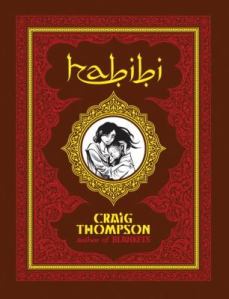
Habibi by Craig Thompson
Habibi tells the story of two lost souls in an Arab world. Dodola was sold to be married as a child by her poverty-stricken father, but is put on the slave market when her husband is murdered. She escapes, taking with her a young African slave baby. She names him Cham and hopes that together, they can make a better life. They start living in a ship abandoned in the desert, Dodola sneaking off to passing caravans to earn food, while Cham is in charge of finding water. Change is always around the corner, and even this early period is interrupted with Cham’s coming puberty and awareness of Dodola, and his horror at finding that she sells herself for their food. Then Dodola is kidnapped and taken to the sultan’s harem while Cham must make his own way. Always, in situations worse and better, Dodola and Cham are trying to find a way back to each other. Although the story at first seems to be set in a distant century, later it seems that it’s just a pocket of the modern world resistant to change. Dodola’s husband had been a scribe, and taught her reading and some of the stories he copied. Pieces of mostly Islamic mythology and folk tale are woven through the book, some told by Dodola to Cham, either in person or in his memory, and some just between sections. These stories, the central symbol of a blessing matrix, and the flowing shapes of Arabic letters play central roles in the book. There’s a lot of violence here, especially sexual violence, and the hopelessness of poverty and harsh reality. This is balanced by the beauty of the flowing lines of Thompson’s drawings, the strength of found family, and the power of love (cue the 80s music) between Cham and Dodola. Obviously for adults or very mature teens; read this when you’re ready to be put through the wringer and come out feeling like a better person.

Posted in books, Uncategorized | Tagged | 1 Comment

Seraphina

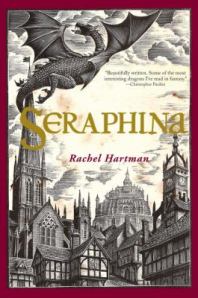
SeraphinaSeraphina by Rachel Hartmann

Decades ago, the Queen of a human kingdom and the King of the dragons worked out a peace treaty, still not completely trusted by anyone. Since then, the dragons (who call themselves saars) have decided that humans can be interesting. They take human form, or sarantras, and come to the city to explore human ways. This is the world that Seraphina has grown up in. She’s recently moved to the city and taken a job as assistant to the court musician, even though her Secret means that she must keep to herself, trusting no one and desperately lonely. A close friend of the family and her teacher, Orma, is a sarantras who has the special scholar’s license not to wear the visible badge. From dealing with him, she has learned to understand how dragons think – a Vulcan-like mindset that prizes scientific calculation and considers emotion dangerous and unreliable. This skill brings her to the attention of Prince Lucian Kiggs, a bastard engaged to Princess Glisselda, granddaughter of the still reigning queen who made the treaty in the first place. Her musical skill, meanwhile, was on display at the funeral for the much-loved prince whose was recently found murdered in dragon-like fashion in the wilderness. The talent lands her a position teaching Princess Glisselda harpsichord, while Kiggs decides that she’s the perfect person to assist in the investigation of the prince’s death. In her personal life, Seraphina’s mind is inhabited with people, some more and some less human in shape, who will take over her mind with visions if she doesn’t carefully visit and talk to the avatars of them in the garden she’s created for them in her mind. She’s always assumed this was her mind just being a little weird on her – until she meets one of them in person.

Seraphina is a character after my own heart. My lonely teen soul had a hard time identifying with any character for whom making friends came easily, and Seraphina’s loneliness brought me right back to that time. Happily for her, by the end of the book she’s found a happier place, one that felt honestly won. There was also a lot about music, and just reading about her playing the oud without her plectrum made me smile in geeky recognition. OK, I’ve never played an oud or used a plectrum, but I loved that Hartmann used real historical instruments, and Seraphina and I had flute, voice and keyboard in common. This is set in a beautifully realistic Renaissance world with a saint-based religion. It’s full of politics, music, personal discovery as well as the dragons, with some romance thrown in for good measure. While there is a villain in the end, for the most part, the sides are drawn in shades of gray, with neither humans nor dragons being the Enemy, and understandable motives on all sides. We have it in teen, and while Seraphina really is going through teen problems, the sex and violence are both low enough to make this fine for advanced younger readers. I would happily recommend this to anyone who identified with Menolly in Dragonsong.

Posted in books, Uncategorized | Tagged , , | 6 Comments

Cinder

CinderI picked this up thinking it looked like steampunk. It’s more cyberpunk than steampunk, but still fun a fun fairy tale/sci-fi mashup.

Cinder by Marissa Meyer. Read by Rebecca Soler.

Obviously, we know going into this story that it’s a Cinderella story. But the setting is changed to such a degree that how things are going to play out is much more in question than in a more straightforward fairy-tale novelization. Over a hundred years since the end of WW IV, Earth has consolidated down to a handful of large countries. Cinder, a teenage cyborg, lives in New Beijing, in the Eastern Commonwealth. The man who decided to take the bold step of adopting a despised cyborg died years ago, leaving Cinder in the very un-tender care of his wife. Cinder (trying hard to conceal that she’s a cyborg under her grease-stained cargo pants) supports her step-family by working as a mechanic from a tiny booth in the market square, accompanied by a cute and friendly little droid named Aiko. The very first day that we meet her, she’s visited by Prince Kai, heir to the Emperor’s Throne, who has a faulty tutor droid he wants repaired. Though Cinder’s never been the type to drool over handsome celebrities, she can’t help falling for Kai in person. Then, almost immediately, a vendor across the square screams as the blue spots of deadly letemosis appear on her. She’s airlifted from the spot; everyone visible is tested and evacuated. Back home, stepmother Audrey is busy getting her daughters, Pearl and Peony, ready for the annual ball (still a few weeks off) and insists that Cinder drop everything to fix the family hover so they can take it. Peony is the nice sister here, and she goes off to the dump with Cinder to help her look for the needed parts. Everything goes wrong when Peony shows signs of the plague and is taken away straight from the dump. Audrey is so enraged that Cinder isn’t ill as well that she volunteers her for the ongoing letemosis research program, always done on cyborgs since cyborgs aren’t considered real humans. This is where things get really interesting.

Meanwhile, we’re also hearing about Prince Kai’s point of view. His father, the Emperor, also has letemosis, and while it will still be fatal for him, at least he isn’t quarantined where his family can’t see him. For years, the Emperor has been trying to enter in peace agreements with the Lunar Queen, Lavanna. Lunars used to be humans, but in centuries on Luna developed mind control and the ability to make themselves look beautiful to others, which then increases their powers. Queen Lavanna used ruthless means to come to power, including setting her three-year-old niece’s bedroom on fire some 13 years ago, and doesn’t treat her subjects any better than you’d expect with that kind of attitude towards power. Prince Kai knows that a marriage alliance is Earth’s best hope, but is putting secret resources into seeing if he can find the princess, rumored to have escaped to earth from the burning bedroom. All through these events, Cinder and Kai bump into each other more than one would think normally possible, and have trouble not thinking about each other in between times. Rebecca Soler’s voice does well for Cinder and Dr. Erlund, the letemosis research doctor, but I found it hard to distinguish between Kai and Cinder.

There were some little things that bothered me with Cinder. Kai and Cinder are both impetuous teenagers, getting angry easily and mouthing off inappropriately. I get this in Cinder, who’s had a lifetime of neglect and built up a lot of resentment. I don’t quite buy it in a prince, though teenage readers might not have this same issue with him. The Big Reveal came too close to the end for me, especially since it seemed pretty obvious from much earlier in the story. The lunar powers never worked out quite to my satisfaction. It seems that the deal is you use them, unethically manipulating the people around you, or you don’t use them and go crazy from the suppressed powers. While there ought to be some ethical compromise, I never really felt that this worked out well. The cyborg issue was a little confusing – why would people having an artificial limb or two no longer be considered real people? But, Meyer did well with looking thoughtfully at the issues of prejudice surrounding both cyborgs and Lunars. Fair warning: this is one of those first-in-a-series books that has a perfunctory ending with lots of loose plot ends. Even with all that, I really liked Cinder and Kai and got absorbed with their problems. I can see why this has been a big hit, and will be keeping my eye out for the sequels.

Posted in books, Uncategorized | Tagged , | 6 Comments

The Battle of Blood and Ink

Battle of Blood and INkBattle of Blood and Ink by Jared Axelrod and Steve Walker.
The author’s note for this book says that the two guys were talking together about the craziest story they could come up with, and what they came up with was a floating city. The Floating City is a steampunky place, with distinct neighborhoods for different classes of people. Ashe, however, journalist and publisher of the insanely popular newspaper The Lurker’s Guide to the Floating City, goes wherever she wants. As the story opens, she has her friend and co-conspirator Tolban fly their little glider up close enough to catch the radio waves coming from a ship in distress. Not until the captain promises that he and his crew will go into slavery to the City are they allowed asylum. Once published, this secret is the one that finally determines the Provost of the City to stop the Lurker’s Guide. But Ashe is not without friends – she is not-so-secretly admired by Cardor, son of one of the richest citizens of the city. And for Ashe, being a target is only a reason to find more dark secrets to reveal and more ways to irritate those in power. The art is spare and angular black-and-white ink, which give it a modern feel despite the setting. The dark secrets were a little too dark to make this altogether light reading, and certainly make it most appropriate for adults or older teens, but this is a fun graphic adventure in a pseudo-Victorian, high-tech world.

Posted in books, Uncategorized | Tagged , | Leave a comment