
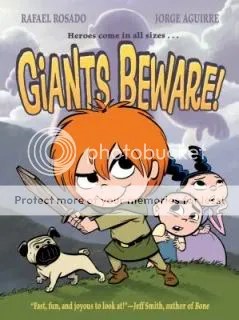
 Giants Beware! by Rafael Rosado and Jorge Aguirre. Graphic novels aren’t my favorites for reading aloud, but I was so excited about this one that I read it aloud to my son. (I read about it on Charlotte’s Library as well as PW.) Even the toddler, normally impatient with my reading to Brother instead of her, was captivated by the bright, vivacious drawings. Active Claudette is incensed when she learns that the hero of her small town did not kill the baby-feet eating giant that plagued it in years past. Even though the giant has been banished to the mountains and the city is safely enclosed within walls, she decides that it’s up to her to slay the giant. She’s the kind of kid who makes up her mind first and thinks through the problems second, if at all. Her first task is convincing her best friend, Marie, a would-be princess, and her little brother Gaston, a chef who dreams of being a sword smith, to come along. This she does by telling them that their ambitions will of course be fulfilled if they come along. They must all then get around Claudette and Gaston’s father, Augustine, the local sword-smith, crippled from a fight with a dragon years ago, and his assistant, the massive, wise and black Zubair, whose words about the foolishness of monster fighting go right over Claudette’s head. Their journey leads them through the Forest of Death, over (or perhaps also through) the Mad River, and up into the mountains. Meanwhile, the Baron of the village, Claudette’s father, leads a party of reluctant villagers in pursuit of the children, while Augustine and Zubair take up a more enthusiastic chase, though slowed by Augustine’s wheelchair. Each one of the children finds that their particular skills will be needed to get them out of one scrape or another along the way. By the end, the quest is accomplished, even if the goal has changed along the way. Claudette has also learned important lessons about the usefulness both of force and telling the truth. These are clear without being preachy or getting in the way of the fabulous adventure. Giants Beware! is a great counter-example to the truism that boys will only read about boys – yes, Gaston is a boy, but Claudette is clearly the reckless adventure-seeker here, and her drive kept my boy enthralled. This is going to the top of my list of good all-ages graphic novels to give both to people who love them already and to people (I keep finding them) who aren’t yet convinced that real literature can come in graphic form.
 The Scottish Prisoner by Diana Gabaldon. It must have been my very first year as a librarian, nearly ten years ago now, when a patron I was talking to put her hands on my shoulders, looked me in the eye, and said, “You have got to read the Outlander series. They are the best books in the world.” Well, I’m too fond of having lots of books to call any one series the best in the world, but for once, I took her advice and started the series. The books are addictive, long and involved, such a tight blend of historical fiction, time travel, and romance that the publishers originally decided to market them as romance mostly because romance had the biggest audience, though at the library, we shelve them in SciFi/Fantasy. Gabaldon now has a spin-off series and has done a graphic novel featuring the story from the first book from the point of view of the other main character. I haven’t kept up with all of these – I have a hard time justifying reading everything in a series as a librarian – but considering the volume of the output, I think that missing just one of the main series (which came out the same time my daughter was born) and one of the spin-offs is doing pretty well. Given all that, I was shocked to realize that I couldn’t find that I’ve ever reviewed a Gabaldon book here. However, there is again no way to review (or read) this book without massive spoilers for the first couple of those books.
 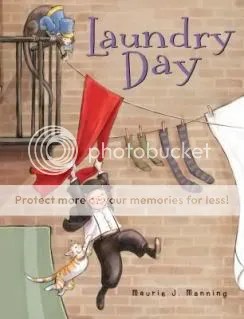 Laundry Day by Maurie J. Manning.
 The Microscope by Maxine Kumin. Illustrated by Arnold Lobel. I read this book to my son’s class in April, for Poetry Month. I like a funny poem for kids, especially, and this one is funny enough that I memorized for a high school poetry assignment, too. That time, I found it in a Cricket magazine, and though I have about half a bookcase devoted to my lifetime collection of Crickets, I couldn’t find the poem when I went looking for it a couple years ago. This year, I tried Google again, with better results. Now I have the perspective for the name Maxine Kumin to sound familiar. Right – former poet laureate and Pulitzer prize winner for poetry. Not only was the poem published as a picture book in 1984, but my library had it on the shelf, shelved with the biographies. It’s a tiny little thing, maybe 5 by 6 inches, so Teacher A. was kind enough to set up the document projector for me so the class could see the pictures. I’m not sure if this is irony or appropriate for the topic. In any case, we had fun.
  Storybound by Marissa Burt. Here is a book that called out to me from the shelf with its beautiful cover. It looked to have many things going for it – a lonely girl sucked into a strange magical world, a world where people study to become characters in books. Yay lonely girls, magic and metafiction! It was fun, but somehow not quite as perfect for me as I was hoping, in ways that I’m still trying to put my finger on.
  The Gift of Dyslexia by Ronald D. Davis with Eldon M. Braun. This is the dyslexia theory that my son’s school espouses, and at least per Amazon.com, seems to be among the top three dyslexia books currently out. Davis’s theories are based on his own experiences as a dyslexic, and the results from helping dyslexics in the clinics he founded. That’s a lot of experience, but as there are no scientifically based studies behind it, it’s more like a very large body of subjective evidence than truly scientific. Anyway, Davis’s theory is that dyslexics are visual learners. They think in pictures, and are used to being able to rotate, explode and reassemble objects in their minds without knowing they’re doing it. This is great for art and engineering, but really unhelpful for reading, where the letters need to stay two-dimensional and in the right order. The more words in a text that don’t make pictures, the more the brain tries to use its unhelpful skills to solve the problem, and the worse it gets. Davis has a test to see if this is the case with the person in question, and then a couple of methods (based primarily on age) for teaching them to be conscious about controlling their mind’s eye and its focus. Once they can do this, the program calls for hands-on work with making letters out of clay and working intensively with the toughest words to read – those that don’t easily translate to pictures. This, Davis says, will effectively cure dyslexia, while still preserving the gifts that caused it in the first place. I’m not sure how much of this really applies to my son, though some of it clearly does. I don’t know whether the school is using their treatment method or just subscribes to the theory that dyslexia stems from a gift rather than a disability. This book does some things very well, though. It has good descriptions of typical symptoms, good and bad, that go along with dyslexia. It is relatively short, printed in larger type with a minimum of hyphenated words to make it easier for dyslexics to read.
  Brain Gym by Paul E. Dennison and Gail E. Dennison This book was recommended to us by a friend, who had great success with both of her children using the exercises in it. I had to have it sent via ILL, and was rather surprised when I got it. It’s a small paperback only 48 pages long with amateurish drawings. The theory behind it is both simple and not much talked about: problems with reading, math, concentration, etc., can be helped by physical exercises, particularly ones that require crossing the body’s midline. For what we were looking at, drawing sideways figure eights in the air, first with just one hand and then with both held together. I think the theory is that problems like these can be caused by lack of communication between the two hemispheres of the brain, and doing physical integration can prime the pump, as it were, making the academic exercises easier. If you or someone you’re helping has difficulty, you can just flip to the appropriate page, where the exercise is drawn out with text descriptions of how to do it and what it should accomplish. I’m not sure we’ve remembered to do this quite as often as we ought, but it has seemed helpful when we do. In order to up the interest quotient, my brilliant husband had the idea of having our son do the exercises holding a foam sword, rather than just tracing the pattern in the air with his hands. It worked. For those more interested in the theory (which, come to think of it, would probably be me), there’s also a teacher’s guide, which has more detailed notes on everything.
 Saving Francesca by Melina Marchetta Life is somewhat difficult for Francesca Spinelli, whose mother has enrolled her at St. Sebastian’s, a school that prior to that year was all boys. Neither teachers nor students seem inclined to change their customs to allow for girls, and the only other girls for Francesca to hang out with are girls who were losers at her old school: crazy, radical Tara Finke, slut Siobhan, and accordian-playing loner Justine. Then things get even worse. Francesca’s mother Mia, always a major force to be reckoned with at home and at work, stops getting out of bed. Francesca and her beloved little brother Luca are sent to separate relative’s houses, while their father keeps trying to pretend that everything will just get better on its own. At school, Tara decides that the girls will make a list of demands, and that Francesca is the best person to bring those demands to their class representative, Will Tromball. Tromball seems to be a jerk who isn’t interested in changing anything – yet their eyes lock every time they see each other. Francesca keeps getting put into detention for things like trying to talk to Luca at school. In detention she meets guitar-obsessed slob Thomas McKee and weirdo Jimmy Hailler, whom she doesn’t really like but who keeps following her home and is able to accomplish the miracle of getting her mother to talk. There are lots and lots of plot strands here, with family, friends old and new, romance, and school, all swirling around Francesca and the identity she’s building for herself in the absence of the people who have in the past always told her who she is: her mother and her clique from her old school. The characters are clearly drawn and easy to root for, despite the (pardon) depressing topic of a seriously depressed mother. As in The Piper’s Son, families are shown as deeply loving despite their problems, friends worth living for despite their quirks. Though Francesca can draw strength from all of them, in the end, the only person who can save Francesca is herself.
  Unterzakhn by Leela Corman.
  Gone to Amerikay by Derek McCullough. Art by Colleen Doran. This graphic novel interweaves the story of three periods of Irish people coming to America. In 1870, Ciara O’Dwyer comes with her young daughter Maire, expecting her husband Fintan to follow soon. She moves in with family in the slums of New York and starts working as a laundress to support herself. Months pass, and even though a letter arrives saying that Fintan is on his way, he never turns up. Only Tim O’Shea, an altar boy with her husband when they were small, comes. Tim tells Ciara that Fintan changed his mind, joined the military, and might turn up in a few years. Meanwhile, he gets involved with the Irish gangs in New York and starts drawing Ciara into his Life of Crime. Meanwhile, in 1960, Johnny McCormack, a young would-be actor, emigrates to New York and finds work performing traditional and original Irish music instead. He falls in love with another Irish boy, a less recent immigrant, who introduces him to the right people but also breaks his heart. Finally, in 2010, businessman Lewis Healy, made rich by the Celtic Tiger, comes with his assistant who is giving him a tour of the origins of “Ciara’s Song.” This was the least interesting story for me – nothing really happens to Lewis himself – but it holds key information to both of the other stories. There is a wee bit of ghost story mixed into this – really just one creepy spread – but lots and lots of Irish song lyrics and an old story or two. I never really got a feel for the modern character, but both Ciara and Johnny have for me a deep inner integrity – that lifted them out of their sordid circumstances and gave the story, despite its many distressing elements, an overall upbeat feeling. I never lost confidence that both Ciara and Johnny would live out their American dreams, despite the many setbacks. Colleen Doran, famous for her work on Sandman, does not disappoint with the beautiful work that captures the people and places of all the different times. There is some violence and implied sex that might make this unsuitable for young children, but overall, this is an uplifting tale of the Irish immigrants in America.
 -
Join 888 other subscribers
- Follow alibrarymama on WordPress.com
-
Recent Posts
- Unraveling Family Secrets in The Inevitable Undoing of Zahara Douglass by Leslye Penelope
- Cozy Fantasy: The Tea Princess Chronicles by Casey Blair
- 8 Sapphic Graphics for Teens
- Author Interview with Julie Abe on the Magic Library of Waterfall Way
- 4 Fantasy Series Starters for Kids: An Encantadora’s Guide to Monstros & Magic, The Genie Game, The Last Ember, and The Magic Library of Waterfall Way
Archives

Tags
- #OwnVoices
- Adult Nonfiction
- adventure
- African-American
- Armchair Cybils
- Asian-American
- audiobooks
- award winners
- bibliography
- book-review
- book reviews
- books
- contemporary fantasy
- cooking
- Cybils
- diversity
- dragons
- fairy tales
- Fantasy
- fiction
- ghosts
- graphic novels
- historical fantasy
- historical fiction
- humor
- knitting
- Latino/a
- Latinx
- LGBTQ
- Middle Grade
- mr. fp
- multiculturalism
- Mystery
- mythology
- parenting
- picture books
- pirates
- reading
- Romance
- science fiction
- steampunk
- teen
- teen fantasy
- teen fiction
- teen science fiction
- Top Ten Tuesday
- youth fantasy
- youth fiction
- youth graphic novels
- youth science fiction
-
Top Posts
-
© Katy Kramp and alibrarymama.com, 2004-2024. Unauthorized use and/or duplication of this material without express and written permission from this site’s author and/or owner is strictly prohibited. Excerpts and links may be used, provided that full and clear credit is given to Katy Kramp and alibrarymama.com with appropriate and specific direction to the original content.

 alibrarymama