Dear readers,
I very much apologize for my spotty posting as of late. I’m not entirely sure what’s going on, but these three factors are probably influencing things:
1. My deep dark secret (but totally legal according to work) is that I write these posts in slow moments between patrons on the reference (or youth or reader’s advisory) desks at work. Slow moments seem to have been few and far between of late.
2. Various health concerns (but! Minor and ordinary!) have kept little L. up at night recently. Somehow, my brain seems to have a lot more difficulty putting a coherent post together on less than six hours of sleep a night.
3. Lightning Bolt has now officially been diagnosed with dyslexia, which means that my to-read shelf is now crowded with titles like The Secret Life of the Dyslexic Child and The Twice Exceptional Child, as well as needing to re-read The No-Cry Sleep Solution for Toddlers and Preschoolers. I dunno – are any of you, dear readers, interested in reviews of dyslexia books? I was thinking not, but let me know.
4. Tiredness and reading more professional book blogs leading to inferiority complexes regarding my little hobby blog. I have more followers that I know about on my little new Pinterest account than on the blog I’ve been posting mostly faithfully to for the last eight years. Hard to even put that in print, but there it is.
Anyway, I have been reading some more fun stuff, so here’s a bit.

Ranger’s Apprentice. Book 1: The Ruins of Gorlan. By John Flanagan. Narrated by John Keating. Will has grown up an orphan, raised in a group of foundlings sponsored by the Baron at Castle Redmont. Now all five of them are 15, and it is Choosing Day, time for them to be chosen as apprentices. Will is small and mischievous, but, believing that his father was a hero knight who died in the battle against the evil Morgarath, his dearest wish is to go to Battleschool and train to be a knight himself. All the other four foundlings are given their wishes, but Will is apprenticed to the Ranger Halt. Rangers are mysterious and much distrusted, even suspected of using black magic. Will is less than thrilled about this assignment, but as the alternative is field labor, he takes it. Of course the apprenticeship itself is lots of hard work, taking care of the menial tasks around the Ranger’s cabin as well as learning volumes of new things. He is learning things like tracking, how to stay hidden moving or holding still, how to use range weapons and to stay out of the line of battle if possible. The Rangers, it turns out, are spies of sort, spending their time in the wilds and small villages in and around the kingdom, keeping track both of political tides and the lay of the physical land. They are, in short, very cool, in a subtle way completely opposed to the flashy, bashy knights. Early on, Will’s story alternates with that of his rival from the castle, the big boy who made it to Battleschool. This boy is bullied very badly, and then takes it out on Will whenever they meet. In a plot turn that seemed inevitable from the beginning, events conspire to make these two the best of friends. Eventually he will proceed to help Halt and a former apprentice defeat some new monsters that Morgarath has sent forth in his latest bid for power.
I listened to this book on my own to see if it would be appropriate to share with my son, now seven, who loves all kinds of epic fantasy and battle-type things. And I came to the conclusion: he would love it. I am not comfortable sharing it for another couple of years at least, solely due to the strong and bullying subplot. That bullying was described in great and painful detail over multiple episodes. It was eventually resolved by Halt allowing Will to beat up on the bullies. While this is probably a very satisfying resolution for kids who have been bullied, it doesn’t seem a good solution to me. I don’t want to go on with the series myself without knowing that those types of unpleasant events wouldn’t continue. I felt with the five friends that Flanagan was assembling a crack gaming party, with a varied assortment of characters, each exceptionally good in a different area. None of these have yet been tapped in this first book, but there are ten books in the series, and I’m sure there are seeds for future plot points that I missed.
Despite my gut negative reaction to the bullying, it isn’t really any more violent than many other teen books, and there are a lot of good points to this book. It’s got constant action paired with a strong and likeable main character. Even though Will and his friends are all Above Average and it’s a fantasy, the skills are all ones that exist and could be useful in our world – no simple wand-waving. This series is aimed squarely at teen and perhaps pre-teen boys. Although most of the characters are boys, two of the five foundlings are girls, and they are given real, important careers as well, making it less gender-imbalanced than, say, LOTR. So far, there’s only the smallest hint of romance. All in all, not quite a series for me, but definitely one I’ll keep in mind for teen patrons and maybe even my son down the road a bit.
Cross-posted to http://library-mama.dreamwidth.org and http://sapphireone.livejournal.com .

 The Steampunk Bible by Jeff Vandermeer. I was at work looking through a list of upcoming nonfiction Steampunk titles, without any thought of being able to buy them for any of my library collections. Then I wondered where The Steampunk Bible would actually fall. And – score! 809.387, in the Dewey 800s (literature), one of the areas for which I do the purchasing. Even more exciting, it appeared on our weekly front-page of the Web site carousel of new purchases. That generated enough demand that I had to buy a second copy, a moment of geeky librarian happiness.
  12 Things to Do Before You Crash and Burn by James Proimos Herc was nicknamed Hercules by his father when he was six. But his father has just died in a plane crash. He was a popular self-help expert, loved by his audience, but a terrible father. Herc, definitely up there on the difficult teen scale, gives this eulogy at the funeral: “He was an ass. My father was a complete and total ass.” Following this, and no doubt further trying incidents at home, his mother ships Herc off to his uncle in Baltimore for two weeks. In the train on the way there, he sits by a Beautiful, Unattainable Woman who is reading Winnie the Pooh. When she leaves the book behind, he determines to track her down to return it. Meanwhile, his uncle, busy working long hours, gives him, like the Hercules of legend, twelve tasks to accomplish: Choose a mission. Find the best pizza joint in town. Clean out the garage. Muck the stalls at Riverbend farm. Read a complete book under a tree. Go to a place of worship and pray. Go on seven job interviews. Spend the day thinking big thoughts. Write them down. Eat a meal with a stranger. Make your uncle something. Recite a poem at Blake’s Coffee shop Midnight Poetry Reading. Complete your mission. Somehow, the force of his uncle’s personality is enough that Herc goes with it, forming most of the book.
  The Astonishing Secret of Awesome Man by Michael Chabon. Illustrated by Jake Parker. Awesome Man himself takes through a day in the life of… Awesome Man. He describes his costumes, his powers (the “Awesome Power Grip,” aka hugging), and his sidekick dog, Moscowitz. We see Awesome Man beating villains like Radioactive Jell-o from Outer Space and Dr. Von Evil. And then, alas, Awesome Man is beaten by his arch nemesis. He must flee to his secret fortress, a small patch of suburbia in an undersea bubble. After some deep reflection huddled on his bed, Awesome Man realizes that the problem is that he’s out of positrons. He needs to eat to regain his strength! But once on the job again, will he ever stop long enough to reveal his secret identity to the reader? The ending is undeniably sweet. The bright, smooth pictures have occasional retro-feeling dot fills, giving a hint of old-school comics. There are just enough details to let you discover new details in subsequent readings. This is ideal for superhero-obsessed preschoolers and early elementary kids, with just the right blend of action and innocence.
 Fabric-by-Fabric One-Yard Wonders by Rebecca Yaker and Patricia Hoskins. Here is an ideal sewing book for busy people. This book features stylish and fairly simple sewing projects with just one yard of fabric (plus notions & sometimes a contrast fabric). It starts with great detailed general sewing instructions, including what type of foot, needle & stitch length to use for different fabric types. Full-sized patterns are included for most projects; some simpler designs just have measuring instructions. From there, it’s divided up by fabric type, each fabric including a short introduction with more on how best to sew and later care for it. Fabrics include lightweight cottons, quilting-weight cottons, home dec, flannel, woven pile, coated fabrics, fleece, knits, and wool & felt. In general, the projects included lots of bags, little kid clothes, shorter women’s tops, some home décor items, and several toys. The projects I thought were the coolest included a hot pad apron; the flirty skirty; a quilted 8-bottle tote; a swaddle blanket with ties; the multi-use bucket; the kid’s comfy chair; a real kid-sized arm chair; the monster-wear hat & mittens; a superhero cape & shorts; a stuffed pig which gives birth to piglets who then attach to velcro teats to nurse; the speedy ruffle scarf; and the last-minute tunic. The ones I’d be most likely to make – mostly simpler and things I can’t buy – include the seafarer’s tricorn hat; a flat-screen TV cover. The book had lovely layout and design, with large photos and diagrams included for all the projects, in addition to the patterns. Smaller illustrations demonstrate techniques needed for particular projects. Coming from the knitting world, I wished that each project had included a source for the fabric, since for many of the simpler designs, the print will make or break the project. There was a list of websites for fabric sources at the end, though the URLs were missing from several of these, and there was no way to tell even which designer the featured fabrics came from. The projects came from many different designers, whose bios and blog addresses were also featured at the end. I’m not running out to buy it, but I am keeping it in mind for when I finish those sewing projects I bought fabric for in September.
 Leave It to Chance. Volume 1: Shaman’s Rain. by James Robinson and Paul Smith with Jeromy Cox. “Why aren’t there more Nancy Drew-style books anymore?” the creators of this book asked themselves, and set out to create one. Well, kind of. These people are comics types, so this is a graphic novel. And they seem to like fantasy, too (fine by me.) Chance is the 14-year-old daughter of a famous modern-day magician whose job is protecting the town of Devil’s Echo. She thinks she should be learning to take over the family business, but her father, shattered by the loss of his wife several years back, has decided that only boys should do magic. Refreshingly, Chance’s preferred clothes are pretty gender-neutral, so that even though her gender is central to her motivation, there isn’t a lot of girliness that would turn boys off of reading it. That’s great, because Chance’s adventures are top-notch. She frees a small dragon from being sent to a possibly hostile dimension. Naturally, he escapes, and chasing him down leads her straight into trouble, as well as a cute and powerful sidekick. Chance finds a dead body, perhaps related to the vicious mayoral campaign underway; overhears a gathering of very disgruntled sewer goblins; and decides to try to locate the kidnapped daughter of a local shaman. She teams up with a Hispanic female police officer and a reporter, and ends up solving bunches of interrelated mysteries while always managing to stay just out of danger herself. The art style is clear and vigorous and shows plainly that Devil’s Echo is diverse in the normal human sense in addition to its magical denizens. This is just right for elementary-aged kids looking for straight-up excitement. While there are definitely shady characters, there isn’t any graphic violence and our heroine always manages to squeak out of even the tightest situation without harm. My love brought this home from the library for us, and as it’s out of print, that may be the easiest way to get it in general. There are two more volumes that I haven’t seen, but may yet track down.
 Clockwork Angel by Cassandra Clare I pulled this off the returns cart, labeled new… and discovered only later that it’s a 2010 book that just gone out so much that no one here had a chance to take the New sticker off.
  An Undone Fairy Tale by Ian Lendler. Illustrated by Whitney Martin. Once upon a time, a beautiful princess was trapped in a tower. Her wicked stepfather, the king, locked her away so that she could bake her famous pies only for him. “Not even her mother could help her.” Naturally, princes and knights came to rescue her, but they all failed the three impossible tasks her stepfather set for them. Up until this point, straightforward fairy tale, told in a fancy typeface. And then, things start to go wrong. The brave, famous Sir Wilbur arrives to meet the king – and finds that he is wearing a doughnut instead of a crown. This, we are informed in plain sans-serif typeface, is because we, the readers, are reading too quickly, and the artist didn’t have time to fill in a proper crown. The artist is right there, in fact, hanging from some scaffolding trying to paint the wall behind the king. Now we are begged not to turn the page – the artist hasn’t gotten his delivery of horses or armor yet. But of course we do, and in the subsequent pages, poor Sir Wilbur is forced to fight a dragon which turns out to be a pretzel, riding on a fish and wearing a pink tutu. Things get more and more out of hand, with the drawings looking less and less polished, until the princess takes matters into her own hands, for a very silly happily-ever-after ending.
 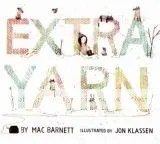 Extra Yarn by Mac Barnett. Illustrated by Jon Klassen. “On a cold afternoon in a cold little town, where everywhere you looked was either the white of snow or the black of soot from chimneys, Annabelle found a box filled with yarn of every color.” She starts to knit. She knits a bright sweater for herself and for her dog. People start finding her brightness distracting, so she knits sweaters for them, too. When she’s knit sweaters for every person and animal in town, she starts knitting cozies for the buildings. The illustrations show the change in the town as it gradually fills with color and warmth. All the while, the box stays full of its beautiful yarn, which seems to be magic both in never running out of yarn and in allowing Annabelle to knit with amazing speed (that last isn’t commented on in the book, but really… she knits a cathedral cozy.) Then, an evil Archduke comes from across the sea to take the box for himself. Annabelle says no. The Archduke is powerful and used to getting his way. What will happen to the box?

 alibrarymama