Hamster Princess: Harriet the Invincible

Can you resist an invincible hamster princess? I certainly couldn’t, and was quite relieved to find this just as much fun as it looked.

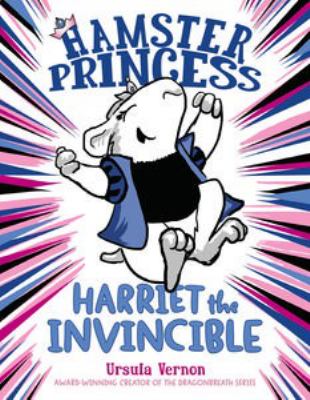
Harriet the InvincibleHamster Princess: Harriet the Invincible by Ursula Vernon. Dial Books for Young Readers, 2015
Here is a twist on the Sleeping Beauty fairy tale perfect for middle and upper elementary students, and younger for read-alouds.  Princess Harriet (yes, she is a hamster) is thrilled when her parents tell her that an early encounter with an evil fairy has doomed her to prick her finger on a hamster wheel and fall asleep on her twelfth birthday.  She’s always had trouble being the quiet, indoor type of princess and this means she’s invincible – she can do anything she wants!  Much to her parents’ disapproval – they would much rather she stayed home and work on finding the right prince to kiss her awake after the fact – she sets out on a life of adventure and monster-battling on her faithful quail steed.

Like Vernon’s popular Dragonbreath series, the story alternates prose storytelling with comic book panels, often for the action scenes.  Vernon makes this style work very well, and it’s a great choice, especially for reluctant readers who are intimidated by large blocks of text.  The story is fun for everyone, though.  Vernon looks at the stereotypes as she’s upending them, so that even as we’re sympathetic towards Harriet’s reluctance to take romance seriously at her young age and cheering for her on her adventures – Harriet also has some lessons to learn about her unthinking targeting of creatures she considers monsters.  There’s a whole lot of fun and, yes, adventure with a very likeable new heroine and her brave yet adorable quail. Ms. Yingling had mentioned that the hamsters are not quite as expressive as the reptiles in the Dragonbreath books.  Unfortunately, I have to agree with her.  I did have some trouble telling some of the characters and expressions apart, but that didn’t keep me from enjoying the book.  And it’s certainly not keeping this from flying off the shelves at my library.

Official disclaimer – this book is nominated for the Cybils award, but this is my personal opinion on the book, not the opinion of the Cybils committee.

Posted in books | Tagged | 5 Comments

A Dragon’s Guide to the Care and Feeding of Humans

I confess, it was being nominated for the Cybils that made me pick this one up (finally), but it had been on my radar for a while, because as my son recently informed my daughter, dragons are the best.

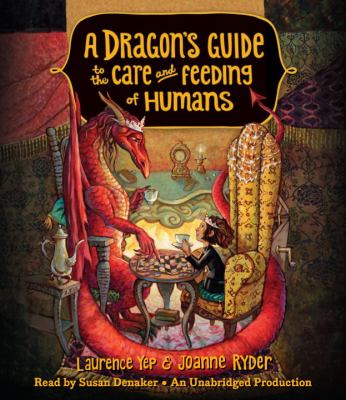
Dragon's Guide to the Care and Feeding of HumasA Dragon’s Guide to the Care and Feeding of Humans by Laurence Yep and Joanne Ryder. Read by Susan Denaker. Random House, 2015.
Miss Drake is a dragon who takes humans as long-term pets.  She’s been doing this for several centuries, but the (unfortunate if timely) death of her latest pet, Fluffy, has sunk her into depression.  She’s startled out of this by the arrival of young Winnie, Fluffy’s great-niece.  (Winnie called her Great-Aunt Amelia rather than Fluffy.)  Miss Drake would like Winnie to go away and leave her in peace.  Winnie has strict final instructions from Great-Aunt Amelia to persist in visiting Miss Drake and making sure she is taken care of.  Can Miss Drake’s attempts to train her new pet stand firm in the face of Winnie’s desires for cookies, tea, and field trips to the local magical shops?

On the surface, this is a clever set-up. Miss Drake and Winnie each consider the other her pet, and it’s entertaining to watch them circle around each other.  It’s also a look at dealing with grief – a refreshing one where the deceased is loved and missed but not the child hero’s parent or sibling, and people are sad but are able to keep living life.  There are fun adventures with unpleasant creatures trying to attack the magical shop and Miss Drake and Winnie having to chase down some runaway magic, but the real heart of the story is the developing cross-generational friendship between the two main characters.  This gentleness makes it appropriate for younger and/or sensitive fantasy readers.  I listened to it on audio and tried playing a bit of it for my six-year-old, who found the story from the dragon’s point of view a little too confusing for her.  Susan Denaker’s Miss Drake voice sounded proper, British and a bit elderly – perfect – but Winnie’s voice sounded like she was five instead of ten, like all of Denaker’s voices for the Penderwick sisters.  That’s a slight complaint, though, for a quite enjoyable book.

If you’re looking for more first fantasy chapter book suggestions, I have a whole list for that!

Posted in books | Tagged , | 3 Comments

Cuckoo Song

My giveaway for the graphic novel Oddly Normal is open for just a few days more – that’s another book good for, but not limited to, Halloween.  Go enter now!

October 31 is also the birthday of Juliette Gordon Low , founder of the Girl Scouts.  Thank you for believing in girls, Juliette!  I recently read the picture book biography Here Come the Girl Scouts by Shana Cory, illustrated by Hadley Hooper to my Daisy troop – they were very impressed by the beautiful portrait in the back!

Here’s one more spooky book just before Halloween – one that I’m handing off to a horror-loving middle schooler as soon as I write this review.

cuckoosongCuckoo Song by Frances Hardinge. Amulet Books, 2015.
When Triss wakes up, the people calling her are only vaguely familiar, and she can’t remember falling into the lake as the people who are supposed to be her parents say she did.  As they decide to cut their vacation short, everyone hopes that being in familiar surroundings will help Triss recover her memories.  Everyone except Triss’s younger sister, Pen, who is inexplicably furious with Triss.  But going home only drives home the fact that Triss doesn’t know things that she should know.  Other strange facts: Triss is always hungry, no matter how much she eats.  There are always dead leaves in her hair when she brushes it. And dolls open their eyes and turn their heads when she walks by.

Triss is badly frightened.  As she sets out to find out what is wrong, she learns both that something is very wrong with her – but also that the family that looked so perfect at first is falling apart, as symbolized by the bedroom that’s supposed to be left untouched in memory of the older brother who never came back from war (World War I going by technology, though it never says outright), but that in fact has regular visitors.  The more she learns, the more she realizes that she has very little time indeed to stop something truly horrible from happening.

This is horror where you find that the shadows you were telling yourself not to be frightened of – you really should be careful about. Yet as scary as the supernatural things are – they were only let in because of the horrible things done by well-meaning humans.  Even though there is plenty of action (on motorcycles! Jumping over rooftops! Falling into freezing water!), this is creepy, not gory, keeping it appropriate for middle grade kids or sensitive adults.  The characters are well-developed and the language is beautiful without focusing too much attention on itself – here’s one quote:

“The Old Docks had not faded gently. They did not look sad… Neglect had given the Old Docks a dangerous air, like that of a half-starved dog.” (p. 333)

I might have passed this up despite the numbers of my blogging friends who are fans of Frances Hardinge, as horror isn’t usually my thing.  I’m so glad I did read it, because it is excellent.

Official disclaimer – this book is nominated for the Cybils award, but this is my personal opinion on the book, not the opinion of the Cybils committee.

Posted in books | Tagged , | 2 Comments

Hoodoo

Here’s another one for kids looking for something spooky for Halloween (or, you know, any other time.) This is one I already had checked out from the library for Cybils reading when I went to Kidlitcon and saw that the author was on the Middle Grade Horror panel!

hoodooHoodoo by Ronald L. Smith. Clarion Books, 2015.
It’s the 1920s or possibly 30s in small-town Alabama.  Hoodoo Hatcher, aged 12, is being raised by his grandma, Mama Frances, as both of his parents are dead – his mother in childbirth and his father hanged for a crime that Hoodoo has pretty much been kept in the dark about.  “Hoodoo” is both what his people call magic and Hoodoo’s name, as his grandmother thought that he was full of that.  Hoodoo feels that this is an injustice – not only does he have a funny name, but he can’t even do the magic his name would imply – at least not yet.  He’s sweeping in the general store for an extra coin when a stranger dressed in black comes into the store looking for “mandragore”.  Hoodoo knows neither what mandragore might be nor why he is so frightened of the stranger.  But when crows and the fortune teller at the state fair and his dreams tell him to be careful, he starts getting very nervous.  Still, he doesn’t want to tell his family.  (Poignantly, he and his not-yet-girlfriend Bunny have to go to the fair on the last day, “Colored Folks Day”, so the white folks don’t have to attend a fair previously attended by coloreds.)  Hoodoo – helped somewhat by Bunny – sets out on a mission first to find out what the man in black wants and stop him.  It’s all bound up with Hoodoo’s personal family history, so that in the end, Hoodoo is both stronger in himself and more connected to his family history.

This sounds pretty grim, and to some extent it is – it doesn’t stop shy of real people being killed, even if the children stay safe, and some of the magic is dark and very, very close to Hoodoo.  But it’s also filled with the warmth of Hoodoo’s extended family and friends.  Hoodoo himself has a fine sense of humor and optimism in the face of everything that reminded me of Bud in Bud, Not Buddy. He tells the story in first person, with asides to explain his world followed by “if you didn’t know” – “Molasses is like syrup but thicker, if you didn’t know.” If you’re looking for a book to make your skin crawl where the young hero still wins in the end, this is a fine one

Official disclaimer – this book is nominated for the Cybils award, but this is my personal opinion on the book, not the opinion of the Cybils committee.

Posted in books | Tagged , , , | 2 Comments

One Witch at a Time

More Cybils reading!

One Witch at a TimeOne Witch at a Time by Stacy DeKeyser. Simon & Schuster, 2015.
This book is the sequel to The Brixen Witch, which I haven’t read, but I deduce from references in this book was a Pied Piper retelling.  The village of Brixen has not been doing well – winter is lasting too long, and there’s not enough food to go around.  Our young hero, Rudi, is sent off to market in the neighboring town to sell one of his family dairy’s few remaining cows.  Susanna Louisa, a neighbor girl only nine years old, comes along, and ends up selling the family cow for a handful of beans that she claims are magic.  Magic beans! These were sold to her by a pretty but clearly dangerous girl that Rudi learns is named Agatha, who’s dressed in the style of people from Petz, even though they are rumored not to be able to leave their village. From this point, we know this is going to be a Jack and the Beanstalk story, with the added wrinkle that each town in this country has its own witch.  Brixen’s witch is the more traditional style: a crotchety old lady that no one wants to cross, but who really has Brixen’s best interests at heart.  Right now, though, it seems that Brixen is being affected by magic from the neighboring town of Petz, whose witch is a large and much less kindly male giant.  It’s up to Rudi, Susanna Louisa, and Agatha to stop the giant from destroying both Petz and Brixen, keeping in mind the rules about witch’s magic that the Brixen witch tells them.

When starting midway through a series, my first question is always, “Can I understand what’s going on or do I feel left in the dust?” Here, I could definitely tell that things had happened to Rudi before, but this was another adventure.  I didn’t feel left behind, but if you have time, you’d probably enjoy this one more after reading the first one.  It is a historical setting, but Rudi’s voice is fresh enough to keep it feeling approachable.  This is a fun fairy tale-inspired adventure, with strong characters of both genders. Rudi is plucky enough to respect, but isn’t the Hero of the Day, even though the story is told from his point of view, a refreshing change.  It’s also great to see a fairy tale story starring a boy, as there are not nearly enough of these for balance – too bad it doesn’t look like it from the cover. This is a fun, fast read for fans of both fairy tales and fantasy adventures.  It would pair well with Liesl Shurtliff’s Rump and Jack.

Official disclaimer – this book is nominated for the Cybils award, but this is my personal opinion on the book, not the opinion of the Cybils committee.

Posted in books | Tagged , , | Leave a comment

The Jumbies

Here’s a scary adventure story perfect for this time of year.

The JumbiesThe Jumbies by Tracey Baptiste. Algonquin Young Readers, 2015.
The woods of Trinidad are filled with jumbies, the collective term for a wide variety of supernatural creatures, with one thing in common: they do not mean humans well.  Most of the residents of Corinne’s village stay away from the forest.  Corinne’s father, though, doesn’t believe in the jumbies, and so Corinne feels free to take shortcuts through the woods.  But when two pesky boys steal the necklace she inherited from her mother and tie it to a lizard that runs into the woods, Corinne is sure she hears things following her.  It turns out that something even worse than the jumbies she’s grown up hearing about is after her – a jumbie in the shape of a beautiful woman who enchants her father so that he no longer recognizes Corinne.  She has no choice but to join with the two boys (maybe too quickly, in my one quibble with the book), as well as another girl from the marketplace, Dru, to try to stop the jumbie before the whole village is taken over with them.

Tracey BaptisteAs a child, I read through all the books of folk tales from around the world that I could find, so I definitely agree with the author that Caribbean folk tales are hard to find, and novels based on them rarer yet.  Baptiste – born and raised in Trinidad but now living in New York – has written a compelling story incorporating the folk lore she grew up with. (It was fun to hear her talk about this at Kidlitcon.) But even those who aren’t specifically interested in the folk tale can’t help but be captivated by the story.  Corinne is a winning character, and the adventure is exciting on its own merits.  Many of the jumbies are quite scary, from the one that looks like your grandmother until it takes off its skin and bursts into flame, to the ones that look like little kids in big hats that call your name and lure you into the forest, never to be seen again.  They aren’t hands-off in this story, either.  It’s nicely balanced with humor and affection, though, as Corinne builds friendships with the other children, works to save her beloved father and learns more about her power to grow.

Official disclaimer – this book is nominated for the Cybils award, but this is my personal opinion on the book, not the opinion of the Cybils committee.

Posted in books | Tagged | 7 Comments

Roller Girl

Here’s a Cybils-nominated graphic novel that I really enjoyed.

Roller GirlRoller Girl by Victoria Jamieson. Dial Books, 2015.
It’s the summer before middle school, and Astrid is just about to learn what a bumpy ride that will be.  After watching a roller derby game with her best friend, Astrid decides she wants to do roller derby summer camp, even though she can’t skate at all.  She’s horrified when her friend signs up for ballet camp instead – something Astrid isn’t interested in at all. Even though she’s on her own, Astrid makes a new friend, Zoey.  At first it looks like it’s mostly going to be physical training – learning to skate and how to be tough are hard enough – but Astrid comes to the hard realization that as disappointed as she feels by her old best friend, she’s not a great friend herself.  There’s looks at that difficult time when some girls are starting to be interested in boys and others still think they’re icky.  I also loved the locker-room notes exchanged between Astrid and the city’s star player, Rainbow Bite.  The art is mostly rounded and friendly, reminiscent of Raina Telgemeier, but once in a while it veers towards the metaphorical, perfectly illustrating Astrid’s inner life.  I can vouch for general kid appeal on top of my enjoyment, as both of mine ate this up.

Posted in books | Tagged | 3 Comments

Shadowshaper

This book was making the rounds of my favorite blogs – The Book Smugglers, Charlotte’s Library, By Singing Light  – and I couldn’t resist it.  It’s one I loved so much that I don’t know if I’ll be able to say anything coherent about it.

ShadowshaperShadowshaper by Daniel Jose Older. Scholastic, 2015.
Our heroine is teenaged Sierra, a dark-skinned bilingual girl of Puerto Rican extraction, who lives in an accurately diverse Brooklyn neighborhood, Bedford-Stuyvesant.  (‘m making a much bigger deal of the diversity than it is in the book, where it’s just Sierra’s world.) I’m used to “urban fantasy” mostly being about whites and “urban literature” being about people of color doing horrible things to each other. In both cases “urban” usually comes in the same breath as “gritty”.  But here, as Charlotte pointed out, it’s urban but not gritty – Sierra’s people aren’t rich or white.  They stick by each other and are the kind of close-knit that suburbia pines for.  So when things start going wrong, it’s not normal, and Sierra and all of her friends band together to stop it.

Sierra first notices it when she sees a mural of an old friend crying. Soon she sees flickers of life in murals around town, and is asked to paint a mural as an attack on an ugly, unfinished building in their neighborhood.  Hints from her grandfather, mostly incoherent after a stroke, lead her onward. She’s just finding out that cute boy Robbie from Haiti is also an artist when they’re chased by a zombie-like corpse. Sierra learns that she is a Shadowshaper, able to use the shades of the dead, a power that gets dangerous very quickly in the wrong hands – I really appreciated how this felt truthfully coming from her heritage.  There’s action, research (helped by a friendly librarian!), help from friends of multiple generations, uncovering family secrets and refusing to put up with old prejudices, all with just the right touch of romance kept nicely to the side.  This could be perfect if you’re looking for something a little spooky for Halloween – or anytime you need a good contemporary fantasy.

Side note: I gave this to one of the people at my ESL conversation group who really wanted ghost stories from around the world.  Not only is it a great story in general, but fast-paced, not too long and with a straightforward narrative that I thought would be good for a non-native reader. I know, I know… you’re not supposed to give kids’ books to adult language learners, but my own experience living abroad was that children’s books are much easier to understand, both because kids are also learning how their culture works and because they don’t feel obliged to use the literary tricks that so many adult books do.  Also, I nearly always like kids and teen books better.  So I tell my language learners both of these things, and figure out if they’d rather have help finding adult books at their level, or if they’re OK with books for kids and teens.

Posted in books | Tagged , , , | 9 Comments

The Wells Bequest and The Poe Estate

Just as a reminder – you still have time to enter the giveaway for Oddly Normal!

I have a never-ending list of books to read for myself in print – but when it comes to audiobooks for the car that are exciting enough for my son and not too scary for my daughter, five years younger, it’s often a challenge.  When I found this on the library shelf, I checked it out, even though it was the second in the series the first, which we hadn’t listened to, was nowhere in sight.

The Wells BequestWells Bequest by Polly Shulman. Narrated by Johnny Heller. Penguin Audio, 2013.
Leo loves taking things apart and putting them back together again to do something else – but he’s the youngest and least scientific of a nerdy Russian immigrant family.  He’s depressed thinking about what he might do for a science fair project that will live up to his family’s high standards, when a tiny flying machine appears in his bedroom.  A tiny version of himself is riding on it – with his arms around the most beautiful girl in the world. He only really catches that he should read H.G. Wells’ The Time Machine before the tiny machine and the tiny people on it vanish again.

Thinking of time machines leads him to want to do something related to that for his science fair project.  His science teacher (a very cool sounding Korean-American woman brightly dyed hair) directs him to the New York Circulating Material Repository, a library where he can check out, if not time machines, at least early robots.  When he gets there, not only does Leo find that the Repository is the coolest place ever, but also that his dream girl, whose name turns out to be Jaya, is the head page there.  Before he quite knows what’s happened, Leo is working as a page at the Repository himself, and he and Jaya are racing to get a time machine in working order, to stop Simon, another page and rival for Jaya’s affections, from stealing Tesla’s death ray from the past and using it in the present.

There were some references to the first book, The Grimm Legacy, but as it clearly had mostly different characters, it didn’t feel like we were being dumped into the middle of a story.  I am always happy to find stories of magical libraries, and the New York Circulating Material Repository, which stores both regular historical artifacts as well as artifacts from fiction that have somehow become real, is a very fun one indeed. They all know it’s confusing and doesn’t quite make sense, and have conversations about it that were also hilarious.  I liked both Leo and Jaya very much, and this gets points for diversity, both with Leo’s first-generation non-native English speaking immigrant family, and for Jaya, who is Indian-American.  Heller reads with an energetic, lightly accented voice that felt just right for Leo, even if some of the minor characters’ accents didn’t come out quite right.

Normally, I’m not a big fan of instalove, but this really worked for me.  Leo’s not quite sure why he’s so drawn to Jaya, aside from her beautiful smile with one crooked tooth – but it’s a believable middle grade intense crush, focused more on her personality and intelligence than the physical attraction and nothing else that really turns me off.  Leo also work hard to be friends with Jaya and has to overcome his shyness to do so in a way that I found adorable and did not cause my son to cover his face in embarrassment, as he has been known to do.  This was an exciting story, with Leo and Jaya racing off in jets and all kinds of fictional methods of travel from submarines to time machines – but they were not in clear mortal danger until the very end.  Since my youngest hates to be scared like that and my oldest wants his books to be exciting, this was a nearly perfect lighthearted, not-too-scary adventure.

The Poe EstateI requested the next book, The Poe Estate by Polly Shulman. Narrated by Jorjeana Marie. Penguin Random House/Listening Library, 2015 from the library, but ended up listening to it on my own.

I’m glad that I did, because this one – perhaps predictably, given the subject – took a sharp turn from the fun adventure of the previous book.  Our new heroine, Sukie, is dealing with a lot: her older sister, who’d always protected her from everything, died a few years ago.  Now her parents haven’t been able to find enough work to live in the house they’d built for themselves, so they are moving in to the giant old family house of their aged Cousin Hepsibah.  The whole first disc of the audiobook is about Kitty’s death and Sukie’s subsequent depression and losing all her friends. While Sukie meets some people collecting haunted artifacts and houses for the New York Circulating Material Repository fairly early on, it isn’t until far into the book that she actually gets to go there.  (I was a little surprised that they needed a whole magical annex to store the haunted houses – I’m used to Greenfield Village, which stores its collection of historical houses on regular land, with historical transportation options to get around to them both for fun and the less mobile.) The last third of the book turns into more of the fun adventure, as Sukie and her friend race against ghost pirates to find a treasure – but that comes after and mixed with scary ghosts.  There are kids who like scary, but for me, a dead sister turning evil is a different level of scary than the scary ghosts of unknown adults or the friendly ghosts of long-dead children that are more common in children’s books.  I am sure there is still an audience for this one, but it’s not my kids, who don’t like scary and especially not siblings dying.  The narrator sounded like she had a cold the whole time, which was also less appealing. We’ll probably still go back for The Grimm Legacy, though.

Posted in books | Tagged , , , | Leave a comment

Kidlitcon 2015

I was very grateful to attend Kidlitcon in Baltimore this last weekend, courtesy of the Friends of the Library.  Kidlitcon is a small conference sponsored by the Kidlitosphere, an association of children’s and young adult literature bloggers.  They also sponsor the Cybils award, now in its 10th year, which I use at least weekly in Reader’s Advisory for our young patrons.  (I am also serving as a Cybils judge for the second time. This was, however, my first time attending Kidlitcon.

Anne Boles Levy, founder of the Cybils award, at the Cybils birthday party

Anne Boles Levy, founder of the Cybils award, at the Cybils birthday party

Kidlitcon is a cozy conference, with only about 100 people attending, mostly librarians, teachers, and authors, with a small sprinkling of enthusiastic readers who blog about children’s literature without doing it as a career.  It is (as I had previously been told) the perfect conference for introverts.  There are no large groups coming from libraries, but it’s easy to get to know everyone there without being intimidated because there are just a small number of people, all of whom are happy to talk about books.  There was no giant room full of vendors, just a set of tables in the hallway outside the meeting room filled with publisher and author donations.  All of the authors and illustrators I talked to were happy not only to autograph books but also to let me photograph them holding my knitting project.  Both of the keynote speakers went to other sessions and hung out with the rest of the attendees at mealtimes.

Session Highlights

I attended nine and half sessions at the conference.  The two author keynote sessions were with Carrie Mesrobian, the author of several realistic teen books, on Friday and Tracey Baptiste, author of the middle grade horror/adventure novel The Jumbies on Saturday.  Carrie talked about finding the “edges” for teen readers – reading at the right level to meet them where they are. Baptiste, who grew up in Trinidad, talked about writing the oral traditions there and her childhood love for printed fairy tales, which inspired her to write the mystical creatures of her homeland into a novel for children.  Except she was very funny and approachable about telling the story.

Genre Panels

Tracey Baptiste

I attended four sessions focused on different ages/genres of books, all with panels of authors and/or artists.  Middle Grade Horror featured authors Tracey Baptiste, Mary Downing Hahn, Dan Poblocki (“best use of ghost Nazis ever” according to the moderator), and Ronald L. Smith.  I was very pleased to note from the get-go that the panel was evenly divided both between men and women and between whites and people of color.  Although the whole discussion was fascinating, the most useful take-away from this session was having benchmark books to reference when helping kids find the right level of scariness for them.

Visual Storytelling had picture book artists Matt Phelan, Minh Le, Kevin O’Malley and Shadra Strickland, and was moderated by former Caldecott committee member Susan Kusel.  Here, the artists talked about how they fit the art to the story and what choices are theirs versus the publishing house, editor, and author.  Message: don’t rate the artist down for plain endpapers – every one of them will jump for fancy endpapers if the publishers give them a choice.

Jorge Aguirre and Rafael Rosado

Jorge Aguirre at the book signing, with my sock in progress! Rafael Rosado signing. Author/illustrator of Dragons Beware!

How Graphic Novels Work had author/artists Jay Hosler, Maggie Thrash, Rafael Rosado & Jorge Aguirre, moderated by extremely enthusiastic graphic novel librarian Miriam DesHarnais.  The author/artists (still ethnically diverse) also wrote a large range of books from science to memoir to fantasy adventure.  Jay, the science writer pointed out that studies have shown that the combination of words and pictures is much more powerful in getting kids to learn and remember than either by themselves.  Maggie, the memoir writer thinks that words put you in someone’s head, while comics put you in the situation yourself.  Rafael, one of the fantasy adventure team, talks about the magic that happens in kids’ heads when they fill in the events that happen between one panel and the next.  Comics stimulate empathy and let you linger on a moment as long as you want, unlike movies.

Middle Grade Madness had authors of realistic middle grade fiction Elissa Brent Weissman, Erica Perl, Elisabeth Dahl, Carol Weston and Wendy Shang.  The authors talked about what they like to put into books for 9-13 year-olds. A particular topic that came up was writing for boys vs. girls – only Carol Weston writes specifically for girls.  Everyone else is trying to let stories be for everyone, whether they’re writing about boys or girls.

Diversity Panels

Diversity was the main focus of last year’s Kidlitcon. This year’s conference had two panels specifically focused on diversity, and the organizers paid close attention to having diversity on every panel whether or not diversity was the focus.   Intersectionality with Mary Fan and Libertad Araceli Thomas and Guinevere Zoyana Thomas (the Twinjas), with absent member Zetta Elliott, looked at how people usually belong to multiple groups – not just the one we tend to want to limit them to.  The Twinjas, for example, are Black and Latina; Mary Fan is a woman from a “good” minority, and talked about privileges and prejudices in various parts of her life.  Let’s move past allowing book characters only one minority identity or problem.

Blogger trio

Meeting for the first time fantastic bloggers Pam Margolis of MotherReader, Melissa Fox of Book Nut, and Anne Boles Levy, Cybils founder

Authentic Voices with bloggers Pam Margolis and Liz Burns focused specifically on GLBTQ literature (Pam) and on making things available and authentic to people with disabilities (from Liz, who works for a library for the Blind.)  It’s good to have these kinds of people represented in books – it’s even more important that their voices be authentic and show the full range of people in these categories.  Liz opened our eyes to just how few books the Library of Congress is able to publish for the Blind each year, both in their special audio format and in the different Braille types.  It’s staggeringly few.

Just for Bloggers (and Librarians)

I also attended “And the Winner is…” a panel discussion with literary award judges, most of whom had judged on lots of different committees, including the Cybils, Caldecott, Newbery, Printz, Schneider, Odyssey, Eisner, as well as state awards. They talked about theoretical issues – making sure you’re reading for the specific criteria of the award you’re judging for – and practical ones like how to keep track when you’re reading a really large volume of books.  Also, once you’ve been a judge, can you turn off those filters and read just for pleasure?

“Who Is the Reader… and why that matters when I’m talking about books” with bloggers Katy Manck of BooksYAlove and Barb Langridge of A Book and a Hug.  A Book and a Hug has a database of book reviews tagged by reader type (Katy and many other reviewers contributed to this.)  They explained their system of identifying reader types.  Barb developed four reader types, which on the web site are shown as different types by gender, even though they’re not.   (Descriptions of the types for girls: http://www.abookandahug.com/books-for-girls2 and for boys: http://www.abookandahug.com/books-for-boys ) Basically, the types are realistic, empathetic (which often tends towards fantasy/sci-fi), thrill-seekers, and nonfiction/fact readers.  We had fun taking the quiz and figuring out our types – way skewed off the types that they’ve found with real kid readers.  They also talked about applying this kind of reader’s advisory to Ranganathan’s Five Laws.  It’s always helpful to have different approaches to try with reader’s advisory, so it was good to hear about this different twist on it.

Conclusion

Kidlitcon was a great conference, kind of like the much-lamented Fantastic Fiction, but twice as long, for kids, and with session presenters drawing from a broader pool.  I really enjoyed the sessions I went to, as well as getting to know so many people outside of the sessions.  I heard from those who attended other years that this year was more author-focused than it has been in the past – I’d really love to attend next year in Wichita, when the focus will be on gatekeepers – both our role in being gatekeepers, and working with young peoples’ other gatekeepers.  Thank you again to the Friends of the Library for supporting my trip to Kidlitcon!

For me, too, it was especially exciting to meet so many bloggers I’d only known on-line for so long.  Here’s a few more pictures:

Maureen and Karen

Bloggers Maureen [ed. 10/19 to add] Kearney of Confessions of a Bibliovore and Karen Yingling of Ms. Yingling Reads

Sondra

Sondra Eklund of Sonderbooks

Me with Charlotte of Charlotte's Library

Me with Charlotte of Charlotte’s Library

Posted in Conference Notes | Tagged , | 9 Comments