The Golem and the Jinni

This historical fantasy came out last year, and I’m always interested to read fantasy novels that get the amount of mainstream coverage this one did. Also, just in case you needed a reason to listen to an audiobook, June is Audiobook Month!

The Golem and the JinniGolem and the Jinni by Helene Wecker. Read by George Guidall. HarperCollins, 2013.
Here’s the premise which hooked me: a young golem and an old jinni, both isolated, meet in the streets of early 20th-century New York and become friends.

It’s a literary story with rich characters, steeped in time and place. Our main characters, Chava the golem and Ahmad the Jinni, are both magical creatures who don’t need sleep, trying to keep themselves both hidden and occupied, especially at night. But from there, they are radically different. Chava cares about everyone, and is very concerned about learning and following all the human rules, even when they seem arbitrary. Ahmad, on the other hand, cares for no one but himself and chafes at the limitations of a newly enforced human existence. But we go in depth into the backstories of a number of other characters, too, who at first seem like detours, but turn out to be highly relevant to the plot. Chava’s circle includes Rabbi Meyer, the kindly old man who first discovers Chava and takes her under his wing; his nephew Michael; the crazy man who created Chava; and the employees of the bakery where Chava takes a job. Ahmad finds work at a tinsmith’s shop, and effortlessly both attracts people like a young boy with a dying mother and a young and beautiful heiress, Sophia (who’s attracted to him in quite a different way), while at the same time repelling the popular owner of the local coffee shop as well as the wandering ice-cream seller, Saleh.

Wecker’s approach makes this a story that will appeal to literary fiction fans as well as fantasy fans – I could see this doing very well with book clubs. It felt like it was bogging down a little in the middle to me (that might have been just that I wasn’t listening often enough for a book this long – over 19 hours), but there was always something to keep me going. George Guidall had a fantastic voice for this, able to capture the age and the ethnicity of the diverse cast. This is a moving look at a fascinating time in history through a fantasy lens, one that deals with deep issues of what it means to be human and to create a meaningful life even though the main characters aren’t human themselves.

Posted in books | Tagged , , , | Leave a comment

The Silver Chair and the Last Battle

My boy and I finished listening to the Chronicles of Narnia together. The last two books:

The Silver ChairSilver Chair by C.S. Lewis. Performed by Jeremy Northam. Harper Children’s Audio, 2004.
If all of Prince Caspian feels like a journey through glorious Narnian June, The Silver Chair is a cold and gray late November. This is the one where Eustace and Jill journey with Puddleglum the Marshwiggle to rescue Prince Rillian, Caspian’s only son who was lost ten years previously. The search leads them through the land of giants and underground caverns to a face-off with another evil enchantress.

I was reflecting on the role of the children in this book. They are of course sent by Aslan, but while he has Jill memorize the Four Signs to help them find their way, Puddleglum does the guiding and much of the heroic action. I wasn’t sure whether to love that the kids seem so ordinary in their constant “muffing” of the signs, or to wish that they had more agency. By this time in the series I really started to notice the gender imbalances in Narnia and Archenland – while the human children are nearly always evenly balanced in gender and usually pretty equally active, all the good queens die before the story starts, and we are left with good kings and evil enchantresses, which is frustrating even if the good kings need girls from Earth to rescue them. The whole thing feels like being frustrated with one’s own parents or grandparents – I can’t help still loving the books even as I wish some of the ideas were more up-to-date.

The Harper Children’s Audio production chose a different narrator for each of the Narnia books, perhaps because the series is less closely linked than modern series usually are. Jeremy Northam has a somewhat growly voice. I quite liked how his children sounded more like normal people and less like the very young children most of the other narrators voiced, but my son didn’t like his work as much. Northam also gives Puddleglum a rustic accent, which I thought worked well, though he didn’t put the Eeyore-like depression into his voice that I’m accustomed to, and which I therefore had to demonstrate to the boy.

The Last BattleThe Last Battle by C.S. Lewis. Narrated by Patrick Stewart. Harper Children’s Audio, 2004. Print Macmillian, 1956.
The Last Battle covers the literal end of Narnia, and more than any of the other books, I was afraid (on re-listening) that the religious aspects might get in the way of the storytelling. It does get metaphysical and there is that jarring revelation regarding the friends of Narnia from Earth, but once past the dreadful beginning with Shift the ape bullying sweet Puzzle the donkey, there is still an awful lot of good story here. (I’ve never liked that beginning.) This is the only one of the stories told primarily from a Narnian point of view, even when there are people from Earth present – and Jill really is admirable here. Even after having read this countless times, and the sheer numbers of fantasy books that have come out since then, having a story where the end of the world is just midway through the book still feels novel.

Patrick Stewart narrates this volume, and I was torn about his narration. I felt like he did a great job on the regular Narnian and British – but when it came to the Calormenes, I was flummoxed. They are a very formal race, clearly modeled on the Middle East. My father always read them with a Middle Eastern accent, which works well with the words the way they’re written, but as the Calormenes are described as a proud and cruel race, this now feels racist – well, the racism is from Lewis. Stewart reads the Calormenes with a lower class city British accent, which I felt was less racist but which didn’t suit the flowery Calormene way of speaking at all. What is the right way of proceeding here? I really don’t know.

All in all, the boy and I very much enjoyed the adventures in Narnia – and they gave us fodder for several good conversations on gender stereotypes, race, and religion.

Posted in books | Tagged , , , | 2 Comments

The Castle Behind Thorns

I really enjoyed both of Merrie Haskell’s previous books, The Princess Curse and Handbook for Dragon Slayers, so when her latest book popped up as an available e-ARC on Edelweiss, I jumped at the chance to read it. It was officially published May 27 – the same day as Sarah Zettel’s Bad Luck Girl and Varian Johnson’s The Great Greene Heist, both of which I have at home waiting to be read.

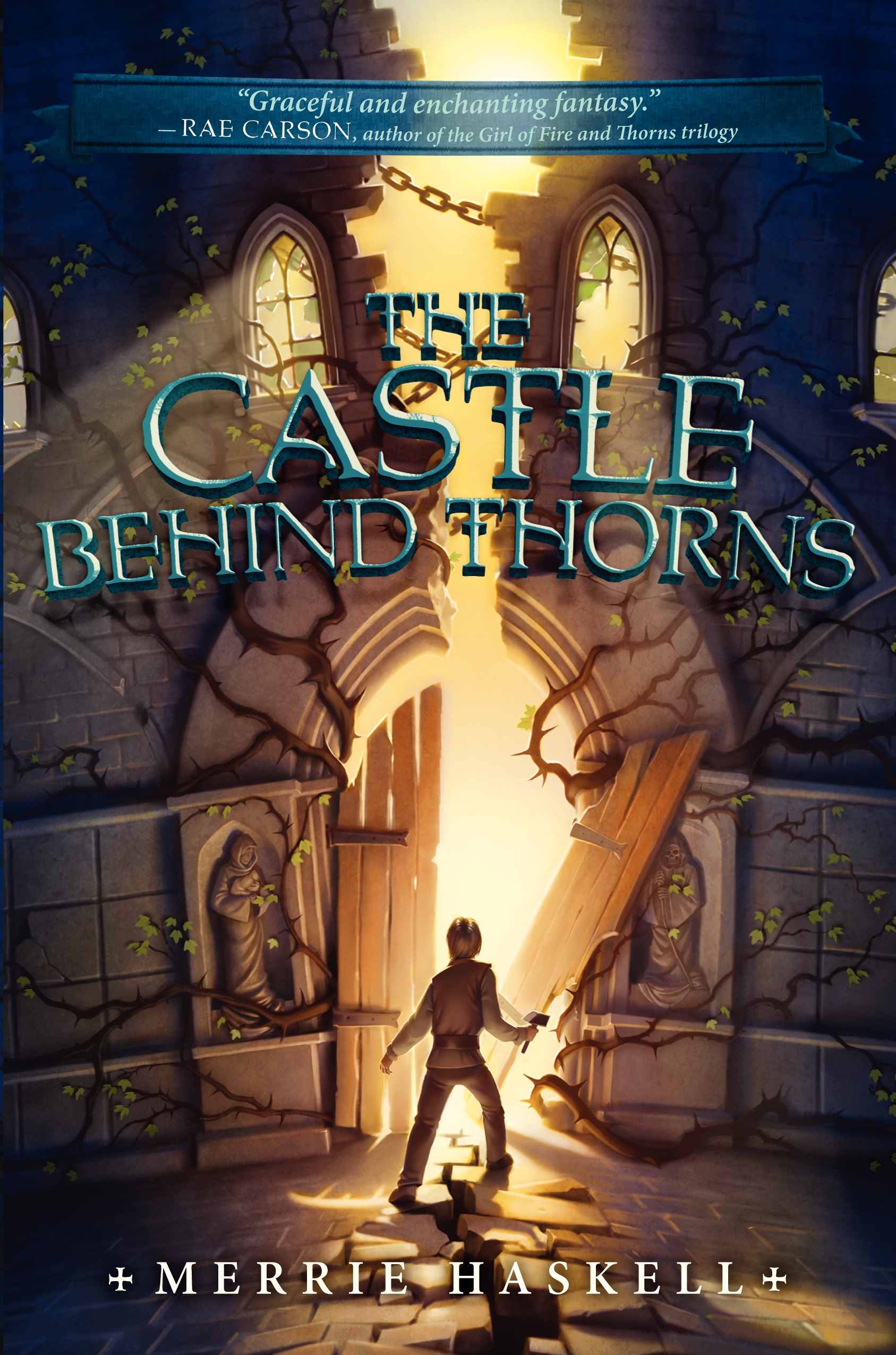
The Castle Behind ThornsThe Castle Behind Thorns by Merrie Haskell. HarperCollins Children’s, 2014.
Sand wakes up in the fireplace of the sundered castle, with no idea how he got there. It’s been 25 years since it and everything in it was split in two. Everyone fled, and a hedge of thorns sprung up around it. Now Sand is stuck inside the viscous, poisonous thorns, with no way to get out. The peculiar magic that broke everything also stopped all life in the castle – which means that while there’s nothing fresh, the remains of the castle’s food supplies are desiccated but not rotten. His first challenge is to survive – to find food and water, and to mend enough of the broken things in the castle to keep going. Fortunately, he’s a blacksmith’s son, with a good grounding in practical skills. Then Perrotte wakes up – the young Lady of the castle whom Sand found lying very dead in the crypt. At first their relationship is very rocky. Perrotte knows that she’s nobility, and expects to be treated that way, while Sand feels that as he’s the only one caring for the castle, he’s not going to take orders from anyone. But as Perrotte comes to accept her new reality, she also finds painful memories rising to the surface – memories that suggest that her death wasn’t a natural one.

Even though most of the book deals with just these two characters, it doesn’t feel empty. Both Sand and Perrotte are richly developed, very much affected by their relationships with the families that are no longer present. Sand is haunted by the arguments with his father, who wanted his only son to go to university rather than follow his footsteps as a blacksmith, while Perrotte had endless conflicts with her stepmother, who did everything she could to stifle Perrotte’s love of learning. We learn lots, too, about the medieval world this is set in – Sand’s blacksmithing, Perrotte’s astronomy, the state of handcrafting and scholarship in general, and the struggles of the duchy to remain independent from France. The local saints also play a major role – here, clearly still fallible humans rather than the diminished gods of Robin LaFevers’ His Fair Assassin series. Ultimately, this is a story of forgiveness – not excusing the horrible things that people can do, but looking at the importance of letting anger go to be able to live life freely. This was one that I had a hard time putting down and was so sad when it was done.

I might have mentioned that I love fairy tale re-tellings. Now that I think about it, Sleeping Beauty is an especially difficult one. It takes a lot of creativity to get around your protagonist being asleep for a hundred years or so, which means that every Sleeping Beauty novel I’ve read has been very different from all of the others. Here are ones I’ve read, and though I found some more I haven’t, I’d love to hear if you have favorites.

Other Sleeping Beauty re-tellings I’ve enjoyed:
Briar Rose by Jane Yolen. (1992, YA/adult)
Castle Waiting by Linda Medley. (2006, YA graphic novel)
Spindle’s End by Robin McKinley. (2000, YA)

Posted in books | Tagged , , | 3 Comments

Velveteen vs.

My love is always on the look-out for new superhero-themed books to listen to, and this is one that he bought and loved so much that he burned it onto to CD for me to listen to in my car, and hounded me until I did. Now that I have, I’ve been seeing Seanan McGuire pop up all sorts of places, like writing the introduction for Speculative Fiction 2013, edited by the Book Smugglers.

Velveteen vs. the Junior Super PatriotsVelveteen vs. the Junior Super Patriots by Seanan McGuire. Read by Allison McLemore. Audible Studios, 2013. Print ISiFic Press, 2012.
Velma Martinez, aka Velveteen, was bought by the Super Patriots, Inc., as a young teen. Her parents were happy to take the large payout with the promise of more to come and freedom from the difficulty of raising a super-powered child. She grew up a member of the Junior Super Patriots, West Coast Division, following strict rules, and given as much training in maintaining a marketable media presence as using her superpowers. She bonded closely with her teammates: Action Dude (your regular flight and super-strength guy), Sparkle Bright (photon manipulator), and the Claw (half lobster due to his father’s genetic experimentation.) Velveteen herself has the power to animate stuffed animals and dolls – hence the gag-worthy bunny ears and tail Marketing forces her to wear. And then the team fell apart. Instead of signing a new contract when she turned 18, Velma quit the superhero life, trying to make it on her own with a series of minimum wage jobs. Now in her 20s, she’s got a car on her last legs and a desperate need to make it from California to Oregon, where the superhero laws will allow her to take shelter from the long arm of the Super Patriots, Inc. Marketing Department. On her way there, she’ll face a former team mate turned villain, a barista determined to use coffee and free wifi to open the world up to a realm of eternal shadow, and the new members of the Junior Super Patriots, West Coast Division.

It sounds hilarious, and it is. These linked short stories (available in print and free on Seanan McGuire’s website) are filled with quirky yet believable characters and Velma’s struggles to live a normal life despite her upbringing and superpowers. But it also has a lot to say about how we treat our child heroes, using them up and spitting them out again when they fail to stay the innocent stars we want them to be, despite the harsh grown-up world we put them into. My love wishes the language were cleaner, so we could share it with our kids – there is a lot of foul language, mild violence, and no real sexual content, so I’d say it’s good for interested teens and up. Allison McLemore does a wonderful job of bringing the characters to life, from Action Dude’s all-American hero voice to Velma’s world-weary tones. I’m just sorry that the audio is only available from Audible, as I’d like to see it available from the library as well.

Velveteen vs. the MultiverseVelveteen vs. the Multiverse by Seanan McGuire. Read by Allison McLemore. Audible Studios, 2013. Print ISiFic Press, 2013.
Now ensconced as Portland’s official superhero, Velma/Velveteen has some fragile success and a whole lot of new challenges, from figuring out when it’s time to exchange real names with her new superhero boyfriend to trying out the alternate versions of her life in the Snow Queen’s mirrors. In one of them, she meets a displaced steampunk heroine, Victory Anna. The stakes are higher and everything is more intense as it might finally be time for Velveteen to take on the Marketing Department directly. It’s even better than the first volume, which is saying a lot. We’ll definitely be looking into more Seanan McGuire – I just saw that her latest, Sparrow Hill Road is on the hold shelf waiting for me to pick it up.

Posted in books | Tagged , , , | 5 Comments

The Real Boy

This one falls in the “I wanted to read it when it first came out, but there were just too many good books!” category, even though I really enjoyed Ursu’s Breadcrumbs. I’m very glad I got around to it anyway!

The Real BoyThe Real Boy by Anne Ursu. Walden Pond Press, 2013.
Oscar is the boy who serves Caleb the Magician and his bullying apprentice Wolf, in the small village of Barrow which supplies the magic for the glittering city of Asteri on the island of Aletheia, the last home of magic in the kingdom after the plague that wiped out most of the population and the magic. Though Wolf constantly belittles and bullies him while the Magician does nothing to stop it, Oscar actually understands more about magic than Wolf, sneaking into the library at night to read about the properties of plants and the history of magic. Oscar may not be happy, and he never expects to be able to formally do the things he loves, but at least he is secure in his place, hiding in the cellar and gardens, away from the baffling public world of people.

Then things start going wrong, as they are wont to do. Wolf is killed; Caleb’s hidden greenhouse is smashed. Oscar is given the paralyzing task of running Caleb’s shop while Caleb tries to figure out what is going on. He is befriended by Callie, the healer’s apprentice, who needs Oscar to help solve the problem of the rich children from the city who are inexplicably falling ill. Their search to solve the problem involves investigations into the purpose and cost of magic and what makes people human, all while fending off outraged nobles and a large, unidentifiable monster.

There are hints of Pinocchio in The Real Boy, though not enough to call it a retelling. Oscar’s difficulty with people is clearly autism spectrum disorder, though of course in the fantasy setting, it’s not labeled as such and is just a part of who Oscar is rather than “Oscar Overcomes ASD.” I loved the way Oscar and Callie’s strengths and weaknesses played off of each other, and that they both found that they could do what needed to be done, even when it was well outside their comfort zones. The setting is beautifully detailed, a world where, again without it being a Thing, everyone is a person of color. Despite the monster and its smashing, this is a reflective story that will appeal most to those who like a story focused on character and setting. I’m not sure, alas, that that would be my son – but it’s certainly welcome to see a story with a thoughtful boy protagonist. At any rate, this is a gem of a book that deserves to be widely read.

Other thoughts on the real boy:
The Book Smugglers
Sonderbooks

Posted in books | Tagged , | 5 Comments

Small Move, Big Change

When I went to PLA in March, one of the sessions I went to was on the most popular kinds of nonfiction books for adults, the Top Five of the Nonfiction 5. Unsurprisingly, self-help is a perennial favorite category (if not one recognized by Dewey), and one of the trending hot themes right now is the power of habit. It just so happened that I’d already put this one (still on order at the time) on hold for myself.

Small Move, Big ChangeSmall Move, Big Change by Caroline L. Arnold. Penguin, 2014.
Most people, Arnold contends, make a few of the standard five resolutions every rear. Every New Year’s they make them, and then, with feelings of deep guilt, realize a few months later that they’ve fallen off the wagon. The problem is that the resolutions – get in shape, lose weight, get organized – are too broad, with no real starting point. Instead, Arnold proposes a series of microresolutions. Pledge to take the stairs, or to let the cookies offered in the meetings go by, or to take care of the mail right away every day. Once this small change is so automatic you don’t have to think about it anymore – usually after a couple of months – you can move on to a new microresolution. Inching your way closer to your goals is ultimately faster and more successful than aiming for sweeping change!!!

Each of the chapters is filled with lots of upbeat stories of real people and how their problems were solved with microresolutions, which I found interesting, but they are also set up to make it easy to skim for the nuts and bolts if that’s what you want. The book starts off with chapters devoted to the parts of successful microresolutions, and then moves on to the most common problem areas, starting with sleep. I’m still looking for that magic bullet of a microresolution that will let me consistently get to bed on time, but overall, I found Arnold’s arguments powerful and convincing.

Posted in books | Tagged , , | 4 Comments

Curtsies & Conspiracies

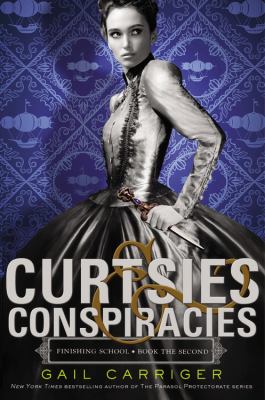
Curtsies & ConspiraciesCurtsies & Conspiracies. Finishing School, Book the Second by Gail Carriger. Little, Brown and Company, 2013.
The students of the steampunk finishing school for future lady assassins of quality return in this second book in the series. Sophronia and the other first-year students are up against their first exams. When Sophronia does better than everyone else, she suddenly finds that none of her classmates will talk to her any more – not even her best friend Dimity. Sophronia’s natural reaction is to spend more time sneaking around, meeting her friend Soap in the engines and young genius Vieve. Then the girls are joined by some of the boys from the rival evil genius school, including handsome goth boy Felix Mersey. There’s a mysterious trip to London, codes hidden in embroidered throw pillows, and more mysteries that only Sophronia and her friends can solve.

I had two issues with this book. First, too much of the plot was resolved by meetings with characters who are central to her previously published adult trilogy (which starts with Soulless), but who are barely introduced here. It made sense to me, since I’ve read them, but I’m not sure that it would make as much sense to people who haven’t. Since this series is aimed at a younger audience, it needs to work on its own. Secondly, this book spends a lot of time on Sophronia’s two would-be beaux, pitting her best male friend Soap, whom she doesn’t see in a romantic light because of the large class difference, against the mysterious and untrustworthy Lord Felix Mersey. But as Sophronia makes it quite clear that she’s not ready for any romance yet, the whole thing seems a waste of time.

Those problems aside, this is still a very fun steampunk romp, full of intrigue, gadgets, and the importance of understanding the complicated rules of etiquette. I’ll still check in with the next volume, and hope the wrinkles in this one are ironed out.

Posted in books | Tagged , | Leave a comment

The Screaming Staircase

This is the book that won the Cybils award for Middle Grade Speculative Fiction this year, reviewed in brief because this week is shaping up to be crazy.
Screaming StaircaseThe Screaming Staircase. Lockwood & Co. Book 1. by Jonathan Stroud. Disney-Hyperion. 2013.
Recently, England has been having Troubles with ghosts. Suddenly, they are everywhere, and lethal. Only kids can see them, and thus fight them, however, putting teens in demand as ghost-hunting agents. Lucy Carlyle joins one such organization, Lockwood & Co., headed by the charismatic Anthony Lockwood – only to discover that the company is on the brink of bankruptcy and disgrace. When one of her first missions with the team winds up with Lucy in possession of a locket haunted by the spirit of a murdered girl and the house it was found in burning down, things heat up even more. (eeks! Pun!)

This alternate-history story has a plot that keeps going like a rollercoaster, characters I could believe in, and is creepily atmospheric as all get-out. There’s something to appeal to all types of readers here – at least if the cover looks appealing in the first place. I was glad to be reading it on my work breaks rather than before bed at home, because it is scary – while none of the three members of our team die, there’s a fairly high body count over all. I think it’s still too intense for my nine-year-old, but this is perfect for older middle grade to teen reader looking for spooky, edge-of-the-seat suspense.

Posted in books | Tagged , , , | 2 Comments

Your Favorite Pirate and 48HBC

Thank you to all the people who entered the giveaway for the Sam Silver: Undercover Pirate books! I hope you all had a great time with Children’s Book Week, and the rest of the stops on the hop, too. And thanks again to Renee of Mother Daughter Books and Katie of Youth Literature Reviews for coordinating the hop.

The winner of the giveaway, chosen by randomly generated number, is commenter #21, Charlotte of Charlotte’s Library, whose favorite pirates are those in Jupiter Pirates: the Hunt for the Hydra, a book I’ve really been wanting to read.

Cursed-Pirate-Girl-GN-CoverI was hoping to be able to announce a Pirate King, based on votes from the comments… but Captain Hook and Captain Jack Sparrow came out dead even at six votes each, with Blackbeard coming in a distant third with three votes. Other literary pirates that got votes, in case your pirate fans want more pirate books, were the pirates in the charming picture book Pirates Don’t Change Diapers by Melinda Long, illustrated by David Shannon; and the star of Cursed Pirate Girl by Jeremy Bastien, a graphic novel with appeal for kids through adults.

For those who prefer their pirates historical, readers recommend you steer towards Blackbeard, Calico Jack Rackham, Bartholomew Roberts, Anne Bonny and Mary Read, and Madam Ching.

48 Hour Book ChallengeIn other news, it’s almost time for the 9th Annual 48 Hour Book Challenge, hosted again this year by Pam of Mother Reader, and focusing this year on diversity in children’s literature. Here’s my reading list so far – please feel free to chime in with suggestions!
Savage Fortress by Sarwat Chadda
The Great Green Heist by Varian Johnson
Bad Luck Girl by Sarah Zettel
Tankborn by Karen Sandler
Menagerie by Tui Sutherland
Nightingale’s Nest by Nikki Loftin
American Born Chinese by Gene Luen Yang
Boxers and Saints by Gene Luen Yang
Avatar gns by Gene Luen Yang
Huntress by Malinda Lo
Sorrow’s Knot by Erin Bow

Posted in Blog | Tagged , , , | Leave a comment

Palace of Spies

Have I mentioned before that Sarah Zettel is a favorite of mine? Bad Luck Girl, the final book in her American Fairy trilogy (after Dust Girl and Golden Girl)is coming out at the end of this month!!! I pre-ordered it today, along with Varian Johnson’s The Great Greene Heist, which is coming out the same day.

My love got this one for me for my birthday a while back, where it sadly went unread for a while because I owned it and had a large pile of library books.

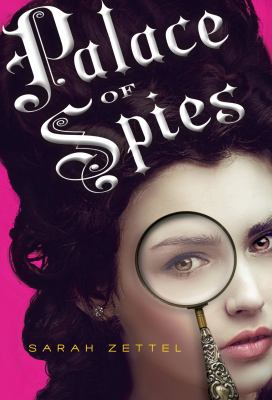
Palace of SpiesPalace of Spies by Sarah Zettel. Houghton Mifflin Harcourt, 2013.
This is the first Zettel book I’ve read that doesn’t have a sci-fi or fantasy element, though I’d hesitate to call it serious historical fiction. There’s some depth – I’d hardly expect less from Zettel – but for the most part, this is a madcap spy adventure.

Margaret Preston Fitzroy, aka Peggy, lives with her cold Uncle Pierpont and her beloved cousin Olivia. When her uncle betroths Peggy to a rich and handsome but abusive gentleman, Peggy rebels – only to find herself cast out into the street without even her pocket money. In desperation, she turns to a brand-new acquaintance, Mr. Tinderflint, who claims to have known her mother. He seems to be a foolish aging dandy, but offers her a position as a spy in the royal court. After some rigorous training with a pair of unpleasant people – card playing from Mr. Peele, clothing and etiquette with Mrs. Abbott – Peggy is sent to court pretending to be the recently deceased (at home, away from court) Lady Francesca Wallingham, a young lady-in-waiting to the Princess in the court of George I.

Here the plot both gets more exciting and more implausible. Really – the other ladies in waiting, the Princess, and even Lady Francesca’s secret lover are all supposed to believe that Peggy is Francesca, just because she has roughly the same build and coloring and the fashion involves heavy make-up? I had to just set this aside for the rest of the story to work. The list of things Peggy should know and doesn’t keeps growing, as she tries to figure out what side her spymasters might be on, what secrets Francesca herself was hiding – and if she actually died of natural. The plots are tangled; the fashion and gossip are epic; there is a pleasurable bit of romance. As always, Zettel pays meticulous attention to historical details, educating the reader about the times along with Peggy.

There are some intense moments in what’s otherwise a light, enjoyable read – an attempted rape near the beginning, Peggy witnessing a couple having sex (I wondered at the people in question for their choice of locale), and some named characters dying violently.

Honestly, I am so in love with Callie and her story that it’s hard for me to be as fond of this book – and perhaps it’s not surprising, fantasy fan that I am, that I prefer Zettel’s fantasy books. But – this is still an awfully fun book, more in the vein of the Gallagher Girls series than your typical serene and serious historical.

Posted in books | Tagged , , , | 2 Comments