I’m always game for a good organizing book, and I figured that this one, still with a months-long hold list at my library over a year after we got it, was a good candidate.
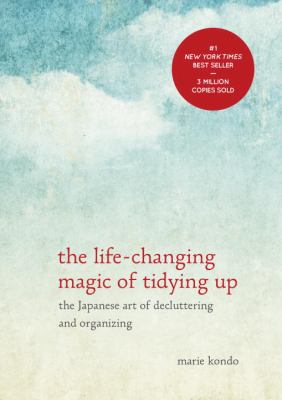 The Life-Changing Magic of Tidying Up by Marie Kondo. Ten Speed Press, 2014.
Paring your possessions down to just the ones that “spark joy” will change your life, claims Kondo. You’ll have a clearer idea of who you are and who you want to become. There’s a whole cult of Kondo now – the book has been an international bestseller, with Kondo making appearances all over the world. Still, she’s not without her detractors – one of my friends got so angry while reading that she threw the book across the room. I wanted to see what I thought myself.
Pros: I really liked Kondo’s central idea, that if you hold your things and let them speak to you, you’ll know if you really need them or not – the “spark joy” that’s also the title of her second book. Some people may find that too woo-woo, but I’m all for a little more concrete woo-woo in my life. It’s also a short, easy-to-read book with main points bolded and summary lists at the end of each chapter – very easy to read. I liked the piece of advice on not to pass your unwanted things on to family and appreciated, given that she says it’s better to go through and declutter in one fell swoop, that she gives a concrete order for this, based on experience. I’m very good at organizing small bits at a time, but I always lose steam before getting to everything. Especially those boxes in the basement that have been there since we moved….
Cons: her thoughts on books, papers and photos. I am both a book lover and a public librarian – which for me does mean going through my books regularly to make sure I love them all and that they will fit in my house. We have a wall in our living room devoted to tall bookcases (you can see a slice in my header bar), because I wanted it to be clear to visitors that books are important to us. I don’t really ever want to have so few books that they’d fit inside my closet with my clothes, as Kondo suggests. More dangerous are her suggestions about financial paperwork – maybe if you’re willing to scan them, or get them all electronically, you can do without saving them, but at least here in the U.S., you need to keep 7-10 years of financial paperwork for tax records, etc. Also on photographs, Kondo says that you’ll remember everything, so you don’t need photos. Yeah. So maybe I will get rid of some of those photos of college friends whose names I don’t remember anymore – but that in itself is proof that my memory is not that great, even when I’m still relatively young. I want to have enough photos to help me along when I’m old and maybe the photos will be all I have to remember when my kids were little, etc. (cue the violins.) Kids are another weakness, I conclude from talking with my friend Dr. M (a professional organizer) about this. Kondo’s clients seem to be mainly young childless professionals or empty nesters. She doesn’t offer much help to parents of children who really are still genuinely attached to the three laundry baskets worth of stuffies, say, or for dealing with the massive rotating quantities of stuff that kids need as they grow. She’s also very confident in her way being the right way – good if you’re either really wanting concrete advice or good at picking at choosing, less good if you want something that’s designed for you to customize it.
So it’s not perfect. I still found it hard to put down and immediately inspiring. I found about 8 garbage bags of clothes that weren’t sparking joy any more. If you’re looking for a push in the right direction to start you de-cluttering, by all means give it a try.
Here are some of the other organizing books I’ve read over the years:
Home Comforts: the Art and Science of Keeping House by Cheryl Mendelson
It’s All Too Much by Peter Walsh
Life’s Too Short to Fold Fitted Sheets by Lisa Quinn

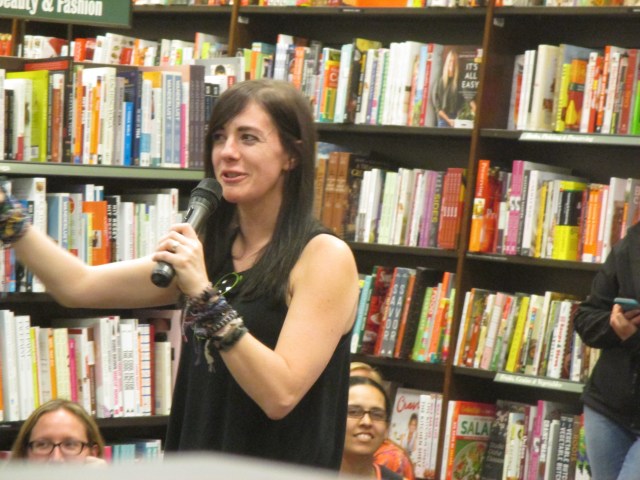
 Then it was time to stand in line to get the book signed. My love had already bought us the book from Audible, but I bought a print copy just to have it signed. I’d thought of lots and lots of things that I wanted to say to her, thinking about her advice A Shy Introvert’s Guide to Stiefvater Signings, but as it happened, the time was so short and line behind me so long that I could not possibly fit in everything I want to say. So here they are: Continue reading
 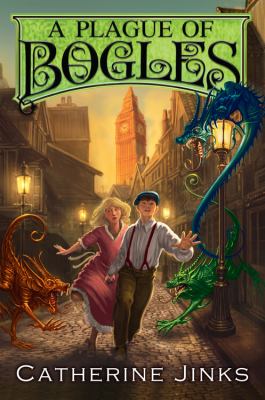 A Plague of Bogles. City of Orphans Book 2 by Catherine Jinks. Read by Mandy Williams. Listening Library, Random House, 2015. Published in Australia by Allen & Unwin, 2013, as A Very Peculiar Plague.
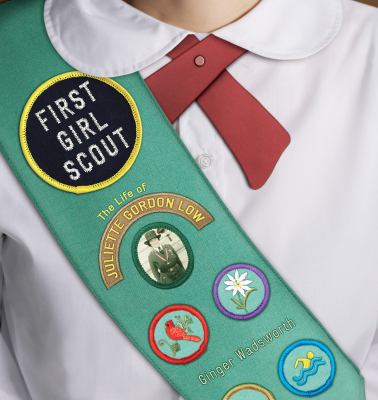 My Daughter (age 6) has started reading chapter books to herself! She still doesn’t have the patience to read them through from start to finish, but she’s definitely sitting down and reading them. She brought home a Boxcar Children mystery from the school library, as well as a longer biography of Juliette Gordon Lowe, First Girl Scout by Ginger Wadsworth. I’m reading Hooray for Anna Hibiscus by Atinuke to her officially, as well First Girl Scout. She’s working on a nonfiction book project for school, and has decided to adapt a recipe into the style used in Pretend Soup by Mollie Katzen. To this end, I was reading her recipes from one of our favorite baking cookbooks,
 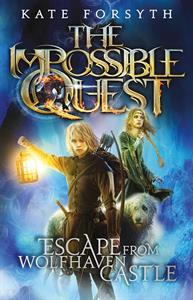 My Son (age 11) is currently going back and forth between reading Escape from Wolfhaven Castle by Kate Forsyth (kindly sent to me by the publisher, Kane Miller) and L
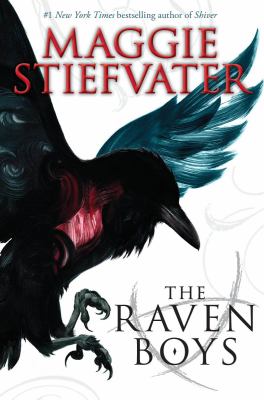 My love just finished listening to The Raven King by Maggie Stiefvater on audio and will perhaps hopefully chime in with what he’s moved on to next. He’s been looking through Cook it in Cast Iron by the editors at America’s Test Kitchen, which I requested the library buy for him to look at. I’m very glad I did, as not only is he enjoying it, but so many other people at the library want to read it that we’ve had to buy three more copies of it!
 And finally, myself. Readers may remember that I tried writing out reading plan for April for the first time. I based the number of books in my list on the total number of books I typically finish in a month, without looking at how many of them are my personal reading versus reading with the kids. Probably half of my reading is kid reading, it turns out, so that I got through just about exactly half of my reading list last month and have now moved seamlessly on to reading mostly the other half this month. I’m reading A Tangle of Gold by Jaclyn Moriarty in print at home and P.S. I Still Love You by Jenny Han at work. I’m really hoping to finish my re-listen of
 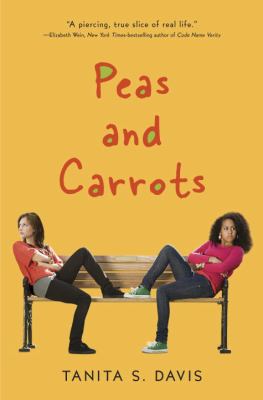 Peas and Carrots by Tanita S. Davis. Alfred A. Knopf, 2016.
 House of Shattered Wings by Aliette de Bodard. Roc, 2015.
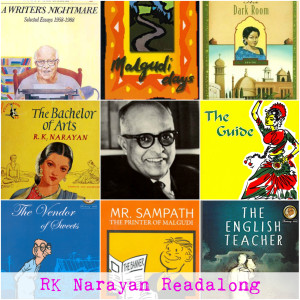 It turns out that I’m not the only American not to be familiar with R.K. Narayan – I was able to find exactly one book by him to interloan from all the libraries in my state. At least it contained two novels, so I was able to broaden the reading experience that way.


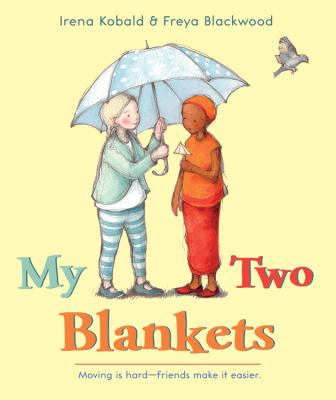 My Two Blankets by Irena Kobald & Freya Blackwood. Houghton Mifflin Harcourt, 2015.

 alibrarymama